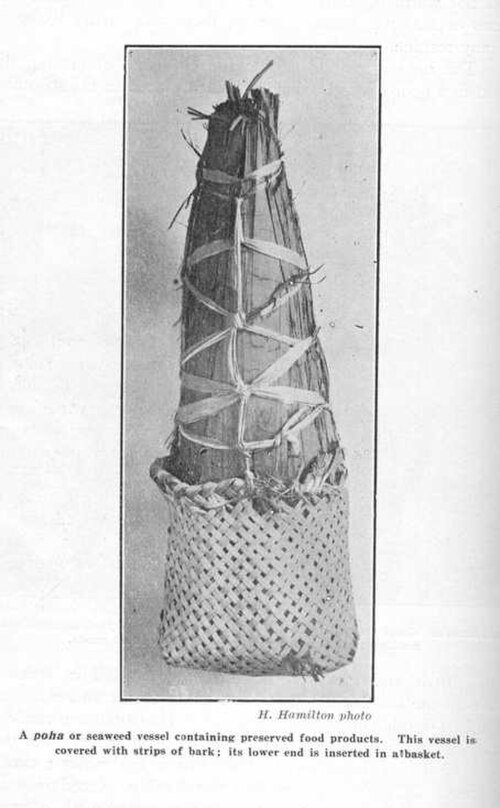
Durvillaea is a genus of large brown algae in the monotypic familyDurvillaeaceae. All members of the genus are found in the southern hemisphere, including Australia, New Zealand, South America, and various subantarctic islands.[4][5]Durvillaea, commonly known as southern bull kelps, occur on rocky, wave-exposed shorelines and provide a habitat for numerous intertidal organisms.[6][7] Many species exhibit a honeycomb-like structure in their fronds that provides buoyancy, which allows individuals detached from substrates to raft alive at sea, permitting dispersal for hundreds of days over thousands of kilometres.[5][8][9]Durvillaea species have been used for clothing, tools and as a food source by many indigenous cultures throughout the South Pacific, and they continue to play a prominent role in Chilean cuisine.[5]
Common name and etymology
The common name for Durvillaea is southern bull kelp. This is often shortened to bull kelp, which can generate confusion with the North Pacific kelp species Nereocystis luetkeana.[10][11]
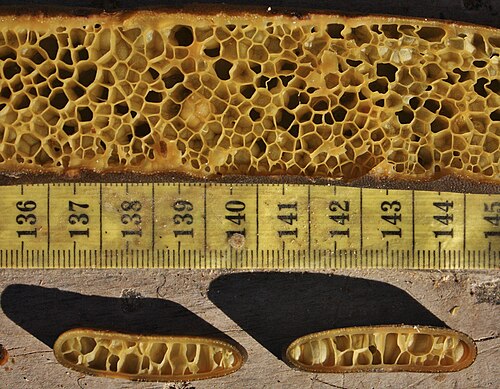
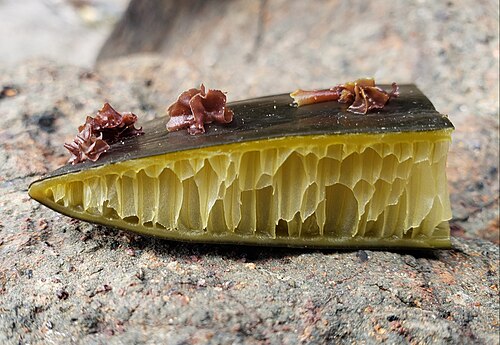
Cross-section of D. antarctica showing the 'honeycomb' structure of the blades
Durvillaea species are dioecious.[13] Based on the concentration of pigments in thalli, males and females of D. antarctica do not significantly differ in colouration.[13] Holdfasts of males and females can be joined together.[13][14]
Durvillaea species are characterised by their prolific growth and plastic morphology.[15]
2010年のチリ地震は、特にアラウコ湾、サンタマリア島、コンセプシオン湾周辺で、海岸の著しい隆起(約0.2~3.1m)を引き起こした。[ 48 ]この隆起により、 D. antarcticaが大量に死滅し、潮間帯の生物群集に劇的な影響が出た。[ 48 ]地震によるインフラへの被害と生態系の撹乱は、海藻採取者とコチャユヨの収穫に特に大きな被害をもたらしたと評価されている。[ 49 ]
ニュージーランド
赤トレ
Duvillaea bull kelp diversity appears to have been affected by uplift along the Akatore fault zone. Phylogeographic analyses using mitochondrialCOX1 sequence data and genotyping by sequencing data for thousands of anonymous nuclear loci, indicate that a historic uplift event (800 – 1400 years before present) along the fault zone and subsequent recolonisation, has left a lasting impact upon the genetic diversity of the intertidal species D. antarctica and D. poha, but not on the subtidal species D. willana.[18][50] Such a genetic impact may support the founder takes all hypothesis.[18][50] Further genetic analysis has revealed that the population structure of two epifaunal species, the gribble L. segnis and the chiton O. neglectus, closely matches the pattern observed in the intertidal host species of Durvillaea along the Akatore fault zone.[7] However, no matching pattern was observed for another epifaunal species, the amphipod P. karaka, most likely because this species has better swimming potential and can rely upon other host seaweeds.[7]
Kaikoura
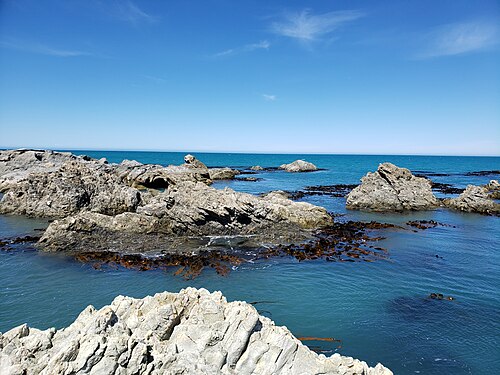
A substantial die off of Durvillaea bull kelp occurred along the Kaikoura coastline following the 2016 Kaikoura earthquake, which caused uplift up to 6 metres.[19][6][45][46][47] The loss of Durvillaea kelp caused ecological disturbance, significantly affecting the biodiversity of the local intertidal community.[45][46][51] Aerial drone imaging two years after the earthquake indicated that Durvillaea abundance remained low on reefs with significant uplift, but it revealed offshore refuge populations less frequently detected by field researchers.[52]
12345678910111213Fraser, C.I.; Winter, D.J.; Spencer, H.G.; Waters, J.M. (2010). "Multigene phylogeny of the southern bull-kelp genus Durvillaea (Phaeophyceae: Fucales)". Molecular Phylogenetics and Evolution. 57 (3): 1301–11. Bibcode:2010MolPE..57.1301F. doi:10.1016/j.ympev.2010.10.011. PMID20971197.
↑M. Huisman, John (2000). Marine Plants of Australia. University of Western Australia Press. p.212. ISBN978-1-876268-33-6.
1234Lizée-Prynne, Dominic; López, Boris A.; Tala, Fadia; Thiel, Martin (2016). "No sex-related dispersal limitation in a dioecious, oceanic long-distance traveller: the bull kelp Durvillaea antarctica". Botanica Marina. 59 (1): 39–50. doi:10.1515/bot-2015-0072.
123López, Boris A.; Macaya, Erasmo C.; Tala, Fadia; Tellier, Florence; Thiel, Martin (2017). "The variable routes of rafting: stranding dynamics of floating bull kelp Durvillaea antarctica (Fucales, Phaeophyceae) on beaches in the SE Pacific". Journal of Phycology. 53 (1): 70–84. Bibcode:2017JPcgy..53...70L. doi:10.1111/jpy.12479. hdl:10533/240100. PMID27734500.
1234"Kelp". Australian Antarctic Division: Leading Australia's Antarctic Program. Department of the Environment and Energy. Retrieved 7 December 2016.
1234Fraser, Ceridwen I.; Spencer, Hamish G.; Waters, Jonathan M. (2012). "Durvillaea poha sp. nov. (Fucales, Phaeophyceae): a buoyant southern bull-kelp species endemic to New Zealand". Phycologia. 51 (2): 151–156. Bibcode:2012Phyco..51..151F. doi:10.2216/11-47.1. S2CID86386681.
1 2 3 4 5 Hay, Cameron H. (2019). "ニュージーランドにおける海岸隆起とブルケルプDurvillaea willana Lindauer の分布". New Zealand Journal of Botany . 2019 (2): 94– 117. doi : 10.1080/0028825X.2019.1679842 . S2CID 208593399 .
1 2 3 4 5 Parvizi, Elahe; Fraser, Ceridwen I.; Dutoit, Ludovic; Craw, Dave; Waters, Jonathan M. (2020). "沿岸地震隆起のゲノムフットプリント" . Proceedings of the Royal Society B . 287 (1930) 20200712. doi : 10.1098/rspb.2020.0712 . PMC 7423469 . PMID 32635859 .
1 2 3 Nikula, Raisa; Fraser, Ceridwen I.; Spencer, Hamish G.; Waters, Jonathan M. (2010). "亜南極のケルプに生息する2種の甲殻類における漂流による極域周回分散" . Marine Ecology Progress Series . 405 : 221– 230. Bibcode : 2010MEPS..405..221N . doi : 10.3354/meps08523 .
1 2 3 Nikula, Raisa; Spencer, Hamish G.; Waters, Jonathan M. (2013). "受動的な漂流は海洋を越えた遺伝子流動の強力な推進力である" . Biology Letters . 9 (1) 20120821. doi : 10.1098/rsbl.2012.0821 . PMC 3565489 . PMID 23134782 .
1 2 3 Waters, Jonathan M.; King, Tania M.; Fraser, Ceridwen I.; Craw, Dave (2018). "ケルプのいかだ上の無脊椎動物による長距離分散の統合的な生態学的、遺伝学的、地質学的評価" . Frontiers of Biogeography . 10 (3/4) e40888. doi : 10.21425/F5FBG40888 .
↑ Pearman, William S.; Duffy, Grant A.; Liu, Xiaoyue P.; Gemmell, Neil J.; Morales, Sergio E.; Fraser, Ceridwen I. (2016). "大型藻類のマイクロバイオームの生物地理は、地理的距離ではなく環境要因によって形成される" . Annals of Botany . 133 (1): 169– 182. doi : 10.1093/aob/mcad151 . PMC 10921836 . PMID 37804485 .
1 2 3 4 Pearman, William S.; Morales, Sergio E.; Vaux, Felix; Gemmell, Neil J.; Fraser, Ceridwen I. (2024). "宿主個体群の激減は関連する海洋微生物叢の多様性を破壊する" . Environmental Microbiology . 26 (1) e16611. Bibcode : 2024EnvMi..26E6611P . doi : 10.1111/1462-2920.16611 . PMID 38519875 .
1 2 Cumming, Rebecca A.; Nikula, Raisa; Spencer, Hamish G.; Waters, Jonathan M. (2014). "海藻に付着するウミウシ集団の海洋を越えた遺伝的類似性:漂流による長距離分散か?". Journal of Biogeography . 41 (12): 2357–2370 . Bibcode : 2014JBiog..41.2357C . doi : 10.1111/jbi.12376 . S2CID 84574097 .
1 2 Salloum, PM; de Villemereuil, P.; Santure, AW; Waters, JM (2020). "遺伝的および形態学的パターンに対するヒッチハイクの影響:ケルプ漂流が抱卵中のヒザラガイに与える影響" . Biological Journal of the Linnean Society . 130 (4): 756– 770. doi : 10.1093/biolinnean/blaa073 .
↑ McLay, CL; Hayward, TL (1987-01-01). "潮間帯に生息するクモDesis marina (クモ目: Desidae)によるDurvillaea antarcticaの付着器の個体群構造と利用". New Zealand Journal of Zoology . 14 (1): 29– 42. doi : 10.1080/03014223.1987.10422679 . ISSN 0301-4223 .
↑ Vink, C., McQuillan, B., Simpson, A., & Correa-Garhwal, S. (2017). The marine spider, Desis marina (Araneae: Desidae): new observations and localities. The Weta, 51 , 71-79. Retrieved from http://publications.ento.org.nz/index.php/weta/article/view/167 Archived 2019-12-20 at the Wayback Machine
↑ Hawes, Nicola A.; Taylor, David I.; Schiel, David R. (2019). "漂流性ヒバマタ藻の輸送:沿岸域での輸送と長距離分散の可能性". Journal of Experimental Marine Biology and Ecology . 490 : 634– 41. doi : 10.1016/j.jembe.2017.02.001 .
↑ Fraser, Ceridwen I.; Morrison, Adele K.; McC Hogg, Andrew; Macaya, Erasmo C.; van Sebille, Erik; Ryan, Peter G.; Padovan, Amanda; Jack, Cameron; Valdiva, Nelson; Waters, Jonathan M. (2018). "嵐による分散と温暖化により、南極の生態学的隔離が破られるだろう". Nature Climate Change . 8 (8): 704– 707. Bibcode : 2018NatCC...8..704F . doi : 10.1038/s41558-018-0209-7 . hdl : 1874/368294 .
↑ Sinclair, Sophie M.; Duffy, Grant A.; Fraser, Ceridwen I. (2023). "Repeated freezing impacts buoyancy and photosynthesis of a rafting kelp species" . Antarctic Science . 35 (6): 403–406 . Bibcode : 2023AntSc..35..403S . doi : 10.1017/S0954102023000305 .
1 2 Dufour, C.; Probert, PK; Savage, C. (2012). "ニュージーランド南部の露出した砂浜に打ち上げられたDurvillaea antarcticaの大型底生動物による定着". New Zealand Journal of Marine and Freshwater Research . 46 (3): 369– 383. Bibcode : 2012NZJMF..46..369D . doi : 10.1080/00288330.2012.676557 . S2CID 84692284 .
1 2 Macaya, EC; López, B.; Tala, F.; Tellier, F. & Thiel, M. (2016年1月6日) [初版 2016年]. "浮遊と筏:非浮遊性関連植物相の系統地理と遺伝構造における浮遊性海藻の役割". Hu, ZM. & Fraser, CI (編). Seaweed Phylogeography . Springer, Dordrecht. pp. 97–130 . doi : 10.1007/978-94-017-7534-2_4 . ISBN978-94-017-7534-2。
1 2マリン、アンドレス;ゲルチッチ、ステファン。アラヤ、ゴンサロ。オレア、ゴンサロ。エスピンドラ、ミゲル。カスティーリャ、フアン C. (2010)。 「2010年チリの津波:沿岸小規模漁村の壊滅と存続」。海洋政策。34 (6): 1381–1384。ビブコード: 2010MarPo..34.1381M。土井:10.1016/j.marpol.2010.06.010。
1 2 3 Parvizi, Elahe; Craw, Dave; Waters, Jonathan M. (2019). "ケルプのDNAはニュージーランド南東部の海岸線の完新世後期の古地震隆起を記録している". Earth and Planetary Science Letters . 520 : 18– 25. Bibcode : 2019E & PSL.520...18P . doi : 10.1016/j.epsl.2019.05.034 . S2CID 189974346 .
1 2 3 4 5 Vaux, Felix; Parvizi, Elahe; Duffy, Grant A.; Dutoit, Ludovic; Craw, Dave; Waters, Jonathan M.; Fraser, Ceridwen I. (2024). "壊滅的な地震後の再定着系統の最初のゲノムスナップショット" . Ecography (6) e07117. Bibcode : 2024Ecogr2024E7117V . doi : 10.1111/ecog.07117 .
↑ Tait, Leigh; Orchard, Shane; Schiel, David R. (2021). "Missing the Forest and the Trees: Utility, Limits and Caveats for Drone Imaging of Coastal Marine Ecosystems" . Remote Sensing . 13 (16): 3136. Bibcode : 2021RemS...13.3136T . doi : 10.3390/rs13163136 .
1 2 3 4 5 Vaux, Felix; Fraser, Ceridwen I.; Craw, Dave; Read, Stephen; Waters, Jonathan M. (2023). "Integrating kelp genomic analyses and geological data to reveal ancient earthquake impacts" . Journal of the Royal Society Interface . 20 (202). doi : 10.1098/rsif.2023.0105 . PMC 10189309 . PMID 37194268 .
1 2 3 4 Vaux, Felix; Craw, Dave; Fraser, Ceridwen I.; Waters, Jonathan M. (2021). " Durvillaea pohaブルケルプの北方向への分布域拡大: 地殻変動への応答か?". Journal of Phycology . 57 (5): 1411– 1418. Bibcode : 2021JPcgy..57.1 411V . doi : 10.1111/jpy.13179 . PMID 33942304 .
1 2 3 4 5 Vaux, Felix; Parvizi, Elahe; Craw, Dave; Fraser, Ceridwen I.; Waters, Jonathan M. (2022). "Parallel recolonisations generate distinct genomic sectors in kelp following high magnitude earthquake disturbance?" . Molecular Ecology . 31 (18): 4818– 4831. Bibcode : 2022MolEc..31.4818V . doi : 10.1111/mec.16535 . PMC 9540901 . PMID 35582778 .
1 2 3 Cameron H., Hay (1979). "Nomenclature and taxonomy within the genus Durvillaea Bory (Phaeophyceae: Durvilleales Petrov)". Phycologia . 18 (3): 191– 202. Bibcode : 1979Phyco..18..191H . doi : 10.2216/i0031-8884-18-3-191.1 .
↑ Cheshire, Anthony C.; Hallam, Neil D. (1985). "The environmental role of alginates in Durvillaea potatorum (Fucales, Phaeophyta)". Phycologia . 24 (2): 147– 153. Bibcode : 1985Phyco..24..147C . doi : 10.2216/i0031-8884-24-2-147.1 .
↑ Cheshire, Anthony C.; Conran, John G.; Hallam, Neil D. (1995). "A cladistic analysis of the evolution and biogeography of Durvillaea (Phaeophyta)". Journal of Phycology . 31 (4): 644– 655. Bibcode : 1995JPcgy..31..644C . doi : 10.1111/j.1529-8817.1995.tb02561.x . S2CID 84955971 .