Loading article…


章(ラテン語:capitulum [ 1 ]またはcapitellum)[ 2 ]は、カトリック教会、古カトリック教会、英国国教会、北欧ルーテル教会、またはそれらの集会における聖職者のいくつかの組織の 1 つです。
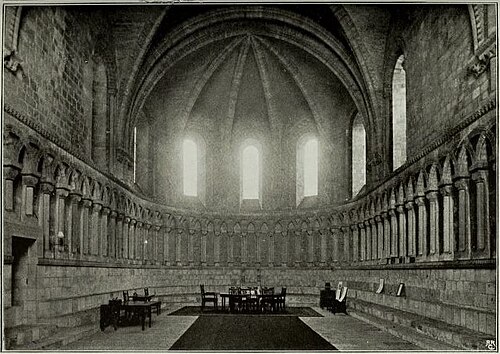
その名前は、聖書の一章または修道会の規則の見出しを読むために修道士、托鉢僧、または参事会員が集まる習慣に由来する。[ 2 ] 6世紀の聖ベネディクトは、修道士たちに日々の集会をそのような朗読から始めるよう指示し、 [ 1 ]時が経つにつれて、「章のために集まる」(convenire ad capitulum)などの表現の意味が、テキストから集会そのもの、そして集会のために集まる集団へと移っていった。[ 2 ]同様に、そのような集会の場所は「チャプターハウス」または「部屋」として知られるようになった。
A cathedral chapter is the body ("college") of advisors assisting the bishop of a diocese at the cathedral church. These were a development of the presbyteries (presbyteria) made up of the priests and other church officials of cathedral cities in the early church. In the Catholic Church, they are now only established by papal decree.[1]
In the event of an episcopal vacancy, cathedral chapters are sometimes charged with election of the bishop's replacement and with the government of the diocese. They are made up of canonpriests.[1] "Numbered" chapters are made up of a fixed number of prebendaries, while "unnumbered" chapters vary in number according to the direction of the bishop. The chapters were originally led by the cathedral's archdeacon but, since the 11th century,[1] have been directed by a dean or provost.[2]
In the Catholic Church, the chapter appoints its own treasurer, secretary, and sacristan and – since the Council of Trent – canon theologian[3] and canon penitentiary.[4] The same council approved of other local offices,[5] which might include precentors, chamberlains(camerarii), almoners(eleemosynarii), hospitalarii, portarii, primicerii, or custodes. Canons are sometimes given the functions of punctator and hebdomadarius as well.[1] In the Church of England, the chapter includes lay members, a chancellor who oversees its educational functions, and a precentor who oversees its musical services. Some Church of England cathedrals have "lesser" and "greater" chapters with separate functions.
In the US Episcopal Church, the chapter is a meeting of those with the responsibilities of a vestry for a cathedral church.[6]
A collegiate chapter is a similar body of canons who oversee a collegiate church other than a cathedral.

A general chapter is a general assembly of monks,[7] typically composed of representatives from all the monasteries of an order or congregation. The equivalent meetings of provincial representatives of Franciscan orders is called a Chapter of Mats.[8]
Catholic orders of nuns or sisters also often hold general chapters: periodic governing assemblies of the order, which vary in geographic scope from congregants within a city to an international gathering. These are considered "a graced, holy time" and often involve long preparation of prayer and study to discuss future directions of the order. General chapters are also a time to elect officers and leadership (e.g., a Mother superior). Pope Paul VI observed in 1964 that general chapters "primarily have relevance to [individual] Orders and Congregations", but "also influence the life of the Church; for the Church, to a great extent, derives Her vigor, Her apostolic zeal, and Her fervor in seeking holiness of life, from the flourishing condition of Her Religious Institutes".[9]
After the Second Vatican Council, the Catholic Church delegated "especially to general chapters" the consideration of how each religious order was to implement the general aims of adaptation and renewal which were set out in the Council's Decree on the Adaptation and Renewal of Religious Life (Perfectae caritatis).[10]
Many orders of nuns or sisters have regular internal gatherings known as some form of chapter, which differs from "general chapters" – in some cases, these are called simply a chapter. These are times for pragmatic, collective discussions about issues relevant to their communal lives (e.g., among the nuns or sisters of a convent).[11]
過ちの集会は、共同体の規則に違反した行為を公に正し、通常の告解とは別に自己批判を行うための集まりです。[ 12 ] [ 13 ]修道女会の中には、罪 の告白とは異なる「過ち」を共有するという、共鳴する習慣を持つところもあります。例えば、米国の隠遁生活を送る観想的なドミニコ会修道女は、この目的のために「定例集会」と呼ばれるものを使用しており、その中で修道院長は、共同体の善に反する個々の過ちを自ら告白するようメンバーに促します。参加者は立ち上がって、「シスター方、私は(このような過ち)を告白します」と言うことができます。この謙遜の行為の後、女性たちはひれ伏し(ヴェニアと呼ばれる)、修道院長が償いを課します。定例集会は明確に区切られたイベントであり、「集会で話されたことは、その外では決して話されない」のです。[ 14 ]
軍事組織や騎士団に所属する騎士たちの集合体は、「チャプター」とも呼ばれた。