
Loading article…
咆哮/ rɔːr /咆哮は、大きく、低く、響き渡る動物の発声の一種です。多くの哺乳類は、遠距離でのコミュニケーションや威嚇などの目的で、咆哮や咆哮に似た発声を発するように進化してきました。これには、様々な種類の大型ネコ科動物、クマ、鰭脚類、シカ、ウシ科動物、ゾウ、そして類人猿。
咆哮する能力の解剖学的基盤は、多くの場合、喉頭と舌骨の構造変化、および低周波の共鳴のための内部気腔の拡大を伴う。動物は咆哮する際に、共鳴空間を広げるために首を伸ばし、頭を上げることがある。
「咆哮」の定義は種によって異なっている。[ 1 ]しかし、Weissengruber ら (2002) は、咆哮は低音と低フォルマントの両方から構成されるという、より一般的な説明を与えている。 [ 2 ] [ 1 ]彼らは、ライオンとアカシカの咆哮をその音の典型的な例として用いている。[ 2 ]他の研究者は、音高またはフォルマントが真の咆哮よりも高い、同様の「咆哮のような」発声について言及している。[ 1 ]
Roaring mammals have evolved various means to achieve their vocalizations. A proportionally large larynx contributes to a deeper pitch. The male hammer-headed bat has a larynx that takes up most of his thoracic cavity and is half the size of his backbone. A larger larynx also has enlarged vocal cords which contributes to a deeper pitch and more massive folds leads to slower oscillation.[1] In addition, the big cats (lion, tiger, jaguar and leopard, referred to as the "roaring cats"), have vocal cords that are square-shaped as opposed to the triangle-shaped cords of other felids; this allows them to produce a louder call with less lung pressure.[2] The elasticity of the larynx and the length of the vocal tract affect the formant or resonance of a sound. In big cats and some male deer, specialized musculature and ligaments pull the larynx deeper in the vocal tract when roaring, lowering the vocal tract resonance.[1]
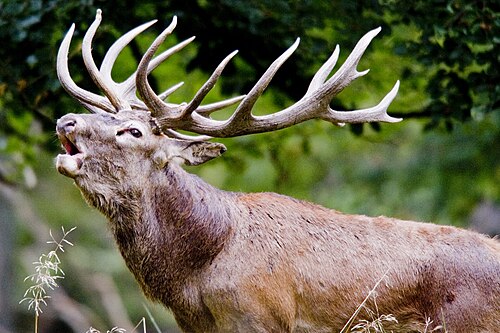
Other species have evolved internal inflatable air spaces connected to the vocal tract, which play a role in vocal resonance. The male Mongolian gazelle and musk ox possess an air space (paired and two-chambered in the former) attached to the larynx,[1] while bears have such spaces connected to the pharynx.[3][1] Male howler monkeys have an unpaired rostroventral laryngeal air sac within the hyoid bulla (extension of the hyoid bone) and a pair of ventral laryngeal air spaces outside.[4] The hammer-headed bat has a pouch in the palatine that connects to an enlarged nasopharynx region, in addition to paired cheek pouches which extend to the rostrum.[1] Elephants possess a pharyngeal pouch associated with their larynx and hyoid apparatus, and their roars can also be modified by the nostrils in their trunks.[5] Male elephant seals and saiga antelopes have an enlarged and inflated proboscis, which also affects resonance. Saiga nevertheless roar with their mouths closed and produce a "nasal roar".[1]
舌骨の構造は、動物の咆哮能力に影響を与える可能性がある。大型ネコ科動物の舌骨は、他のネコ科動物に比べて骨化が少なく、柔軟性が高い。ユキヒョウもこの特性を持っているが、声帯が短いため空気の流れに対する抵抗が少なく、咆哮することはできない。[ 2 ] [ 6 ]ホエザルでは、舌骨は比較的大きくカップ状になっており、鳴き声の深みと共鳴に貢献している。[ 4 ]通常は空中で発せられる咆哮だが、オスのゼニガタアザラシのように水中で発せられる咆哮もある。[ 1 ]
一部の種では、咆哮は性選択によって進化し、咆哮するのは一方の性別のみです。[ 1 ]例えば、ゴリラでは、成体のオス(シルバーバック)だけが、十分な大きさの喉頭と十分に長い声帯を持ち、完全な咆哮を発することができます。[ 7 ]しかしながら、他の種では、両性の動物がこれらの鳴き声を発することができます。ライオンでは、両性の動物が咆哮し、その鳴き声は社会的距離の確保と縄張り防衛に役割を果たしています。咆哮は、他のライオンが誤って別のライオンの縄張りに侵入するのを防ぎます。ライオンの咆哮は、人間の聴覚では最大5マイル先まで聞こえ、ライオン自身にとってはさらに遠くまで聞こえる可能性があります。[ 8 ] [ 9 ] [ 10 ]
ライオンの咆哮は、メトロ・ゴールドウィン・メイヤーが配給する映画のオープニングシーケンスで見られる象徴的なロゴであるレオ・ザ・ライオンを通して、多くの人に馴染み深い。レオの現在の咆哮は、1982年にマーク・マンジーニによって再現され、1994年と1995年に作り直されたもので、実際のライオンの咆哮ではなく、トラの唸り声で構成されている。マンジーニが後に述べたように、「ライオンはそのような獰猛な音は出さないので、ロゴは獰猛で威厳のあるものでなければならなかった」。[ 11 ]