
Loading article…

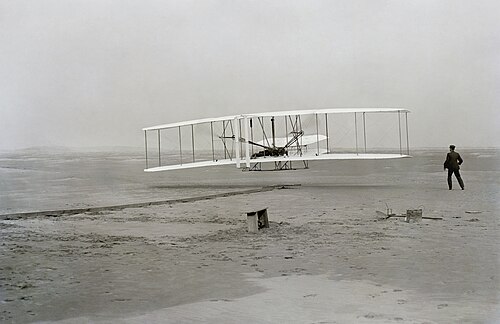
Wing warping was an early system for lateral (roll) control of a fixed-wing aircraft or kite. The technique, used and patented by the Wright brothers, consisted of a system of pulleys and cables to twist the trailing edges of the wings in opposite directions. In many respects, this approach is similar to that used to trim the performance of a paper airplane by curling the paper at the back of its wings.[1]
In 1900, Wilbur Wright wrote, "...my observations of the flight of birds convince me that birds use more positive and energetic methods of regaining equilibrium than that of shifting the center of gravity...they regain their lateral balance...by a torsion of the tips of the wings. If the rear edge of the right wing tip is twisted upward and the left downward the bird becomes an animated windmill and instantly begins to turn, a line from its head to its tail being the axis." After Wilbur demonstrated the method, Orville noted, "From this it was apparent that the wings of a machine of the Chanute double-deck type, with the fore-and-aft trussing removed, could be warped in like manner, so that in flying the wings on the right and left sides could be warped so as to present their surfaces to the air at different angles of incidence and thus secure unequal lifts on the two sides."[2]
Birds visibly use wing warping to achieve control. This was a significant influence on early aircraft designers. The Wright brothers were the first group to use warping wings. Their first plane mimicked the bird's flight patterns and wing form.[3]
In practice, since most wing warping designs involved flexing of structural members, they were difficult to control and liable to cause structural failure. Ailerons had begun to replace wing warping as the most common means of achieving lateral control as early as 1911, especially in biplane designs. Monoplane wings of the period were much more flexible, and proved more amenable to wing warping – but even for monoplane designs, ailerons became the norm after 1915.
初期の航空機における横方向(ロール)制御は、せいぜい問題だらけだった。過度に柔軟で、意図せずねじれる翼は、意図しないロールを引き起こすだけでなく、さらに悪いことに、翼のねじれや補助翼による修正操作を、逆方向の「サーボタブ」効果に変えてしまうこともあった。このことが完全に理解されると、翼の構造は徐々に剛性を高め、翼のねじれを完全に排除するようになり、航空機の横方向の操縦性は格段に向上した。
現在の技術によって、科学者たちは翼の変形(モーフィングウィングとも呼ばれる)という概念を改めて検討することが可能になった。
翼の歪みは、初期の航空機によく見られる特徴であり、以下のような例が挙げられる。
映画『素晴らしき飛行野郎たち』のために製作されたいくつかの復元機は、オリジナルの航空機の翼のねじり制御システムを採用したが、結果はまちまちだった。アブロ三葉機の翼のねじりは驚くほど効果的だったが、非常に柔軟な翼を持つ復元機のアントワネットでは、翼のねじりは効果的な横方向制御をほとんど提供しなかった。オリジナルのアントワネット式のエルロンはさらに効果が低かったと思われるため、目立たない「現代的」エルロンが挿入されたが、それでも横方向制御は非常に劣っていた。[ 4 ]
翼の変形は、翼の空力形状をコンピュータ制御で変更する翼の変形技術の現代版である。この分野の研究は主にNASAによって行われており、例えば、1985年からゼネラル・ダイナミクスとボーイングの共同開発機であるAFTI/F-111Aアードバークに搭載されたミッション適応翼(MAW)などが挙げられる。
多くの大手企業や科学者が変形翼の開発に取り組んでいます。NASAは、鳥の動きを模倣するようにねじれる細胞でできた変形翼の開発に取り組んでいます。NASAが翼の構築に使用している細胞は、炭素繊維でできた小さな黒いモジュールです。現在、NASAは無人ドローンに注力しています。[ 5 ]
形状変化翼の魅力は、結果として得られる形状が隙間がなく滑らかである点にあります。従来の翼は、エルロン、フラップ、スラットなどの可動部品を用いて形状、ひいては空力特性を変化させますが、モーフィング翼は外表面の連続的な変形によって形状変化を実現します。曲率の変化や隙間がないため、翼の形状抗力を低減し、空力効率を高めることができます。この特性により、適応翼は様々な運用条件下での運用に適しており、形状を最適に調整することで抗力を最小限に抑えることができます。