
Loading article…
 ボイジャー宇宙船の設計図 | |
| ミッションタイプ | 惑星探査 |
|---|---|
| オペレーター | NASA / JPL [1] |
| コスパーID | 1977-076A [2] |
| SATCAT番号 | 10271 [2] |
| Webサイト | voyager.jpl.nasa.gov |
| ミッション期間 |
|
| 宇宙船の特性 | |
| メーカー | ジェット推進研究所 |
| 打ち上げ質量 | 721.9キログラム(1,592ポンド)[3] |
| 力 | 470ワット(発売時) |
| ミッション開始 | |
| 発売日 | 1977年8月20日 14:29:00 UTC |
| ロケット | タイタンIIIE |
| 発射場 | ケープカナベラル LC-41 |
| 木星の接近 | |
| 最接近 | 1979年7月9日 |
| 距離 | 570,000キロメートル(350,000マイル) |
| 土星の接近 | |
| 最接近 | 1981年8月26日 |
| 距離 | 101,000 km (63,000 マイル) |
| 天王星の接近 | |
| 最接近 | 1986年1月24日 |
| 距離 | 81,500 km (50,600 マイル) |
| 海王星の接近 | |
| 最接近 | 1989年8月25日 |
| 距離 | 4,951 km (3,076 マイル) |
大型戦略科学ミッション 惑星科学部門 | |
プロット 1 は、スケールどおりに北黄極から見たものです。
プロット 2 から 4 は、 20% スケールの第三角投影です。SVG
ファイルで、軌道または軌道にマウスを合わせると、それとそれに関連する打ち上げおよびフライバイが強調表示されます。
ボイジャー2号は、1977年8月20日にNASAのボイジャー計画の一環として打ち上げられた宇宙探査機である。木星と土星という巨大ガス惑星に向かう軌道で打ち上げられ、天王星と海王星という氷の巨星とのさらなる遭遇を可能にした。この探査機は、いずれかの巨大氷惑星を訪れた唯一の探査機であり、太陽系を離脱できる太陽脱出速度に到達した5機の探査機のうち3番目である。47年1ヶ月8日間地球に科学データを送信し続けており、最も古い活動中の宇宙探査機となっている。 [4]双子のボイジャー1号より16日前に打ち上げられたこの探査機の主な使命は外惑星を調査することであり、拡張された使命は太陽の太陽圏の向こうの星間空間を調査することである。
ボイジャー2号は、1979年に木星系、1981年に土星系、1986年に天王星系、 1989年に海王星系を訪問するという主要ミッションを無事に達成した。この宇宙船は現在、星間物質を研究するという拡張ミッションに取り組んでいる。 2024年6月現在、地球から136.1 AU(204 億 km、127億 マイル)の距離にある [update]。[5]
探査機は2018年11月5日に太陽から119.7AU(111億マイル、179億km)の距離で星間物質に進入し[6] 、太陽に対して15.341km/s(34,320mph)[7]の速度で移動している。ボイジャー2号は太陽の太陽圏を離れ、太陽系内にありながらも星間物質を旅しており、2012年に星間物質に到達したボイジャー1号に合流した。 [8] [9] [10] [11]ボイジャー2号は、星間プラズマの密度と温度の初めての直接測定を開始した。[12]
ボイジャー2号はNASAの深宇宙ネットワークを通じて地球との連絡を続けている。[13]通信はキャンベラ近郊にあるオーストラリアのDSS 43通信アンテナ が担当している。[14]
歴史
背景
宇宙時代の初期には、 1970年代後半に外惑星の周期的な一直線上の一直線上に起こり、当時の新技術であった重力アシストを利用して、単一の探査機で木星、土星、天王星、海王星を訪問できると認識されていました。NASAはグランドツアーの作業を開始し、これは2機ずつの探査機からなる2つのグループを含む大規模なプロジェクトに発展しました。1つのグループは木星、土星、冥王星を訪問し、もう1つのグループは木星、天王星、海王星を訪問しました。探査機は、ツアー全体を通して確実に生き残るために冗長システムを使用して設計されました。1972年までにミッションは縮小され、マリナー計画から派生した2機の探査機、マリナー木星土星探査機に置き換えられました。見かけのプログラム寿命コストを低く抑えるため、ミッションには木星と土星のフライバイのみが含まれ、グランドツアーのオプションは残されました。[15] : 263 プログラムが進むにつれて、名前はボイジャーに変更されました。[16]
ボイジャー1号の主なミッションは、木星、土星、そして土星最大の衛星タイタンを探査することだった。ボイジャー2号も木星と土星を探査することになっていたが、その軌道は天王星と海王星まで進むか、ボイジャー1号のバックアップとしてタイタンに向け直されるかの選択肢があった。ボイジャー1号の目的が無事達成されると、ボイジャー2号はミッションを延長して天王星と海王星へ探査機を送ることになっていた。[15]タイタンが選ばれたのは、1979年にパイオニア11号 が撮影した画像からタイタンの大気が濃厚で複雑であることが示唆されたため、関心が高まったためである。そのため、軌道はタイタンへの最適なフライバイのために設計された。[17] [18]
宇宙船の設計
ジェット推進研究所(JPL)によって建造されたボイジャー2号には、高利得アンテナを地球に向け続けるための16個のヒドラジンスラスタ、3軸安定化装置、ジャイロスコープ、天体基準装置(太陽センサー/カノープス・スタートラッカー)が搭載されていた。これらの機器は、ほとんどの機器の冗長ユニットと8つのバックアップスラスタとともに、姿勢制御サブシステム(AACS)の一部となっている。宇宙船には、宇宙を移動しながら天体を研究するための科学機器が11個搭載されていた。[19]
コミュニケーション
ボイジャー2号は、最終的には恒星間旅行を目的に建造され、地球上の深宇宙ネットワークを介してデータを送受信するための、3.7メートル(12フィート)の大型パラボラ高利得アンテナ(図を参照)を搭載していた。通信はSバンド(波長約13cm)とXバンド(波長約3.6cm)で行われ、木星までの距離では115.2キロビット/秒ものデータレートが提供され、距離が離れるにつれて反比例の法則によりレートは低下し続ける。[20]宇宙船が地球と通信できない場合、デジタルテープレコーダー(DTR)は約64メガバイトのデータを記録し、別の機会に送信できる。[21]
力
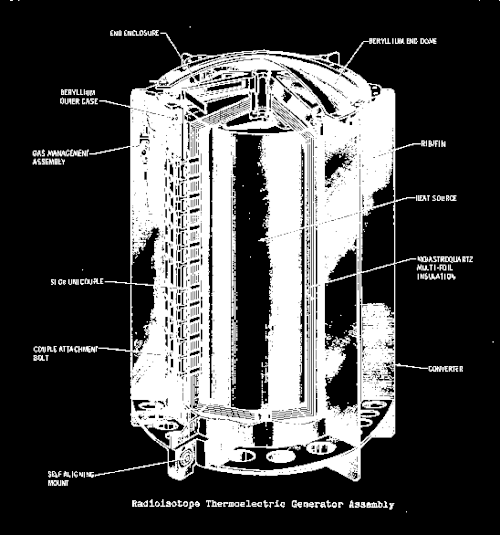
ボイジャー2号には、数百ワットの放射性同位元素熱電発電機(MHW RTG)が3台搭載されている。各RTGには、24個の圧縮されたプルトニウム酸化物球が含まれている。打ち上げ時には、各RTGは約157ワットの電力を生成するのに十分な熱を提供した。合計で、RTGは打ち上げ時に宇宙船に470ワットを供給した(87.7年ごとに半減)。少なくとも2020年までは運用を継続できると予測されており、2023年初頭まで5つの科学機器に電力を供給し続けた。2023年4月、JPLは機内安全機構用のバックアップ電源の貯蔵庫を使い始めた。その結果、5つの機器すべてが2026年まで運用を継続すると予想されている。[19] [22] [23] [24]
姿勢制御と推進
825 キログラム (1,819 ポンド) のペイロードを木星軌道に乗せるために必要なエネルギーのため、宇宙船には 1,123 キログラム (2,476 ポンド) の固体ロケット モーターと 8 基のヒドラジン一元推進剤ロケットエンジン (4 基はピッチとヨーの姿勢制御用、4 基はロール制御用) で構成された推進モジュールが搭載されました。推進モジュールは木星への燃焼が成功した直後に投棄されました。
ミッションモジュールには16個のヒドラジンエアロジェットMR-103スラスタが搭載されており、姿勢制御に使用されます。 [25] 4個は軌道修正操作を実行するために使用され、残りは2つの冗長な6スラスタブランチで宇宙船を3軸上で安定させます。姿勢制御スラスタは常に1つのブランチのみが必要です。[26]
スラスタは直径70センチメートル(28インチ)の球形チタンタンク1基から供給される。打ち上げ時には100キログラム(220ポンド)のヒドラジンが積まれており、2034年まで十分な燃料を供給できる。[27]
科学機器
宇宙船の画像
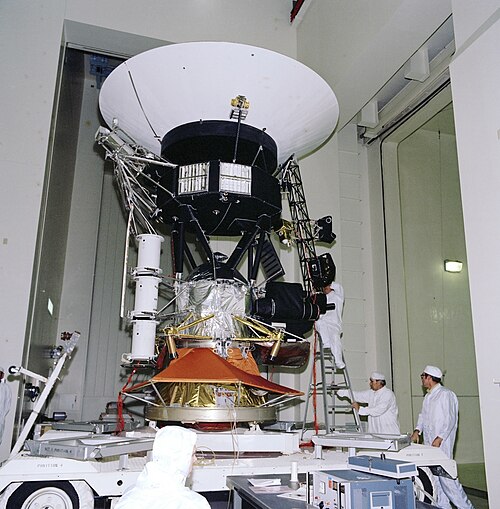

 ウィキメディア・コモンズにあるボイジャー宇宙船に関連するメディア
ミッションプロフィール
打ち上げと軌道
ボイジャー2号探査機は、1977年8月20日にNASAによってフロリダ州ケープカナベラルのスペース・ローンチ・コンプレックス41からタイタンIIIE /セントール打ち上げロケットで打ち上げられた。2週間後、双子のボイジャー1号探査機が1977年9月5日に打ち上げられた。しかし、ボイジャー2号はより長く、より円形の軌道で打ち上げられていたため、ボイジャー1号の方が早く木星と土星に到達した。 [36] [37]
ボイジャー1号の初期軌道の遠日点は8.9AU(8億3000万マイル、13億3000万キロメートル)で、土星の軌道9.5AU(8億8000万マイル、14億2000万キロメートル)よりわずかに短かった。一方、ボイジャー2号の初期軌道の遠日点は6.2AU(5億8000万マイル、9億3000万キロメートル)で、土星の軌道よりはるかに短かった。[38]
1978年4月、一定期間ボイジャー2号にコマンドが送信されなかったため、宇宙船は主無線受信機からバックアップ受信機に切り替えた。 [39]その後しばらくして、主受信機は完全に故障した。バックアップ受信機は機能していたが、受信機内のコンデンサが故障したため、正確な周波数で送信された信号しか受信できず、この周波数は地球の自転(ドップラー効果による)や搭載受信機の温度などの影響を受けることとなった。[40] [41]
-

-

-
 ボイジャー2号の主要ミッションの軌道
 -
![ボイジャー2号の太陽からの距離に対する太陽中心速度のグラフ。木星、土星、天王星の重力アシストを利用して宇宙船を加速している様子を示している。[A]](https://img-server.japedia.wiki/wikipedia/commons/thumb/2/2c/Voyager_2_velocity_vs_distance_from_sun.svg/500px-Voyager_2_velocity_vs_distance_from_sun.svg.png) ボイジャー2号の太陽からの距離に対する太陽中心速度のグラフ。木星、土星、天王星の重力アシストを利用して宇宙船を加速している様子を示している。 [A]
ボイジャー2号の太陽からの距離に対する太陽中心速度のグラフ。木星、土星、天王星の重力アシストを利用して宇宙船を加速している様子を示している。 [A]
木星との遭遇

ボイジャー2号 · 木星 · イオ · ヨーロッパ · ガニメデ · カリスト

ボイジャー2号が木星に最も接近したのは、1979年7月9日22時29分(UT)でした。 [43]木星の雲頂から57万km(35万マイル)以内に接近しました。[44] 木星の大赤斑は、反時計回りに移動する複雑な嵐として現れました。縞状の雲のいたるところに、その他の小さな嵐や渦が見られました。[45]
ボイジャー2号は木星とその衛星アマルテア、イオ、カリスト、ガニメデ、エウロパの画像を送り返した。[43] 10時間の「火山監視」中に、ボイジャー1号によるイオの活火山の観測を確認し、前回の訪問から4か月の間に月の表面がどのように変化したかを明らかにした。[43]ボイジャー2号は合わせてイオの9つの火山の噴火を観測し、2回のボイジャーのフライバイの間に他の噴火が起こったという証拠がある。[46]
木星の衛星エウロパは、ボイジャー1号の低解像度の写真で、多数の交差する線状の地形が写っていた。当初、科学者たちは、これらの地形は地殻の裂け目や地殻変動によって生じた深い亀裂ではないかと考えていた。しかし、ボイジャー2号の高解像度の写真は不可解なものだった。地形の起伏がなく、ある科学者は「フェルトペンで描かれたのかもしれない」と述べている。[46]エウロパは、イオの10分の1程度の潮汐加熱により、内部が活発に活動している。エウロパは、水氷の薄い地殻(厚さ30km未満)を持ち、深さ50kmの海に浮かんでいると考えられている。[47] [48]
2つの新しい小型衛星、アドラステアとメティスがリングのすぐ外側を周回しているのが発見された。[46] 3つ目の新しい衛星、テーベがアマルテアとイオの軌道の間に発見された。[46]


.jpg/500px-Io_-_July_10_1979_(34593324401).jpg)
 ウィキメディア・コモンズにあるボイジャー2号の木星遭遇に関するメディア
土星との遭遇
土星への最接近は1981年8月26日3時24分5秒UTに起こった。[49]ボイジャー2号が地球から見て土星の後ろを通過したとき、土星の無線リンクを利用して土星の上層大気を調査し、温度と圧力の両方のデータを収集した。気圧が70ミリバール(1.0 psi)と測定された大気の最上部では、[50] ボイジャー2号は82 K(−191.2 °C、−312.1 °F)の温度を記録した。気圧が1,200ミリバール(17 psi)と記録された大気の深部では、温度は143 K(−130 °C、−202 °F)まで上昇した。[51]探査機はまた、北極が100ミリバール(1.5psi)で中緯度よりも約10℃(18℉)低いことを観測したが、この変動は季節の変化に起因する可能性がある[51](土星の衝も参照)。
土星フライバイ後、ボイジャー2号のスキャンプラットフォームに異常が発生し、方位アクチュエータが停止した。この故障により一部のデータが失われ、宇宙船のミッション継続に支障をきたした。この異常は、アクチュエータシャフトベアリングとギア潤滑システムの設計上の欠陥、腐食、デブリの蓄積など、複数の問題が組み合わさって発生したものだった。過度の使用と潤滑剤の枯渇が要因であったが、[52]異種金属反応やリリーフポートの不足など、他の要素が問題を悪化させた。地上のエンジニアは一連のコマンドを発行し、スキャンプラットフォームが機能を再開できる程度まで問題を修正することができた。[53] ボイジャー1号がタイタンフライバイを実行できなかった場合、タイタンフライバイを実行するために迂回されるはずだったボイジャー2号は、故障のためにタイタンの近くを通過せず、その後、天王星系探査ミッションを続行した。[54] : 94
_large.jpg/500px-Saturn_(planet)_large.jpg)


 ウィキメディア・コモンズにあるボイジャー2号の土星遭遇に関するメディア
天王星との遭遇
天王星への最接近は1986年1月24日で、ボイジャー2号は惑星の雲頂から81,500 km(50,600マイル)以内に接近した。[55] ボイジャー2号はまた、コーデリア、オフィーリア、ビアンカ、クレシダ、デズデモーナ、ジュリエット、ポーシャ、ロザリンド、ベリンダ、パック、パーディタという、これまで知られていなかった11の衛星を発見した。[B]このミッションでは、 97.8 °の軸の傾きによって生じる惑星の独特の大気を調査し、天王星の環系を調査した。[55]ボイジャー2号によって測定された天王星の1日の長さは17時間14分である。[55]天王星は、それまでに観測された他の惑星とは異なり、自転軸とずれた磁場を持ち、[56] [59]太陽から1000万キロメートル(600万マイル)離れたところまで螺旋状の磁気尾が伸びていることが示された。[56]
ボイジャー2号が天王星を訪れた際、その雲の特徴の多くは霞の層に隠されていた。しかし、擬似カラーとコントラストを強調した画像では、南極の周囲に同心円状の雲の帯が見られる。この領域は大量の紫外線を放射していることも判明しており、これは「昼光」と呼ばれる現象である。大気の平均温度は約60 K (-351.7 °F; -213.2 °C) である。明るい極と暗い極、そして惑星の大部分は、雲頂でほぼ同じ温度を示している。[56]
ボイジャー2号の惑星電波天文学(PRA)実験では、周波数が0.9~40MHzの天王星の静電放電である雷が140回観測された。[60] [61] UEDは24時間にわたって天王星の60万km上空から検出されたが、そのほとんどは目に見えなかった。[60]しかし、微物理モデリングでは、天王星の雷は対流圏深部の水雲で発生する対流嵐で発生することが示唆されている。[60] [62]この場合、対流圏上部の厚い雲層のために雷は目に見えない。[61]天王星の雷の電力は約10 8 Wで、1×10^7 J~2×10^7 Jのエネルギーを放出し、平均120ミリ秒持続する。[61]
ボイジャー2号が天王星の衛星ミランダをフライバイした際の詳細な画像には、地質学的断層によって形成された巨大な峡谷が写っていた。[56]ある仮説では、ミランダは、激しい衝突によって粉々に砕け散った以前の出来事の後に、物質が再集合してできたものである可能性があると示唆している。[56]
ボイジャー2号は、これまで知られていなかった2つの天王星の環を発見した。[56] [57]測定により、天王星の環は木星や土星の環とは異なることが示された。天王星の環系は比較的新しく、天王星と同時に形成されたわけではない可能性がある。環を構成する粒子は、高速衝突によって破壊されたか、潮汐力によって引き裂かれた衛星の残骸である可能性がある。[36] [63]
2020年3月、NASAの天文学者たちは、フライバイ中に記録された古いデータを再評価した後、天王星から宇宙空間に放出されたプラズモイドとしても知られる大規模な大気磁気バブルを検出したと報告した。[64] [65]


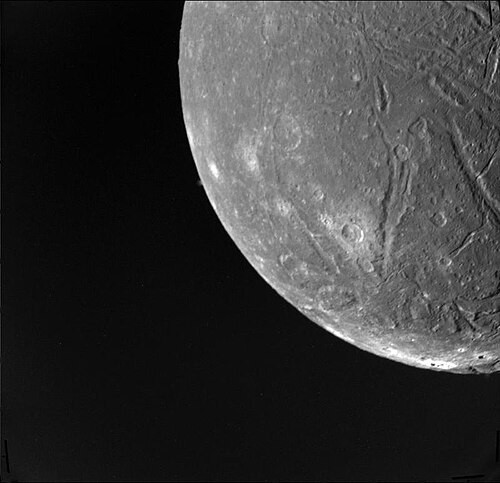
 ウィキメディア・コモンズにあるボイジャー2号の天王星遭遇に関するメディア
海王星との遭遇
1987年の進路修正の後、ボイジャー2号は1989年8月25日に海王星に最接近した。 [66] [67] [68]事前に行われた海王星系を通る軌道のコンピュータ化されたテストシミュレーションを繰り返して、飛行管制官は海王星-トリトン系を通過するボイジャー2号の最適な経路を決定した。トリトンの軌道面は黄道面に対して大きく傾いているため、進路修正により、ボイジャー2号は海王星の北極から約4,950 km (3,080 mi)上空の経路に導かれた。[69] [70]ボイジャー2号が海王星に最接近してから5時間後、同機は海王星最大の衛星トリトンに接近し、約40,000 km (25,000 mi)以内を通過した。[69]
1989年、ボイジャー2号の惑星電波天文学(PRA)実験では、約60回の雷閃光、つまり7×10 8 Jを超えるエネルギーを放出する海王星の静電放電が観測されました。 [71]プラズマ波システム(PWS)は、磁気緯度7˚-33˚で50 Hz-12 kHzの周波数範囲を持つ16の電磁波イベントを検出しました。[60] [72]これらのプラズマ波検出は、磁気圏のアンモニア雲内で20分間にわたって発生した雷によって引き起こされた可能性があります。[72]ボイジャー2号が海王星に最も接近した際、PWS機器は毎秒28,800サンプルのサンプルレートで海王星の最初のプラズマ波検出を提供しました。[72]測定されたプラズマ密度は10 –3 - 10 –1 cm –3の範囲です。[72] [73]
ボイジャー2号は、これまで知られていなかった海王星の環を発見し、[74]デスピナ、ガラテア、ラリサ、プロテウス、ナイアド、タラッサの6つの新しい衛星を確認した。[75] [C]海王星の近くにいる間、ボイジャー2号は「大暗斑」を発見したが、ハッブル宇宙望遠鏡の観測によると、それはその後消滅した。[76]大暗斑は後に、惑星の高高度メタン雲層に窓を形成する透明なガスの領域であると仮定された。[77]


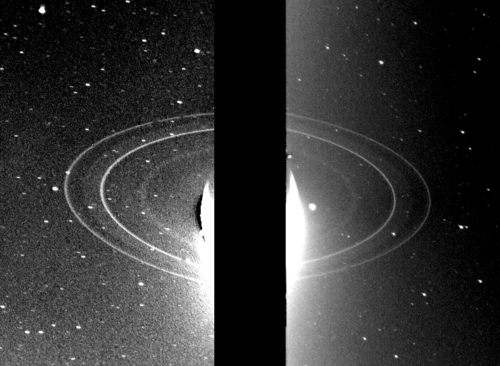
.jpg/500px-Triton_moon_mosaic_Voyager_2_(large).jpg) ウィキメディア・コモンズにあるボイジャー2号の海王星遭遇に関するメディア
ウィキメディア・コモンズにあるボイジャー2号の海王星遭遇に関するメディア星間ミッション


惑星探査ミッションを終えたボイジャー2号は、NASAが太陽圏外の太陽系がどのようなものかを調べるために使用している恒星間ミッションに取り組んでいると説明されている。2023年9月現在、ボイジャー2号は1秒あたり約160ビットの速度で科学データを送信している。[78]ボイジャー2号との継続的なテレメトリ交換に関する情報は、ボイジャーウィークリーレポートから入手できる。[79][update]

1992年、ボイジャー2号は初めて遠紫外線で新星V1974 Cygniを観測した。この波長での明るさがさらに増加したことで、新星のより詳細な研究が可能になった。 [80] [81]
1994年7月、シューメーカー・レヴィ第9彗星の破片が木星に衝突する様子を観測する試みがなされた。 [80]探査機の位置から衝突地点が直接見える位置にあり、紫外線と電波のスペクトルで観測が行われた。[80] ボイジャー2号は何も検出できなかったが、計算によると火球は探査機の検出限界をわずかに下回っていたことが示された。[80]
2006年11月29日、ボイジャー2号に送られた遠隔測定コマンドが、搭載コンピューターによって、ランダムエラーにより、宇宙船の磁力計の電気ヒーターをオンにするコマンドとして誤って解読された。このヒーターは2006年12月4日までオンのままで、その間、磁力計が耐えられる温度を大幅に上回る130℃(266℉)を超える高温が発生し、センサーが正しい方向から回転した。[82]
2007年8月30日、ボイジャー2号は終端衝撃波を通過し、ヘリオシースに入りました。これはボイジャー1号よりも太陽に約10億マイル(16億km)近い距離です。[83]これは深宇宙の星間磁場によるものです。太陽系の太陽圏の南半球が押し込まれています。[84]
2010年4月22日、ボイジャー2号は科学データフォーマットの問題が発生しました。[85] 2010年5月17日、JPLのエンジニアは、搭載コンピューターのビットが反転したことが問題の原因であると明らかにし、5月19日にビットリセットを予定しました。 [86] 2010年5月23日、エンジニアが反転したビットを修正した後、ボイジャー2号は深宇宙からの科学データの送信を再開しました。[87]
2013年、当初ボイジャー2号は2~3年以内に星間空間に入り、プラズマ分光計が星間プラズマの密度と温度を初めて直接測定すると考えられていた。しかし、ボイジャー計画の科学者であるエドワード・C・ストーンと彼の同僚は、星間空間の重要な特徴である磁場の方向の変化の証拠が不足していると述べた。[88]最終的に、2018年12月、ストーンはボイジャー2号が2018年11月5日に星間空間に到達したと発表した。 [10] [11]

深宇宙ネットワークのメンテナンスにより、2020年には探査機との通信が8か月間途絶えた。11月2日に一連の指示が送信され、その後実行され、通信成功メッセージが中継されて通信が再開された。[89] 2021年2月12日、地上局のアンテナの大規模なアップグレードが1年かけて完了し、完全な通信が回復した。[14]
2020年10月、天文学者はボイジャー1号とボイジャー2号によって太陽系の外の空間で密度が予想外に大幅に増加したことを検出したと報告した。これは「密度勾配は、太陽圏ノーズの一般的な方向におけるVLISM(超局所星間物質)の大規模な特徴である」ことを意味している。[90] [91]
2023年7月18日、ボイジャー2号はパイオニア10号を追い抜いて太陽から2番目に遠い宇宙船となった。 [92] [93]
2023年7月21日、プログラミングエラーによりボイジャー2号の高利得アンテナ[94]が地球から2度ずれ、探査機との通信が途絶えた。8月1日までに、探査機の搬送波信号はディープスペースネットワークの複数のアンテナを使用して検出された。[95] [96] 8月4日にキャンベラ局から送信された高出力の「叫び」[97]により、探査機は地球に向きを変えるよう正常に指示され、通信が再開された。[96] [98]フェイルセーフ対策として、探査機は地球を指すように自動的に向きをリセットするようにプログラムされており、これは10月15日までに実行されるはずだった。[96]
能力の削減
RTGからの電力が徐々に減少するにつれて、宇宙船上の様々な機器がオフになりました。 [ 99]ボイジャー2号で最初にオフになった科学機器は1991年のPPSで、1.2ワットを節約しました。[99]
方向スラスターに関する懸念
宇宙船の正しい姿勢を制御し、高利得アンテナを地球の方向に向けるために必要ないくつかのスラスタは、ヒドラジン注入器の詰まりの問題により使用できなくなっている。宇宙船にはスラスタシステムのバックアップがもうなく、「搭載されているものはすべてシングルストリングで動作している」と、 JPLのボイジャープロジェクトマネージャーであるスザンヌ・ドッドはArs Technicaとのインタビューで認めている。[106] NASAは、残りのスラスタの機能を変更して小径ヒドラジン注入ジェットの詰まりを遅らせるために、コンピュータソフトウェアにパッチを当てることを決定した。ボイジャー1号のコンピュータにソフトウェアアップデートをアップロードする前に、NASAはまず地球に近いボイジャー2号でこの手順を試す予定である。 [106]
探査機の将来
探査機は打ち上げから48年以上経った2020年代半ばまでは微弱な無線メッセージを送信し続けると予想されている。[107] NASAは「ボイジャー号はおそらく永遠に天の川をさまよう運命にある」と述べている。[108]
ボイジャー2号は特定の恒星に向かっているわけではない。最も近い恒星は4.2光年離れており、15.341 km/sの速度で、この探査機は約19,541年かけて1光年を移動する。その間、近くの恒星も大きく移動する。およそ42,000年後、ボイジャー2号はロス248(地球から10.30光年離れている)を1.7光年の距離で通過する。[109] 296,000年間妨害がなければ、ボイジャー2号はシリウス(地球から8.6光年離れている)を4.3光年の距離で通過するはずである。 [110]
ゴールデンレコード

Both Voyager space probes carry a gold-plated audio-visual disc, a compilation meant to showcase the diversity of life and culture on Earth in the event that either spacecraft is ever found by any extraterrestrial discoverer.[111][112] The record, made under the direction of a team including Carl Sagan and Timothy Ferris, includes photos of the Earth and its lifeforms, a range of scientific information, spoken greetings from people such as the Secretary-General of the United Nations and the President of the United States and a medley, "Sounds of Earth", that includes the sounds of whales, a baby crying, waves breaking on a shore, and a collection of music spanning different cultures and eras including works by Wolfgang Amadeus Mozart, Blind Willie Johnson, Chuck Berry and Valya Balkanska. Other Eastern and Western classics are included, as well as performances of indigenous music from around the world. The record also contains greetings in 55 different languages.[113] The project aimed to portray the richness of life on Earth and stand as a testament to human creativity and the desire to connect with the cosmos.[112][114]
See also

- Family Portrait
- The Farthest, a 2017 documentary on the Voyager program.
- List of artificial objects leaving the Solar System
- List of missions to the outer planets
- New Horizons
- Pioneer 10
- Pioneer 11
- Timeline of artificial satellites and space probes
- Voyager 1
Notes
- ^ To observe Triton, Voyager 2 passed over Neptune's north pole, resulting in an acceleration out of the plane of the ecliptic, and, as a result, a reduced velocity relative to the Sun.[42]
- ^ Some sources cite the discovery of only 10 Uranian moons by Voyager 2,[56][57] but Perdita was discovered in Voyager 2 images more than a decade after they were taken.[58]
- ^ One of these moons, Larissa, was first reported in 1981 from ground telescope observations, but not confirmed until the Voyager 2 approach.[75]
References
- ^ "Voyager: Mission Information". NASA. 1989. Archived from the original on February 20, 2017. Retrieved January 2, 2011.
- ^ a b "Voyager 2". US National Space Science Data Center. Archived from the original on January 31, 2017. Retrieved August 25, 2013.
- ^ "Voyager 2". NASA's Solar System Exploration website. Archived from the original on April 20, 2017. Retrieved December 4, 2022.
- ^ "NASA's Voyager 1 Resumes Sending Engineering Updates to Earth". NASA/JPL. Archived from the original on April 22, 2024. Retrieved June 22, 2024.
- ^ "Voyager – Mission Status". Jet Propulsion Laboratory. National Aeronautics and Space Administration. Archived from the original on January 1, 2018. Retrieved July 9, 2023.
- ^ Staff (September 9, 2012). "Where are the Voyagers?". NASA. Archived from the original on March 10, 2017. Retrieved September 9, 2012.
- ^ "Voyager – Mission Status". voyager.jpl.nasa.gov. Archived from the original on January 1, 2018. Retrieved September 14, 2018.
- ^ University of Iowa (November 4, 2019). "Voyager 2 reaches interstellar space – Iowa-led instrument detects plasma density jump, confirming spacecraft has entered the realm of the stars". EurekAlert!. Archived from the original on April 13, 2020. Retrieved November 4, 2019.
- ^ Chang, Kenneth (November 4, 2019). "Voyager 2's Discoveries From Interstellar Space – In its journey beyond the boundary of the solar wind's bubble, the probe observed some notable differences from its twin, Voyager 1". The New York Times. Archived from the original on April 13, 2020. Retrieved November 5, 2019.
- ^ a b Gill, Victoria (December 10, 2018). "Nasa's Voyager 2 probe 'leaves the Solar System'". BBC News. Archived from the original on December 15, 2019. Retrieved December 10, 2018.
- ^ a b c d Brown, Dwayne; Fox, Karen; Cofield, Calia; Potter, Sean (December 10, 2018). "Release 18–115 – NASA's Voyager 2 Probe Enters Interstellar Space". NASA. Archived from the original on June 27, 2023. Retrieved December 10, 2018.
- ^ "At last, Voyager 1 slips into interstellar space – Atom & Cosmos". Science News. September 12, 2013. Archived from the original on September 15, 2013. Retrieved September 17, 2013.
- ^ NASA Voyager – The Interstellar Mission Mission Overview Archived May 2, 2011, at the Wayback Machine
- ^ a b Shannon Stirone (February 12, 2021). "Earth to Voyager 2: After a Year in the Darkness, We Can Talk to You Again – NASA's sole means of sending commands to the distant space probe, launched 44 years ago, is being restored on Friday". The New York Times. Archived from the original on December 28, 2021. Retrieved February 14, 2021.
- ^ a b Butrica, Andrew. From Engineering Science to Big Science. p. 267. Archived from the original on February 29, 2020. Retrieved September 4, 2015.
Despite the name change, Voyager remained in many ways the Grand Tour concept, though certainly not the Grand Tour (TOPS) spacecraft.
- ^ Planetary Voyage Archived August 26, 2013, at the Wayback Machine NASA Jet Propulsion Laboratory – California Institute of Technology. March 23, 2004. Retrieved April 8, 2007.
- ^ David W. Swift (January 1, 1997). Voyager Tales: Personal Views of the Grand Tour. AIAA. p. 69. ISBN 978-1-56347-252-7.
- ^ Jim Bell (February 24, 2015). The Interstellar Age: Inside the Forty-Year Voyager Mission. Penguin Publishing Group. p. 93. ISBN 978-0-698-18615-6.
- ^ a b "Voyager 2: Host Information". NASA. 1989. Archived from the original on February 20, 2017. Retrieved January 2, 2011.
- ^ Ludwig, Roger; Taylor, Jim (2013). "Voyager Telecommunications" (PDF). Archived (PDF) from the original on August 8, 2023. Retrieved August 7, 2023.
- ^ "NASA News Press Kit 77–136". JPL/NASA. Archived from the original on May 29, 2019. Retrieved December 15, 2014.
- ^ "Voyager 2 Craft Details". NASA-NSSDC-Spacecraft-Details. NASA. Archived from the original on January 31, 2017. Retrieved March 9, 2011.
- ^ Furlong, Richard R.; Wahlquist, Earl J. (1999). "U.S. space missions using radioisotope power systems" (PDF). Nuclear News. 42 (4): 26–34. Archived from the original (PDF) on October 16, 2018. Retrieved January 2, 2011.
- ^ "NASA's Voyager Will Do More Science With New Power Strategy". NASA Jet Propulsion Laboratory. Archived from the original on April 27, 2023. Retrieved April 28, 2023.
- ^ "MR-103". Astronautix.com. Archived from the original on December 28, 2016. Retrieved December 11, 2018.
- ^ "Voyager Backgrounder" (PDF). Nasa.gov. Nasa. October 1980. Archived (PDF) from the original on June 9, 2019. Retrieved December 11, 2018.
- ^ Koerner, Brendan (November 6, 2003). "What Fuel Does Voyager 1 Use?". Slate.com. Archived from the original on December 11, 2018. Retrieved December 11, 2018.
- ^ NASA/JPL (August 26, 2003). "Voyager 1 Narrow Angle Camera Description". NASA / PDS. Archived from the original on October 2, 2011. Retrieved January 17, 2011.
- ^ NASA/JPL (August 26, 2003). "Voyager 1 Wide Angle Camera Description". NASA / PDS. Archived from the original on August 11, 2011. Retrieved January 17, 2011.
- ^ "Voyager 2 Full Mission Timeline" Archived July 23, 2011, at the Wayback Machine Muller, Daniel, 2010
- ^ "Voyager Mission Description" Archived October 7, 2018, at the Wayback Machine NASA, February 19, 1997
- ^ "JPL Mission Information" Archived February 20, 2017, at the Wayback Machine NASA, JPL, PDS.
- ^ Sullivant, Rosemary (November 5, 2011). "Voyager 2 to Switch to Backup Thruster Set". JPL. 2011-341. Archived from the original on February 26, 2021. Retrieved October 5, 2018.
- ^ "Distance between the Sun and Voyager 2". Archived from the original on July 9, 2023. Retrieved July 18, 2023.
- ^ "Distance between the Sun and Pioneer 10". Archived from the original on July 14, 2023. Retrieved July 18, 2023.
- ^ a b "Voyager - Fact Sheet". NASA/JPL. Archived from the original on April 13, 2020. Retrieved June 9, 2024.
- ^ "Voyager - Fast Facts". NASA/JPL. Archived from the original on May 22, 2022. Retrieved June 9, 2024.
- ^ HORIZONS Archived October 7, 2012, at the Wayback Machine, JPL Solar System Dynamics (Ephemeris Type ELEMENTS; Target Body: Voyager n (spacecraft); Center: Sun (body center); Time Span: launch + 1 month to Jupiter encounter – 1 month)
- ^ "40 Years Ago: Voyager 2 Explores Jupiter – NASA". July 8, 2019. Archived from the original on April 4, 2024. Retrieved April 4, 2024.
- ^ Littmann, Mark (2004). Planets Beyond: Discovering the Outer Solar System. Courier Corporation. p. 106. ISBN 978-0-486-43602-9.
- ^ Davies, John (January 23, 1986). "Voyage to the tilted planet". New Scientist. p. 42.[permanent dead link]
- ^ "Basics of space flight: Interplanetary Trajectories". Archived from the original on September 4, 2015. Retrieved October 5, 2018.
- ^ a b c National Aeronautics and Space Administration "Voyager 2" Archived April 20, 2017, at the Wayback Machine NASA Science: Solar System Exploration. Updated January 26, 26, 2018. Accessed December 12, 2018.
- ^ "History". www.jpl.nasa.gov. Archived from the original on April 16, 2022. Retrieved October 5, 2018.
- ^ "Voyager Mission Description". pdsseti. Archived from the original on October 7, 2018. Retrieved June 22, 2024.
- ^ a b c d "Voyager Fact Sheet". JPL. Archived from the original on April 13, 2020. Retrieved December 11, 2018.
- ^ "Voyager – Fact Sheet". NASA/JPL. Archived from the original on April 13, 2020. Retrieved June 9, 2024.
- ^ "Voyager – Fast Facts". NASA/JPL. Archived from the original on May 22, 2022. Retrieved June 9, 2024.
- ^ "NASA – NSSDCA – Master Catalog – Event Query". nssdc.gsfc.nasa.gov. Archived from the original on March 26, 2019. Retrieved October 5, 2018.
- ^ "Saturn Approach". Jet Propulsion Laboratory. Archived from the original on August 9, 2023. Retrieved September 8, 2023.
- ^ a b c "Voyager – Frequently Asked Questions". Jet Propulsion Laboratory. Archived from the original on August 13, 2023. Retrieved December 11, 2018.
- ^ Laeser, Richard P. (1987). "Engineering the voyager uranus mission". Acta Astronautica. 16. Jet Propulsion Laboratory: 75–82. Bibcode:1986inns.iafcQ....L. doi:10.1016/0094-5765(87)90096-8. Retrieved September 8, 2023.
- ^ Jet Propulsion Laboratory (May 30, 1995). "Lesson 394: Voyager Scan Platform Problems". NASA Public Lessons Learned System. NASA. Archived from the original on September 8, 2023. Retrieved September 8, 2023.
- ^ Bell, Jim (February 24, 2015). The Interstellar Age: Inside the Forty-Year Voyager Mission. Penguin Publishing Group. p. 93. ISBN 978-0-698-18615-6. Archived from the original on September 4, 2016.
- ^ a b c "Uranus Approach" Archived September 9, 2018, at the Wayback Machine NASA Jet Propulsion Laboratory, California Institute of Technology. Accessed December 11, 2018.
- ^ a b c d e f g Elizabeth Landau (2016) "Voyager Mission Celebrates 30 Years Since Uranus" Archived May 5, 2017, at the Wayback Machine National Aeronautics and Space Administration, January 22, 2016. Accessed December 11, 2018
- ^ a b Voyager 2 Mission Team (2012) "1986: Voyager at Uranus" Archived May 24, 2019, at the Wayback Machine NASA Science: Solar System Exploration, December 14, 2012. Accessed December 11, 2018.
- ^ Karkoschka, E. (2001). "Voyager's Eleventh Discovery of a Satellite of Uranus and Photometry and the First Size Measurements of Nine Satellites". Icarus. 151 (1): 69–77. Bibcode:2001Icar..151...69K. doi:10.1006/icar.2001.6597.
- ^ Russell, C. T. (1993). "Planetary magnetospheres". Reports on Progress in Physics. 56 (6): 687–732. Bibcode:1993RPPh...56..687R. doi:10.1088/0034-4885/56/6/001. S2CID 250897924.
- ^ a b c d Aplin, K.L.; Fischer, G.; Nordheim, T.A.; Konovalenko, A.; Zakharenko, V.; Zarka, P. (2020). "Atmospheric Electricity at the Ice Giants". Space Science Reviews. 216 (2): 26. arXiv:1907.07151. Bibcode:2020SSRv..216...26A. doi:10.1007/s11214-020-00647-0.
- ^ a b c Zarka, P.; Pederson, B.M. (1986). "Radio detection of uranian lightning by Voyager 2". Nature. 323 (6089): 605-608. Bibcode:1986Natur.323..605Z. doi:10.1038/323605a0.
- ^ Aglyamov, Y.S.; Lunine, J.; Atreya, S.; Guillot, T.; Becker, H.N.; Levin, S.; Bolton, S.J. (2020). "Atmospheric Electricity at the Ice Giants". Space Science Reviews. 216 (2). arXiv:1907.07151. Bibcode:2020SSRv..216...26A. doi:10.1007/s11214-020-00647-0.
- ^ "Voyager - Fast Facts". NASA/JPL. Archived from the original on May 22, 2022. Retrieved June 9, 2024.
- ^ Hatfield, Miles (March 25, 2020). "Revisiting Decades-Old Voyager 2 Data, Scientists Find One More Secret – Eight and a half years into its grand tour of the solar system, NASA's Voyager 2 spacecraft was ready for another encounter. It was Jan. 24, 1986, and soon it would meet the mysterious seventh planet, icy-cold Uranus". NASA. Archived from the original on March 27, 2020. Retrieved March 27, 2020.
- ^ Andrews, Robin George (March 27, 2020). "Uranus Ejected a Giant Plasma Bubble During Voyager 2's Visit – The planet is shedding its atmosphere into the void, a signal that was recorded but overlooked in 1986 when the robotic spacecraft flew past". The New York Times. Archived from the original on March 27, 2020. Retrieved March 27, 2020.
- ^ "Voyager Steered Toward Neptune". Ukiah Daily Journal. March 15, 1987. Archived from the original on December 7, 2017. Retrieved December 6, 2017.
- ^ "Fact Sheet". JPL. Archived from the original on November 29, 2016. Retrieved March 3, 2016.
- ^ Nardo 2002, p. 15
- ^ a b National Aeronautics and Space Administration "Neptune Approach" Archived September 9, 2018, at the Wayback Machine NASA Jet Propulsion Laboratory: California Institute of Technology. Accessed December 12, 2018.
- ^ "Neptune". Jet Propulsion Laboratory. Archived from the original on March 4, 2016. Retrieved March 3, 2016.
- ^ Borucki, W.J. (1989). "Predictions of lightning activity at Neptune". Geophysical Research Letters. 16 (8): 937-939. Bibcode:1989GeoRL..16..937B. doi:10.1029/gl016i008p00937.
- ^ a b c d Gurnett, D. A.; Kurth, W. S.; Cairns, I. H.; Granroth, L. J. (1990). "Whistlers in Neptune's magnetosphere: Evidence of atmospheric lightning". Journal of Geophysical Research: Space Physics. 95 (A12): 20967-20976. Bibcode:1990JGR....9520967G. doi:10.1029/ja095ia12p20967. hdl:2060/19910002329.
- ^ Belcher, J.W.; Bridge, H.S.; Bagenal, F.; Coppi, B.; Divers, O.; Eviatar, A.; Gordon, G.S.; Lazarus, A.J.; McNutt, R.L.; Ogilvie, K.W.; Richardson, J.D.; Siscoe, G.L.; Sittler, E.C.; Steinberg, J.T.; Sullivan, J.D.; Szabo, A.; Villanueva, L.; Vasyliunas, V.M.; Zhang, M. (1989). "Plasma observations near Neptune: Initial results from Voyager 2". Science. 246 (4936): 1478–1483. Bibcode:1989Sci...246.1478B. doi:10.1126/science.246.4936.1478. PMID 17756003.
- ^ National Aeronautics and Space Administration "Neptune Moons" Archived April 10, 2020, at the Wayback Machine NASA Science: Solar System Exploration. Updated December 6, 2017. Accessed December 12, 2018.
- ^ a b Elizabeth Howell (2016) "Neptune's Moons: 14 Discovered So Far" Archived December 15, 2018, at the Wayback Machine Space.com, June 30, 2016. Accessed December 12, 2018.
- ^ Phil Plait (2016) "Neptune Just Got a Little Dark" Archived December 15, 2018, at the Wayback Machine Slate, June 24, 2016. Accessed December 12, 2018.
- ^ National Aeronautics and Space Administration (1998) "Hubble Finds New Dark Spot on Neptune" Archived June 11, 2017, at the Wayback Machine NASA Jet Propulsion Laboratory: California Institute of Technology, August 2, 1998. Accessed December 12, 2018.
- ^ "Voyager Space Flight Operations Schedule" (PDF). Voyager Mission Status. Jet Propulsion Laboratory. September 7, 2023. Archived (PDF) from the original on September 8, 2023. Retrieved September 8, 2023.
- ^ "Voyager Weekly Reports". Voyager.jpl.nasa.gov. September 6, 2013. Archived from the original on September 21, 2013. Retrieved September 14, 2013.
- ^ a b c d Ulivi, Paolo; Harland, David M (2007). Robotic Exploration of the Solar System Part I: The Golden Age 1957–1982. Springer. p. 449. ISBN 978-0-387-49326-8.
- ^ V1974 Cygni 1992: The Most Important Nova of the Century (PDF) (Report). Archived (PDF) from the original on May 6, 2023. Retrieved June 9, 2024.
- ^ Shuai, Ping (2021). Understanding Pulsars and Space Navigations. Springer Singapore. p. 189. ISBN 9789811610677. Archived from the original on April 5, 2023. Retrieved March 20, 2023.
- ^ "NASA – Voyager 2 Proves Solar System Is Squashed". www.nasa.gov. Archived from the original on April 13, 2020. Retrieved October 5, 2018.
- ^ Voyager 2 finds solar system's shape is 'dented' # 2007-12-10, Week Ending December 14, 2007. Archived September 27, 2020, at the Wayback Machine Retrieved December 12, 2007.
- ^ John Antczak (May 6, 2010). "NASA working on Voyager 2 data problem". Associated Press. Archived from the original on March 5, 2016. Retrieved October 5, 2018.
- ^ "Engineers Diagnosing Voyager 2 Data System". Jet Propulsion Laboratory. Archived from the original on June 12, 2010. Retrieved May 17, 2010.
- ^ "NASA Fixes Bug On Voyager 2". Archived from the original on May 27, 2010. Retrieved May 25, 2010.
- ^ "At last, Voyager 1 slips into interstellar space – Atom & Cosmos". Science News. September 12, 2013. Archived from the original on September 15, 2013. Retrieved September 17, 2013.
- ^ Dockrill, Peter (November 5, 2020). "NASA finally makes contact with Voyager 2 after longest radio silence in 30 years". Live Science. Archived from the original on November 5, 2020. Retrieved November 5, 2020.
- ^ Starr, Michelle (October 19, 2020). "Voyager Spacecraft Detect an Increase in The Density of Space Outside The Solar System". ScienceAlert. Archived from the original on October 19, 2020. Retrieved October 19, 2020.
- ^ Kurth, W.S.; Gurnett, D.A. (August 25, 2020). "Observations of a Radial Density Gradient in the Very Local Interstellar Medium by Voyager 2". The Astrophysical Journal Letters. 900 (1): L1. Bibcode:2020ApJ...900L...1K. doi:10.3847/2041-8213/abae58. S2CID 225312823.
- ^ "Distance between the Sun and Voyager 2". Archived from the original on July 9, 2023. Retrieved July 18, 2023.
- ^ "Distance between the Sun and Pioneer 10". Archived from the original on July 14, 2023. Retrieved July 18, 2023.
- ^ Inskeep, Steve (August 2, 2023). "NASA loses contact with Voyager Two after a programming error on Earth". NPR. Archived from the original on August 2, 2023. Retrieved January 15, 2023.
- ^ "Voyager 2: Nasa picks up 'heartbeat' signal after sending wrong command". BBC News. August 1, 2023. Archived from the original on August 2, 2023. Retrieved August 2, 2023.
- ^ a b c "Mission Update: Voyager 2 Communications Pause – The Sun Spot". blogs.nasa.gov. July 28, 2023. Archived from the original on July 29, 2023. Retrieved July 29, 2023.
- ^ Ellen Francis (August 5, 2023). "'Interstellar shout' restores NASA contact with lost Voyager 2 spacecraft". Washington Post. Archived from the original on August 5, 2023. Retrieved August 5, 2023.
- ^ "Voyager 2: Nasa fully back in contact with lost space probe". BBC News. August 4, 2023. Archived from the original on August 4, 2023. Retrieved August 4, 2023.
- ^ a b c d "Voyager – Operations Plan to the End Mission". voyager.jpl.nasa.gov. Archived from the original on September 10, 2020. Retrieved September 20, 2019.
- ^ "Voyager – The Spacecraft". voyager.jpl.nasa.gov. Archived from the original on March 1, 2017. Retrieved October 5, 2018.
- ^ "Voyager – Interstellar Science". NASA Jet Propulsion Laboratory. December 1, 2009. Archived from the original on March 1, 2017. Retrieved December 2, 2009.
- ^ "A New Plan for Keeping NASA's Oldest Explorers Going". NASA/JPL. Archived from the original on April 13, 2020. Retrieved January 2, 2020.
- ^ Stirone, Shannon (February 12, 2021). "Earth to Voyager 2: After a Year in the Darkness, We Can Talk to You Again". The New York Times. Archived from the original on February 12, 2021. Retrieved February 12, 2021.
- ^ "NASA's Voyager Will Do More Science With New Power Strategy". NASA/JPL. Archived from the original on April 30, 2023. Retrieved May 1, 2023.
- ^ Folger, T. (July 2022). "Record-Breaking Voyager Spacecraft Begin to Power Down". Scientific American. 327 (1): 26. doi:10.1038/scientificamerican0722-26. PMID 39016957. Archived from the original on June 23, 2022. Retrieved August 14, 2023.
- ^ a b Clark, Stephen (October 24, 2023). "NASA wants the Voyagers to age gracefully, so it's time for a software patch". Ars Technica. Archived from the original on October 27, 2023. Retrieved October 27, 2023.
- ^ "Voyager – Spacecraft – Spacecraft Lifetime". NASA Jet Propulsion Laboratory. March 15, 2008. Archived from the original on March 1, 2017. Retrieved May 25, 2008.
- ^ "Future". NASA. Archived from the original on May 14, 2012. Retrieved October 13, 2013.
- ^ Bailer-Jones, Coryn A. L.; Farnocchia, Davide (April 3, 2019). "Future stellar flybys of the Voyager and Pioneer spacecraft". Research Notes of the AAS. 3 (4): 59. arXiv:1912.03503. Bibcode:2019RNAAS...3...59B. doi:10.3847/2515-5172/ab158e. S2CID 134524048.
- ^ Baldwin, Paul (December 4, 2017). "NASA's Voyager 2 heads for star Sirius... by time it arrives humans will have died out". Express.co.uk. Archived from the original on September 1, 2022. Retrieved September 1, 2022.
- ^ Ferris, Timothy (May 2012). "Timothy Ferris on Voyagers' Never-Ending Journey". Smithsonian Magazine. Archived from the original on November 4, 2013. Retrieved August 19, 2013.
- ^ a b Gambino, Megan. "What Is on Voyager's Golden Record?". Smithsonian Magazine. Archived from the original on April 8, 2020. Retrieved January 15, 2024.
- ^ "Voyager Golden record". JPL. Archived from the original on September 27, 2011. Retrieved August 18, 2013.
- ^ Ferris, Timothy (August 20, 2017). "How the Voyager Golden Record Was Made". The New Yorker. ISSN 0028-792X. Archived from the original on January 15, 2024. Retrieved January 15, 2024.
Further reading
- "Saturn Science Results". Voyager Science Results at Saturn. Retrieved February 8, 2005.
- "Uranus Science Results". Voyager Science Results at Uranus. Retrieved February 8, 2005.
- Nardo, Don (2002). Neptune. Thomson Gale. ISBN 0-7377-1001-2
- JPL Voyager Telecom Manual
External links
Wikimedia Commons has media related to:
Voyager 2 (category)
Voyager 2 (category)
- NASA Voyager website
- Voyager 2 Mission Profile by NASA's Solar System Exploration
- Voyager 2 (NSSDC Master Catalog)