
Loading article…
.jpg/500px-Kenya_August_2010_444_(4939520158).jpg)
.jpg/500px-Use_Me_(393539335).jpg)
Jackals mark their territories with urine[1]
In ethology, territory is the sociographical area that an animal consistently defends against conspecific competition (or, occasionally, against animals of other species) using agonistic behaviors or (less commonly) real physical aggression. Animals that actively defend territories in this way are referred to as being territorial or displaying territorialism.
Territoriality is only shown by a minority of species. More commonly, an individual or a group of animals occupies an area that it habitually uses but does not necessarily defend; this is called its home range. The home ranges of different groups of animals often overlap, and in these overlap areas the groups tend to avoid each other rather than seeking to confront and expel each other. Within the home range there may be a core area that no other individual group uses, but, again, this is as a result of avoidance.
Function
The ultimate function of animals inhabiting and defending a territory is to increase the individual fitness or inclusive fitness of the animals expressing the behaviour. Fitness in this biological sense relates to the ability of an animal to survive and raise young. The proximate functions of territory defense vary. For some animals, the reason for such protective behaviour is to acquire and protect food sources, nesting sites, mating areas, or to attract a mate.
Types and size
Among birds, territories have been classified as six types.[2]
- Type A: An 'all-purpose territory' in which all activities occur, e.g. courtship, mating, nesting and foraging
- Type B: A mating and nesting territory, not including most of the area used for foraging.
- Type C: A nesting territory which includes the nest plus a small area around it. Common in colonial waterbirds.
- Type D: A pairing and mating territory. The type of territory defended by males in lekking species.
- Type E: Roosting territory.
- Type F: Winter territory which typically includes foraging areas and roost sites. May be equivalent (in terms of location) to the Type A territory, or for a migratory species, may be on the wintering grounds.
Reports of territory size can be confused by a lack of distinction between home range and the defended territory. The size and shape of a territory can vary according to its purpose, season, the amount and quality of resources it contains, or the geography. The size is usually a compromise of resource needs, defense costs, predation pressure and reproductive needs.
Some species of squirrels may claim as much as 10 hectares (25 acres) of territory.[3] For European badgers, a home range may be as small as 30 hectares (74 acres) in a good rural habitat, but as large as 300 hectares (740 acres) in a poor habitat. On average, a territory may be approximately 50 hectares (120 acres), with main setts normally at least 500 metres (1,600 ft) apart. In urban areas, territories can be as small as 5 hectares (12 acres), if they can obtain enough food from bird tables, food waste or artificial feeding in suburban gardens.[4] Spotted hyenas (Crocuta crocuta) have highly variable territory sizes, ranging from less than 4,000 hectares (9,900 acres) in the Ngorongoro Crater to over 100,000 hectares (250,000 acres) in the Kalahari.[5]
In birds, golden eagles (Aquila chrysaetos) have territories of 9,000 hectares (22,000 acres), least flycatchers' (Empidonax minimus) territories are about 600 square metres (6,500 sq ft) and gulls have territories of only a few square centimetres in the immediate vicinity of the nest.[6]
Territories can be linear. Sanderlings (Calidris alba) forage on beaches and sandflats. When on beaches, they feed either in flocks or individual territories of 10 to 120 metres of shoreline.[7]
The time to develop territories varies between animals. The marine iguana (Amblyrhynchus cristatus) is a lekking reptile. Males start to establish small display territories two months ahead of the mating season.[8]
Retaining a territory
Rather than retaining a territory simply by fighting, for some animals this can be a 3-stage process. Many animals create "sign-posts" to advertise their territory. Sometimes these sign-posts are on the boundary thereby demarcating the territory, or, may be scattered throughout the territory. These communicate to other animals that the territory is occupied and may also communicate additional information such as the sex, reproductive status or dominance status of the territory-holder. Sign-posts may communicate information by olfactory, auditory, or visual means, or a combination of these. If an intruder progresses further into the territory beyond the sign-posts and encounters the territory-holder, both animals may begin ritualized aggression toward each other. This is a series of stylised postures, vocalisations, displays, etc. which function to solve the territory dispute without actual fighting as this could injure either or both animals. Ritualized aggression often ends by one of the animals fleeing (generally the intruder). If this does not happen, the territory may be defended by actual fighting, although this is generally a last resort.
Advertising the territory
Scent marking

Wikimedia Commons has media related to Scent marking.
.jpg/500px-Self_Indulgence_(2526930264).jpg)

Felids rub their heads on vegetation


Wolves mark their territories with urine[9]

_marking_its_territory_..._(52806595064).jpg/500px-Lion_(Panthera_leo)_marking_its_territory_..._(52806595064).jpg)
Scent marking, also known as territorial marking or spraying when this involves urination, is a behaviour used by animals to identify their territory.[10][11][12] Most commonly, this is accomplished by depositing strong-smelling substances contained in the urine, faeces, or, from specialised scent glands located on various areas of the body. Often, the scent contains pheromones or carrier proteins such as the major urinary proteins to stabilize the odours and maintain them for longer.[13][14] The animal sniffing the scent frequently displays a flehmen response to assist in detecting the mark. Scent marking is often performed by scent rubbing in many mammals.[15] In many mammal species, scent marking is more frequent during the breeding season.[16]
Bears[17] and felids such as leopards and jaguars scent-mark by urinating on[18][19][20][21] or rubbing against vegetation. Prosimians and New World monkeys also use scent marking, including urine washing (self-anointing the body with urine), to communicate.[22][23][24] Many ungulates, for example the blue wildebeest, use scent marking from two glands, the preorbital gland and a scent gland in the hoof.[citation needed]
Territorial scent marking may involve behaviours specific to this activity. When a wolf marks its territory, it lifts a hind leg and urinates on a scent post (usually an elevated position like a tree, rock, or bush).[25] This raised leg urination is different from normal urination, which is done while squatting.[26] This posture is exclusive to alpha wolves of either sex, although the alpha male does this most often. The alpha female usually urinates on a scent post that her breeding partner has just urinated on, although during the mating season, the female may first urinate on the ground. All other females in the pack, and also young wolves and low-ranking male wolves, urinate while squatting.[27][unreliable source?] Similar urination postures are used by coyotes and golden jackals.[28]
Males and female ring-tailed lemurs (Lemur catta) scent-mark both vertical and horizontal surfaces at the overlaps in their home ranges using their anogenital scent glands. To do this, they perform a handstand to mark vertical surfaces, grasping the highest point with their feet while applying the scent.[29]
In the Eastern carpenter bee, Xylocopa virginica, both sexes have glands that evolved for marking the nest. Males, although they have the gland, are unable to produce the marking substance. Females secrete it near the nest site entrance to establish their territory.[30]
Wombats use feces to mark their territory. They have evolved specialized intestinal anatomy to produce cubical feces to ensure the feces do not roll away.[31]
Visual
Visual sign-posts may be a short-term or long-term mode of advertising a territory. Short-term communication includes the colouration or behaviour of the animal, which can only be communicated when the resident is present. Other animals may use more long-term visual signals such as faecal deposits, or marks on the vegetation or ground. Visual marking of territory is often combined with other modes of animal communication.
Some animals have prominent "badges" or visual displays to advertise their territory, often in combination with scent marking or auditory signals. Male European robins are noted for their highly aggressive territorial behaviour. They attack other males that stray into their territories, and have been observed attacking other small birds without apparent provocation. Such attacks sometimes lead to fatalities, accounting for up to 10% of adult robin deaths in some areas.[32] The red breast of the bird (i.e. badge) is highly visible when it sings (vocal marking) at the boundary of its territory. The ring-tailed lemur (Lemur catta) advertises its territory with urine scent marks. When it is urinating for marking purposes, it holds its extremely distinctive tail high in the air adding a visual component to the advertisement; when it is urinating for eliminative purposes, its tail is only slightly raised.[33]
Rhinoceros have poor vision but may use visual marking. Dominant white rhino bulls mark their territory with faeces and urine (olfactory marking).[34] The dung is laid in well defined piles. There may be 20 to 30 of these piles to alert passing rhinoceroses that it is occupied territory. Other males may deposit dung over the piles of another and subsequently the sign-post grows larger and larger. Such a dung heap can become up to five metres wide and one metre high.[35] After defecating, greater one-horned rhinos scratch their hind feet in the dung. By continuing to walk, they "transport" their own smell around the paths, thus establishing a scent-marked trail. Another method of visually marking their territory is wiping their horns on bushes or the ground and scraping with the feet, although this is likely combined with the smell of the marking animal. The territorial male scrape-marks every 30 m (98 ft) or so around its territory boundary.
After leaving a urination mark, some animals scrape or dig the ground nearby, thereby leaving a visual advertisement of the territory. This includes domestic dogs.
Several species scratch or chew trees leaving a visual mark of their territory. This is sometimes combined with rubbing on the tree which may leave tufts of fur. These include the Canada lynx (Lynx canadensis)[36] and the American black bear (Ursus americanus).[37][38] Many animals have scent glands in their paws or deposit fur during tree-marking, so tree-marking may be a combination of both visual and olfactory advertising of the territory. The male ring-tailed lemur has a specialised adaptation to assist in leaving visual/olfactory territorial marks. On their inner forearm (antebrachial) is a scent gland which is covered by a spur. In a behaviour called "spur marking", they grasp the substrate, usually a small sapling, and drag the spur over it, cutting into the wood and spreading the gland's secretions. When on the ground, ring-tailed lemurs preferentially mark small saplings and when high in the trees, they usually mark small vertical branches.[29]
European wildcats (Felis silvestris) deposit their faecal marks on plants with high visual conspicuousness that enhances the visual effectiveness of the signal.[39]
Auditory
Many animals use vocalisations to advertise their territory. These are short-term signals transmitted only when the animal is present, but can travel long distances and over varied habitats. Examples of animals which use auditory signals include birds, frogs and canids.

Wolves advertise their territories to other packs through a combination of scent marking and howling. Under certain conditions, wolf howls can be heard over areas of up to 130 km2 (50 sq mi).[40] When howling together, wolves harmonize rather than chorus on the same note, thus creating the illusion of there being more wolves than there actually are.[41] Wolves from different geographic locations may howl in different fashions: the howls of European wolves are much more protracted and melodious than those of North American wolves, whose howls are louder and have a stronger emphasis on the first syllable.[42]
Ritualized aggression
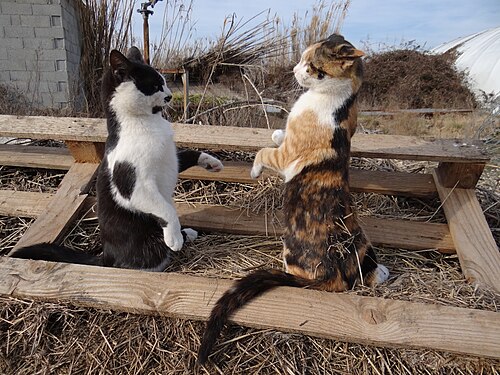
Animals use a range of behaviours to intimidate intruders and defend their territories, but without engaging in fights which are expensive in terms of energy and the risk of injury. This is ritualized aggression. Such defense frequently involves a graded series of behaviours or displays that include threatening gestures (such as vocalizations, spreading of wings or gill covers, lifting and presentation of claws, head bobbing, tail and body beating) and finally, direct attack.
Defense
Territories may be held by an individual, a mated or unmated pair, or a group. Territoriality is not always a fixed behavioural characteristic of a species. For example, red foxes (Vulpes vulpes) either establish stable home ranges within particular areas or are itinerant with no fixed abode.[43] Territories may vary with time (season). For example, European robins