
Loading article…

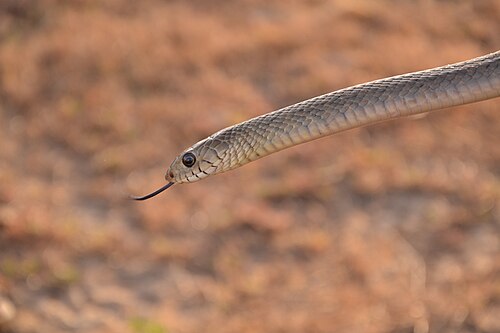
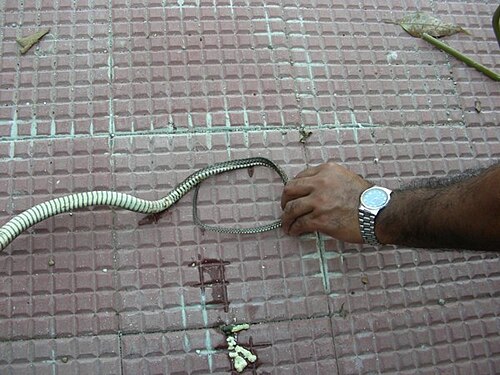
オリエンタルラットスネーク[ 2 ]またはインドラットスネーク[ 4 ]として知られるPtyas mucosaは、南アジアおよび東南アジアの一部に生息する一般的な無毒のナミヘビ科のヘビです。これらは大型のヘビです。典型的な成熟した全長は1.5~1.95m (4フィート11インチ~6フィート5インチ)ですが、 2m (6フィート7インチ)を超えるものもいます。この種の記録的な長さは3.7m (12フィート2インチ)で、現存するナミヘビ科のヘビの中では近縁種のPtyas carinataに次ぐ長さです。 [ 5 ] [ 6 ]オリエンタルラットスネークは大型であるにもかかわらず、通常は非常に細身で、2m(6フィート7インチ)の個体でも直径は4 ~ 6cm( 1.6 ~2.4インチ)程度です。 [ 7 ]さらに、ジャワ島で捕獲されたネズミヘビの平均体重は約877 ~ 940 g (1.933 ~ 2.072ポンド)でしたが、 2.3 m (7フィート 7インチ)を超える大型のオス(この種ではオスの方が平均的にやや大きい) は、簡単に2.5 kg (5.5ポンド)を超えることがあります。 [ 8 ]体色は、乾燥地帯では淡い茶色から湿潤な森林地帯ではほぼ黒色まで変化します。ネズミヘビは昼行性で、半樹上性、無毒で、動きが速いです。ネズミヘビはさまざまな獲物を食べ、げっ歯類が繁殖する都市部でよく見られます。
国際動物命名規約(ICZN)では、特定の種の名称の文法上の性別は、関連する属名の性別から論理的に導かれるべきであると規定されています。Ptyas は女性名詞(ギリシャ語で毒蛇を意味する πτυάς に由来)であるため、種の名称の正しい形はmucosa(後期ラテン語で「ぬるぬるした」を意味する)です。2004 年より前の参考資料では男性名詞のmucosus がしばしば示されており、 CITESリストでも引き続きこの形で記載されています。[ 9 ] [ 10 ] [ 11 ]
アフガニスタン、バングラデシュ、ミャンマー、カンボジア、中国(浙江省、湖北省、江西省、福建省、広東省、海南省、広西チワン族自治区、雲南省、チベット自治区、香港)、台湾、インド(アンダマン・ニコバル諸島を含む)、スリランカ、インドネシア(スマトラ島、ジャワ島、バリ島)、イラン、ラオス、西マレーシア、ネパール、ミャンマー、パキスタン(シンド州)、タイ、トルクメニスタン、ベトナムで発見されている。[ 12 ] [ 13 ]
ブーレンジャー著『イギリス領インドの動物相:爬虫類と両生類』 (1890年)からの記述:
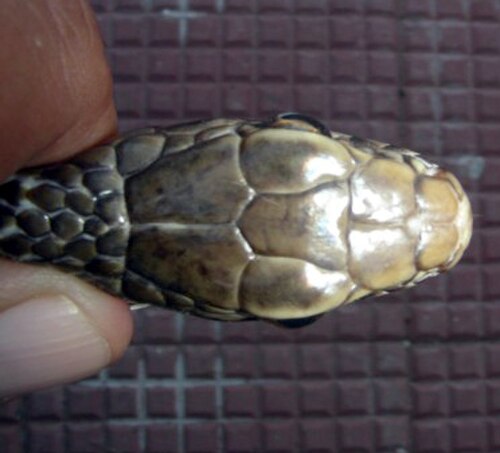
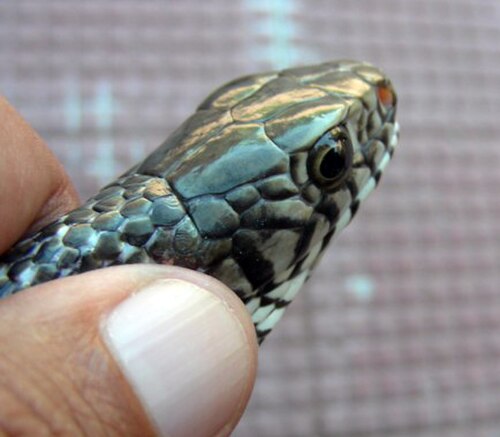
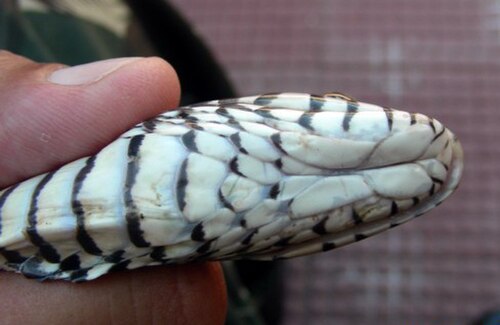
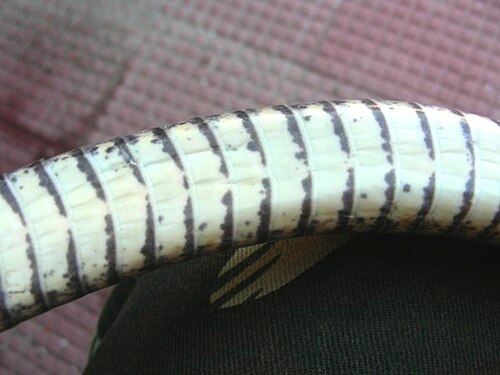
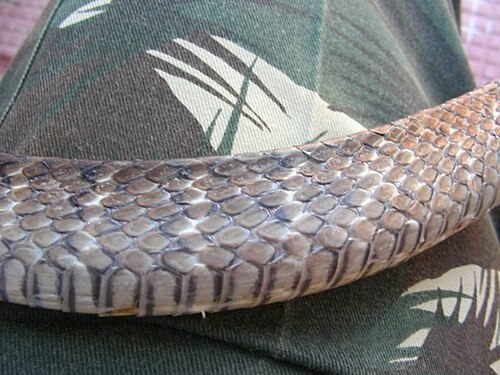
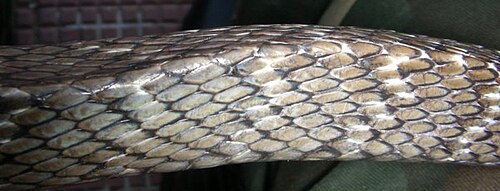
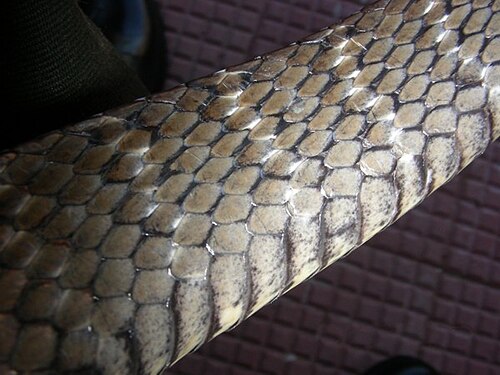
Snout obtuse, slightly projecting; eye large; rostral a little broader than deep, visible from above; suture between the internasals shorter than that between the prefrontals; frontal as long as its distance from the end of the snout, as long as the parietals or slightly shorter; usually three loreals; one large preocular, with a small subocular below; two postoculars; temporals 2+2; 8 Upper labials, fourth and fifth entering the eye; 5 Lower labials in contact with the anterior chin shields, which are shorter than the posterior; the latter in contact anteriorly. Dorsal scales in 17 rows at midbody, more or less strongly keeled on the posterior part of the body. Ventrals 190–208; anal divided; subcaudals 95–135, divided. Brown above, frequently with more or less distinct black crossbands on the posterior part of the body and on the tail; young usually with light crossbands on the front half of the body. Lower surface yellowish; the posterior ventral and the caudal shields may be edged with black.[14]
It is the second largest snake in Sri Lanka, after the Indian rock python.
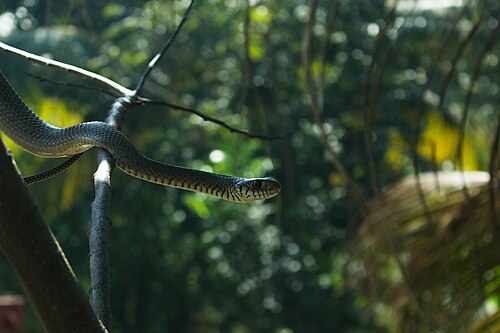
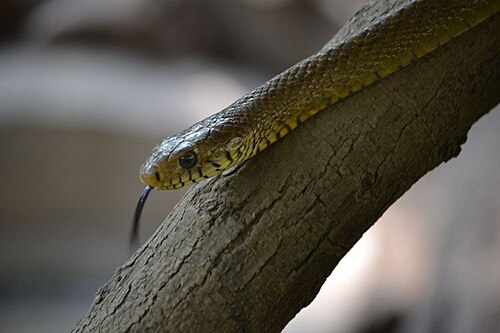
Rat snakes, though harmless to humans, are fast-moving, excitable snakes. Rat snakes are diurnal and semi-arboreal. They inhabit forest floors, wetlands, rice paddies, farmland, and suburban areas where they prey upon small reptiles, amphibians, birds, and mammals. Adults, unusually for a colubrid, prefer to subdue their prey by sitting on it rather than by constricting, using body weight to weaken prey.[15][16] In captivity, they are territorial and may defend their turf aggressively, attempting to startle or strike at passing objects.
Rat snakes mate in late spring and early summer, though in tropical areas reproduction may take place year round. Males establish boundaries of territory using a ritualised test of strength in which they intertwine their bodies. The behaviour is sometime misread by observers as a "mating dance" between opposite-sex individuals.[16] Females produce 6–15 eggs per clutch several weeks after mating.[15][16]
Adult members of this species emit a growling sound and inflate their necks when threatened. This adaptation may represent mimicry of the king cobra or Indian cobra which overlaps this species in range.[17] The resemblance often backfires in human settlements, though, as the harmless animal may be mistaken for a venomous snake and killed.[15][16]

Adult rat snakes have no natural predators, although younger specimens are the natural prey of King cobras that overlap them in their range. Juveniles fear birds of prey, larger reptiles, and mid-sized mammals. They are wary, quick to react, and fast-moving.[15]
Rat snakes and related colubrids are aggressively hunted by humans in some areas of their range for skins and meat. Harvesting and trade regulations exist in China and Indonesia, but these regulations are often ignored.[18]

{{cite journal}}: CS1 maint: multiple names: authors list (link) Media related to Ptyas mucosa at Wikimedia Commons