低地ドイツ語からの借用語や外国語からの借用語(例えば、フランス語のparcからのPark 、ドイツ語のPferchの同義語、どちらもラテン語のparricusに由来)を除くと、現代標準ドイツ語では、摩擦音の後(例えば、英語のstoneのStein )または/tr/の組み合わせ(例えば、英語のtrueのtreu )でのみ、非移動 / p t k/ が保持されている。[ 10 ]
Another change, the shift of /þ/ (/θ/) to /d/, is sometimes seen as related to the High German consonant shift.[1] However, it also comes to encompass the other continental West Germanic languages.[4] The relation of this change to the second consonant shift, as well as that of another change, that of initial /x/ to /h/, is disputed.[11] Braune and Reiffenstein discount a connection entirely.[12]
Detailed description
Shifts from voiceless stops
The result of the shift of the voiceless stops /ptk/ depends on their position in the word. The degree to which the stops are shifted also shows considerable variation between Upper German and Central German dialects.[1][13] In particular, the shift of /p/ and /k/ in initial position is subject to dialectal variation.[14]
/t/ shifts
to /t͡s/ initially, in geminates, and after another consonant:[b]
Old Saxon tehan: OHG zehan (English ten, modern German zehn)
Old Saxon herta: OHG herza (English heart, modern German Herz)
Old Saxon settian: OHG sezzen (English set, modern German setzen)
to ⟨ȥȥ⟩ after a vowel, simplifying to ⟨ȥ⟩ at the end of a word,[11] as well as frequently after a long vowel:[15][c]
Old Saxon etan: OHG ezzan (English eat, modern German essen)
Old Saxon bîtan: OHG bîzan (English bite, modern German beißen)
Old Saxon ût: OHG ûz (English out, modern German aus)
Both of these shifts affect /t/ in all High German dialects.[16] However, the Central German Middle Franconian dialects show unshifted final /t/ for neuter pronouns (that, thit, it, wat, allet).[17][18] Beginning in the 13th century, the fricative /ȥ/ merges with /s/ in most German dialects.[19]
/p/ shifts
to /p͡f/ initially, in geminates, and after another consonant:[d]
Old Saxon piper: OHG pfeffar (English pepper, modern German Pfeffer)
Old Saxon helpan: OHG helphan/helfan (English help, modern German helfen)[e]
Old Saxon skeppian: OHG skephen (English scoop, modern German schöpfen)
to /ff/ after a vowel, simplifying to /f/ at the end of a word,[11] as well as often after a long vowel:[21][f]
Old Saxon piper: pfeffar (English pepper, modern German Pfeffer)
Old Saxon grîpan: OHG grîf(f)an (English gripe, modern German greifen)
Old Saxon skip: OHG scif (English ship, modern German Schiff)
In Central German Middle and most Rhine Franconian dialects, the shift only takes place after a vowel:[22]
Additionally, some Middle Franconian dialects retain final /p/ in the preposition up.[18]
/k/ shifts
to /k͡x/ initially, in geminates, and after another consonant:[g]
いわゆる中音化では、有声子音/d b ɡ/は/t p k/に無声化する。[ i ]無声破裂音への変化と同様に、有声破裂音への変化は方言によって異なり、ある程度は単語内の位置によっても異なる。[ 1 ] 3 つの破裂音すべてが変化した上部ドイツ語の方言では、有声子音と無声子音の区別はもはやなかったと考えられる。[ 27 ]
中世語の変遷の影響は、 /d/から/t/への変化に最も顕著に現れています。これは最も広範囲に及んだ変化であり、古高ドイツ語期に部分的に逆転しなかった唯一の変化です。[ n ]一方、初期のバイエルン語とアレマン語はどちらも/g b/から/k p/への変化を示していますが、9 世紀までにアレマン語は重子音の破裂音/kk/と/pp/を除いて⟨ ɡ ⟩と⟨ b ⟩と書くようになり、10 世紀にはバイエルン語も⟨ ɡ ⟩と⟨ b ⟩と書く頻度が増え始めます。[ 24 ]中高ドイツ語期までに、バイエルン語は単語の先頭位置でのみ単一の/b/に対して一貫して⟨ p ⟩と書きます。これは現代の南バイエルン方言で保存されている状態です。[ 32 ] [ 26 ] [ o ]
変更点一覧
↑ The precise value of this sound is unknown, but it was distinct from the sound written ⟨s⟩ (Braune & Reiffenstein 2004, pp.167–168). Although often written as ⟨ʒ⟩ or ⟨ȥ⟩ in modern grammars and textbooks, in original Old High German and Middle High German texts, it was usually written ⟨z⟩ and thus not distinguished from the affricate /ts/ (Braune & Reiffenstein 2004, p.15)(Paul, Wiehl & Grosse 1998, p.31).
123456 The pre-Old High German phonemes /dbɡ/ are the results of an earlier shift of West Germanic /ðβɣ/ in all positions (Fulk 2018, p.134).
Chronology
There is no agreement about the time period in which the High German consonantal shift took place.[34] Its completion is usually dated to just before the earliest attestations of Old High German (8th century CE).[22] The change affects geminate consonants in a different manner than simple consonants, indicating that West Germanic gemination predated it; the gemination is usually dated to the 5th century CE.[35] Additionally, Latin loanwords adopted into the language prior to the 6th century display the shift, whereas those adopted from the 8th century onward do not.[34] The relative chronology of the different changes remains poorly understood.[36] It is usually argued to have begun with /t/, then moved to /p/, then to /k/.[35]
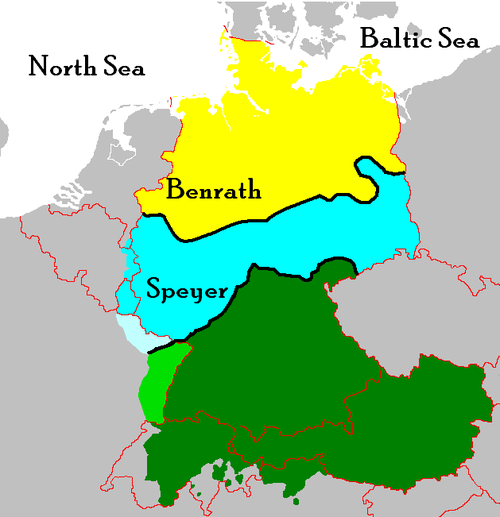
Although the boundaries of the dialects have shifted since the Old High German period, the degree to which dialects underwent the High German consonant shift continues to form the basis for differentiating the different modern German dialects, and, in particular, for the division between Central German dialects, which have fewer shifted consonants, and Upper German dialects, which have more.[37] The gradually increasing application of the shift from north to south is most extensive in the west. Here, the isoglosses defined by the occurrence of individual shifts are spread out in a fan-like manner, forming the Rheinischer Fächer ('Rhenish fan').[38][39]
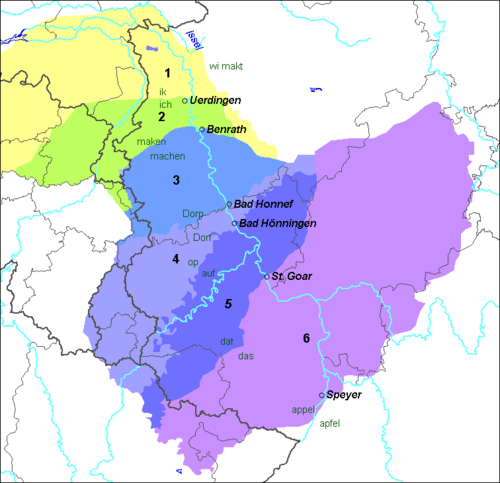
The northern border for the occurrence of the shift of /t/ to /(t)s/ in all positions (except in absolute final position in pronouns like dat, wat and the neuter ending -t) and the shift of /p/ and /k/ to /f/ and /x/ in intervocalic and root-final position is the Benrath line that separates the High German dialects to the south from the Low Saxon and Low Franconian dialects to the north.[39] Further north, the consonant shift is only found with the adverb auch 'also' and a handful of pronouns that have final /k/ shifted to /x/ (ich 'I', dich 'thee', mich 'me') in the South Low Franconian dialect area, whose northern border is the Uerdingen line.[40][p]
The shift of /p/ to /f/ after consonants (e.g. helpan > helfen 'help') sets off Moselle Franconian dialects from Ripuarian dialects, which retain unshifted /p/. The shift of /t/ to /s/ in wat, dat > was, das etc. characterizes Rhine Franconian.[39] The shift of root-initial and historically geminated /p/ to /pf/ (Pund > Pfund 'pound', Appel > Apfel 'apple') marks the transition from the West Central German to the Upper German dialects. East Central German is separated from West Central German through having shifted initial p (the "Pund-Fund" line); only far southern East Central German dialects retain initial /pf-/, whereas other East Central German dialects have simplified it to initial /f-/.[42][43][44] The shift of root-initial and historically geminated /k/ to /kx/ (and further to /x/, as in Kind > Chind) occurs in the southern part of the Upper German dialect area.[42]
↑The shift of voiceless to voiced stops is reversed in many Upper and Central German dialects by a process of lenition, beginning around 1300 in parts of Bavarian.[7]
↑ Prior to this shift, the West Germanic fricatives /ðβɣ/ had shifted to /dbg/ in all positions except in the Central German Middle Franconian dialect, where /β/ and /ɣ/ remained.[25] In many other German dialects, /ɡ/ and /b/spirantize word internally; however, this appears to be later development, as shown by their partaking in final devoicing as stop consonants rather than fricatives.[26]
↑In Middle High German, the sequence /nt/ mostly changes to /nd/, as found in modern standard German: Middle High German: binden vs. Old High German: bintan.[29]
↑ The lack of a return of shifted /t/ (=earlier /d/) to /d/ in those dialects that underwent the shift is likely related to the subsequent shift of /þ/ (=/θ) to /d/ throughout the West Germanic area.[31]
↑In modern dialects, the shift is further disguised in northern Bavarian and Alemannic dialects by inner-German lenition, a shift of /tpk/ to /dbɡ/ that takes place after 1350.[33]
↑A special case is observed in the dialect of Wermelskirchen, where the Benrath and Uerdingen lines meet. Here, in addition to the South Low Franconian shift of absolute final /k/ to /x/ in ich etc., intervocalic and root-final /p/, /t/ and /k/ undergo a shift only when preceded by a historically short high or mid vowel (e.g. etan > esən 'eat'), and remain unshifted after long vowels, diphthongs and the low vowels /a/ and /aː/, and also in all other positions (e.g. laːtan > lɔːtən 'let').[40] This phonologically conditioned distribution of shifted and unshifted voiceless stops is highly regular and not the result of lexical diffusion; it even occurs in the conjugation paradigms of strong verbs, e.g. riːtən 'tear' vs. jəresən 'torn'; jriːpən 'seize' vs. jəjrefən 'seized'.[41]
Davis, Garry W. (2005). "Entstehung und Alter der Hochdeutschen Lautverschiebung in Wermelskirchen". Zeitschrift für Dialektologie und Linguistik. 72 (3): 257–277. JSTOR40505392.
Ebert, Robert P.; Reichmann, Oskar; Solms, Hans-Joachim; Wegera, Klaus-Peter (1993). Ebert, Robert P.; Reichmann, Oskar; Solms, Hans-Joachim; Wegera, Klaus-Peter (eds.). Frühneuhochdeutsche Grammatik. de Gruyter. doi:10.1515/9783110920130. ISBN978-3-484-10672-7.
Fulk, R.D. (2018). A Comparative Grammar of the Early Germanic Languages. Studies in Germanic Linguistics. Vol.3. John Benjamins. doi:10.1075/sigl.3. ISBN978-90-272-6312-4.
Höder, Steffan (2015) [2013]. "Zweite Lautverschiebung". Wörterbücher zur Sprach- und Kommunikationswissenschaft (WSK) Online.
Iverson, Gregory K.; Salmons, Joseph C. (2006). "Fundamental Regularities in the Second Consonant Shift". Journal of Germanic Linguistics. 18 (1): 45–70. doi:10.1017/S147054270600002X.
König, Werner (1994). dtv-Atlas zur deutschen Sprache (10ed.). Deutscher Taschenbuch Verlag.