Loading article…
物理学と数学において、ジョサイア・ウィラード・ギブスにちなんで名付けられたギブス測度は、確率論、統計力学、力学系の多くの問題で頻繁に見られる確率測度である。[ 1 ]これは、正準アンサンブルを無限系に一般化したものである。正準アンサンブルは、システムXが状態xにある確率(あるいは、確率変数Xが値xを持つ確率)を次のように表す。
ここで、Eは状態空間から実数への関数です。物理学の応用では、E ( x )は構成xのエネルギーとして解釈されます。パラメータβは自由パラメータです。物理学では、逆温度です。正規化定数Z ( β )は分配関数です。しかし、無限系では、全エネルギーはもはや有限数ではなく、正準アンサンブルの確率分布の従来の構成には使用できません。統計物理学の従来のアプローチでは、有限系のサイズが無限に近づくときの示強性の極限 (熱力学的極限) を研究しました。エネルギー関数が、それぞれ有限部分系からの変数のみを含む項の和として書ける場合、ギブス測度の概念は別のアプローチを提供します。ギブス測度は、ドブルシン、ランフォード、リュエルなどの確率論者によって提案され、有限系の極限を取る代わりに、無限系を直接研究するための枠組みを提供しました。
測度がギブス測度であるのは、それが各有限部分系に誘導する条件付き確率が整合性条件を満たす場合である。すなわち、有限部分系の外側のすべての自由度が固定されている場合、これらの境界条件に従う部分系の正準アンサンブルは、固定された自由度を条件とするギブス測度の確率と一致する。
The Hammersley–Clifford theorem implies that any probability measure that satisfies a Markov property is a Gibbs measure for an appropriate choice of (locally defined) energy function. Therefore, the Gibbs measure applies to widespread problems outside of physics, such as Hopfield networks, Markov networks, Markov logic networks, and boundedly rational potential games in game theory and economics. A Gibbs measure in a system with local (finite-range) interactions maximizes the entropy density for a given expected energy density; or, equivalently, it minimizes the free energy density.
The Gibbs measure of an infinite system is not necessarily unique, in contrast to the canonical ensemble of a finite system, which is unique. The existence of more than one Gibbs measure is associated with statistical phenomena such as symmetry breaking and phase coexistence.
The set of Gibbs measures on a system is always convex,[2][3] so there is either a unique Gibbs measure (in which case the system is said to be "ergodic"), or there are infinitely many (and the system is called "nonergodic"). In the nonergodic case, the Gibbs measures can be expressed as the set of convex combinations of a much smaller number of special Gibbs measures known as "pure states" (not to be confused with the related but distinct notion of pure states in quantum mechanics). In physical applications, the Hamiltonian (the energy function) usually has some sense of locality, and the pure states have the cluster decomposition property that "far-separated subsystems" are independent. In practice, physically realistic systems are found in one of these pure states.
If the Hamiltonian possesses a symmetry, then a unique (i.e. ergodic) Gibbs measure will necessarily be invariant under the symmetry. But in the case of multiple (i.e. nonergodic) Gibbs measures, the pure states are typically not invariant under the Hamiltonian's symmetry. For example, in the infinite ferromagnetic Ising model below the critical temperature, there are two pure states, the "mostly-up" and "mostly-down" states, which are interchanged under the model's symmetry.
マルコフ性の例は、イジングモデルのギブス測度に見られる。あるスピンσkが状態sにある確率は、原理的には、システム内の他のすべてのスピンの状態に依存する可能性がある。したがって、確率は次のように書ける。
しかし、有限範囲の相互作用(例えば、最近接相互作用)のみを持つイジングモデルでは、実際には
ここでN kはサイトkの近傍です。つまり、サイトkでの確率は有限近傍のスピンのみに依存します。この最後の式は局所マルコフ特性の形をしています。この特性を持つ測度は、マルコフランダム場と呼ばれることがあります。より強く言えば、その逆も真です。マルコフ特性を持つ任意の正の確率分布 (密度がどこでもゼロでない) は、適切なエネルギー関数のギブス測度として表すことができます。[ 4 ]これはハマーリー・クリフォードの定理です。
以下は、格子上のランダム場という特殊な場合に対する正式な定義である。しかし、ギブス測度の概念は、これよりもはるかに一般的である。
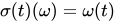
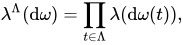
格子上のギブスランダム場の定義には、いくつかの用語が必要となる。
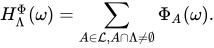
Φ A は、有限集合Aのすべての点間の相互作用に関連する全エネルギー (ハミルトニアン) への寄与として解釈されます 。満たすすべての有限集合Aの全エネルギーへの寄与として総エネルギーは通常無限大ですが、各それは有限であるべきだと、私たちは願っている。
上記の定義を理解するために、最近接相互作用(結合定数J)と磁場(h)を持つイジングモデルの重要な例における、 Z d上の対応する量を以下に示します。