
Loading article…
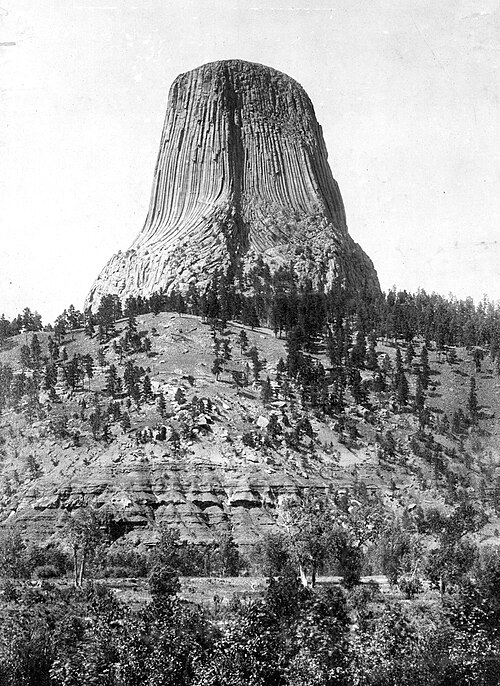
Devils Tower (also known as Matȟó Thípila or Bear Lodge)[8] is a laccolithicbutte, composed of igneous rock in the Bear Lodge Ranger District of the Black Hills, near Hulett and Sundance in Crook County, northeastern Wyoming, above the Belle Fourche River. It rises 1,267 feet (386 m) above the Belle Fourche River, standing 867 ft (264 m) from summit to base. The summit is 5,112 ft (1,558 m) above sea level.
Devils Tower National Monument was the first United States national monument, established on September 24, 1906, by President Theodore Roosevelt.[9] The monument's boundary encloses an area of 1,347 acres (545 ha).
Indigenous names for the monolith include Bear's House or Bear's Lodge (or Bear's Tipi, Home of the Bear, Bear's Lair); Cheyenne, Lakota: Matȟó Thípila, Crow: Daxpitcheeaasáao (Home of Bears[10]), Aloft on a Rock (Kiowa), Tree Rock, Great Gray Horn,[11] and Brown Buffalo Horn (Lakota: Ptehé Ǧí).
The name "Devil's Tower" originated in 1875 during an expedition led by Colonel Richard Irving Dodge, when his interpreter reportedly misinterpreted a native name to mean "Bad God's Tower".[11] All information signs in that area use the name "Devils Tower", following a geographic naming standard whereby the apostrophe is omitted.[12]
2005年、モノリスをベア・ロッジ国立歴史建造物として追加指定することで先住民とのつながりを認める提案に対し、米国下院議員バーバラ・キュービンは「名称変更は観光業に悪影響を与え、地域社会に経済的困難をもたらす」と主張し反対した。[ 13 ] 2014年11月、アーボル・ルッキング・ホースは地理的特徴を「ベア・ロッジ」と改名することを提案し、米国地名委員会に要請を提出した。2度目の提案では、米国が現在の名称を維持することは「不快な」間違いであると認め、記念碑と聖地をベア・ロッジ国立歴史建造物に改名するよう要請した。正式なパブリックコメント期間は2015年秋に終了した。地元州上院議員オグデン・ドリスキルは変更に反対した。[ 14 ] [ 15 ]名称は変更されなかった。

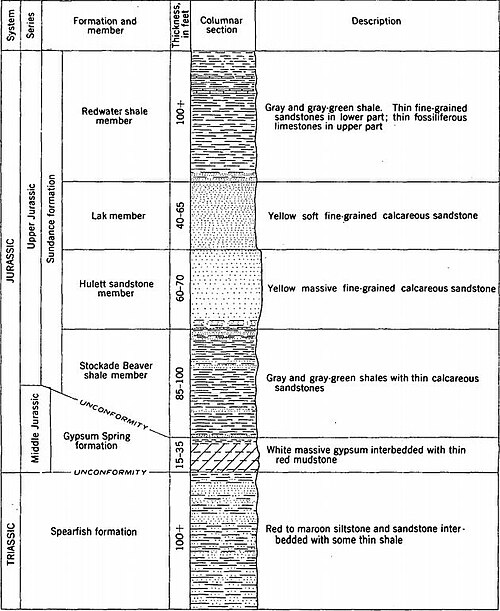
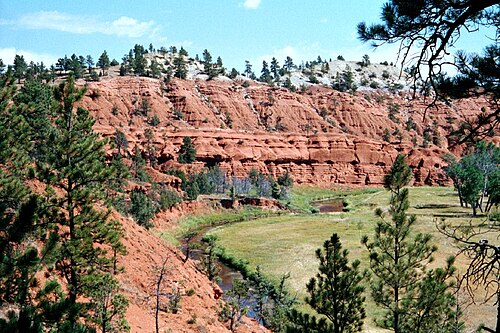
デビルズタワー周辺の景観は、主に堆積岩で構成されています。デビルズタワー国定公園で見られる最も古い岩石は、三畳紀に浅い海で堆積したものです。[ 16 ]この暗赤色の砂岩と栗色のシルト岩は、頁岩と互層をなしており、ベル・フォーシュ川沿いで見ることができます。鉄鉱物の酸化により、岩石が赤くなっています。この岩層は、スピアフィッシュ層として知られています。スピアフィッシュ層の上には、ジュラ紀の白い石膏の薄い層があり、ジプサムスプリングス層と呼ばれています。この層の上には、サンダンス層があります。[ 17 ]暁新世、5600万年前から6600万年前、ロッキー山脈とブラックヒルズが隆起しました。[ 16 ]マグマが地殻を上昇し、既存の堆積岩層に貫入しました。[ 16 ]
Geologists Carpenter and Russell studied Devils Tower in the late 19th century and came to the conclusion that it was formed by an igneousintrusion.[18] In 1907, geologists Nelson Horatio Darton and C.C. O'Harra (of the South Dakota School of Mines) theorized that Devils Tower must be an eroded remnant of a laccolith.[19]
The igneous material that forms the tower is a phonoliteporphyry intruded about 40.5 million years ago,[20] a light- to dark-gray or greenish-gray igneous rock with conspicuous crystals of white feldspar.[21] As the magma cooled, hexagonalcolumns formed (though sometimes four-, five-, and seven-sided columns were possible), up to 20 ft (6.1 m) wide and 600 ft (180 m) tall.
As rain and snow continue to erode the sedimentary rocks surrounding the tower's base, more of Devils Tower will be exposed. Nonetheless, the exposed portions of the tower still experience erosion. Cracks along the columns are subject to water and ice erosion. Portions, or even entire columns, of rock at Devils Tower are continually breaking off and falling. Piles of broken columns, boulders, small rocks, and stones, called scree, lie at the base of the tower, indicating that it was once wider than it is today.[16]
The geologically related Missouri Buttes are located 3.5 mi (5.6 km) northwest of Devils Tower.
デビルズタワーは、数多くの地質神話の着想源となった。
According to the traditional beliefs of Native American peoples, the Kiowa and Lakota, several girls went out to play and were spotted by several giant bears that began to chase them. To escape the bears, the girls climbed atop a rock, fell to their knees, and prayed to the Great Spirit to save them. Hearing their prayers, the Great Spirit made the rock rise from the ground towards the heavens so that the bears could not reach the girls. The bears, to climb the rock, left deep claw marks in the sides, which had become too steep to climb. Those marks appear today on the sides of Devils Tower. When the girls reached the sky, they were turned into the stars of the Pleiades.[24]
Another version tells that two Sioux boys wandered far from their village when Mato the bear, a huge creature that had claws the size of tipi poles, spotted them, and wanted to eat them for breakfast. He was almost upon them when the boys prayed to Wakan Tanka the Creator to help them. They rose up on a huge rock, while Mato tried to get up from every side, leaving huge scratch marks as he did. Finally, he sauntered off, disappointed and discouraged. The bear came to rest east of the Black Hills at what is now Bear Butte. Wanblee, the eagle, helped the boys off the rock and back to their village. A painting depicting this legend by artist Herbert A. Collins hangs over the fireplace in the visitor center at Devils Tower.
In a Cheyenne version of the story, the giant bear pursues the girls and kills most of them. Two sisters escape back to their home with the bear still tracking them. They tell two boys that the bear can only be killed with an arrow shot through the underside of its foot. The boys have the sisters lead the bear to Devils Tower and trick it into thinking they have climbed the rock. The boys attempt to shoot the bear through the foot while it repeatedly attempts to climb up and slides back down, leaving more claw marks each time. The bear was finally scared off when an arrow came very close to its left foot. This last arrow continued to go up and never came down.[25]
Wooden Leg, a Northern Cheyenne, recounted another legend told to him by an old man while they were traveling together past Devils Tower around 1866–1868. An indigenous man decided to sleep at the base of Bear Lodge next to a buffalo head. In the morning, he discovered that both the buffalo head and he had been transported to the top of the rock by the Great Medicine, with no way to descend. He spent another day and night on the rock without food or water. After praying all day and then going to sleep, he awoke to find that the Great Medicine had brought him back down to the ground, but had left the buffalo head at the top near the edge. Wooden Leg asserted that the buffalo head was clearly visible through the old man's spyglass. At that time, the tower had never been climbed, and a buffalo head at the top was otherwise inexplicable.[26] The buffalo head gives this story special significance for the Northern Cheyenne. All the Cheyenne maintained in their camps a sacred teepee to the Great Medicine containing the tribal sacred objects. In the case of the Northern Cheyenne, the sacred object was a buffalo head.[27]
N. Scott Momaday (Kiowa) was given the name Tsoai-talee (Rock Tree Boy) by Pohd-lohk, a Kiowa elder, linking the child to the Devils Tower bear myth. To reinforce this mythic connection, his parents took him there.[28] Momaday incorporated the bear myth as unifying subtext into his 1989 novel The Ancient Child.[29]
Fur trappers may have visited Devils Tower, but they left no written evidence of having done so. The first documented nonindigenous visitors were members of Captain William F. Raynolds's 1859 expedition to Yellowstone. Sixteen years later, Colonel Richard I. Dodge escorted an Office of Indian Affairs scientific survey party to the massive rock formation and coined the name Devils Tower.[30] Recognizing its unique characteristics, the United States Congress designated the area a U.S. forest reserve in 1892, and in 1906, Devils Tower became the nation's first national monument.[31]
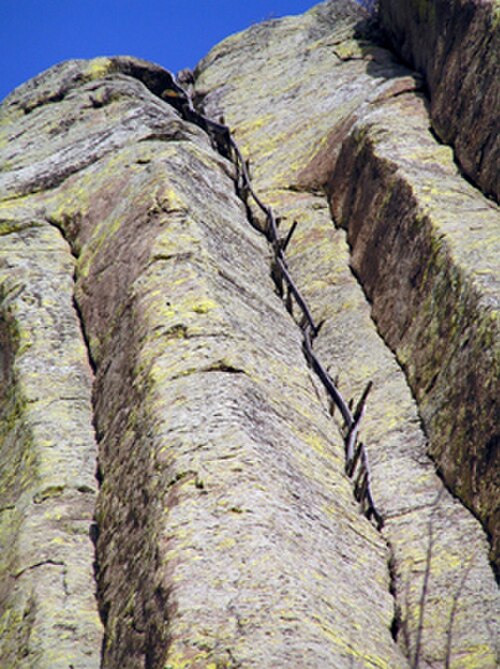
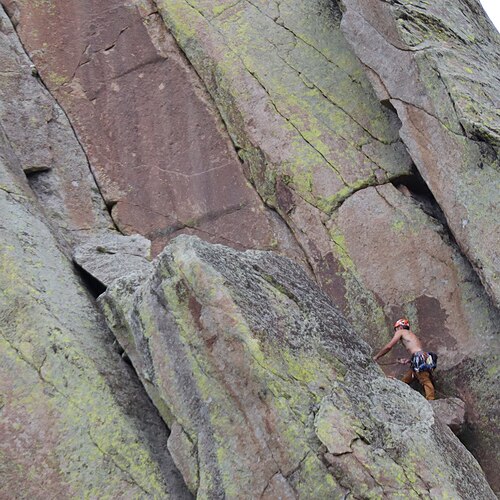

1994年現在、デビルズタワーへの登山は人気が高まっている。同国定公園の年間訪問者40万人のうち約1.3%がデビルズタワーに登り、そのほとんどが伝統的な登山技術を使用している。[ 32 ]どのような方法であれ、デビルズタワーへの最初の登頂は1893年7月4日に行われ、地元の牧場主であるウィリアム・ロジャースとウィラード・リプリーによるものとされている。彼らは岩壁の割れ目に打ち込んだ木の杭で梯子を作り、この最初の登頂を完了した。これらの木の杭のいくつかは今でも無傷で、デビルズタワー国定公園の1.3マイル(2.1km )のタワートレイルをハイキングすると、タワー上で見ることができる。その後30年間、この梯子を使って多くの登山が行われたが、その後、梯子は荒廃した。
近代的な登山技術を用いた初登攀は、 1937年にフリッツ・ヴィースナーがウィリアム・P・ハウス、ローレンス・コヴェニーと共に達成した。ヴィースナーはほぼ全行程をフリークライミングで登攀し、固定具としてピトンを1本だけ使用したが、後にそれを不必要だったとして後悔した。
1941年、ジョージ・ホプキンスは賭けの結果、宣伝目的で許可なくデビルズタワーにパラシュート降下した[ 33 ] 。彼は、岩山に無事着地した後、投下される1,000フィート(300メートル)のロープで降下するつもりだったが、ロープ、大ハンマー、アンカーポイントとして岩に打ち込む自動車の車軸が入った荷物が崖から滑り落ちてしまった。天候が悪化するにつれ、装備を投下する2度目の試みが行われたが、ロープが雨と風で絡まり凍ってしまったため、ホプキンスは使用不可能と判断した。ホプキンスは6日間、寒さ、雨、時速50マイル(80キロ)の風にさらされ、1938年にデビルズタワー登頂に成功したジャック・デュランス率いる山岳救助隊がようやく彼を見つけ、下ろすまで、孤立していた。[ 34 ] [ 35 ]彼の罠にかかり救出されたことは、報道機関によって広く報道された。[ 36 ]
Today, hundreds of climbers scale the sheer rock walls of Devils Tower each summer. The most common route is the Durrance Route, which was the second free-climbing route, established in 1938. Many established and documented climbing routes cover every side of the tower, ascending the various vertical cracks and columns of the rock. The difficulty of these routes ranges from relatively easy to some of the most challenging in the world. All climbers are required to register with a park ranger before and after attempting a climb. No overnight camping at the summit is allowed; climbers must return to base on the same day they ascend.[37]
The Tower is sacred to several Plains tribes, including the Lakota, Cheyenne, and Kiowa. Because of this, many Native American leaders object to climbers ascending the monument, considering this to be a desecration. The climbers have argued that they have a right to climb the tower, since it is on federal land. A compromise eventually reached enacted a voluntary climbing ban during June, when the tribes conduct ceremonies around the monument and climbers are asked, but not required, to stay off the tower. According to the PBS documentary In the Light of Reverence, about 85% of climbers honor the ban and voluntarily choose not to climb the tower during June, but several climbers along with the Mountain States Legal Foundation have sued the Park Service, claiming an inappropriate government entanglement with religion.[38][39]
Seven people have died climbing Devils Tower in the park's 119-year history. Rescues of stranded and underequipped climbers on the formation are common.[40] The most recent fatality was in September 2024, when a climber fell to his death while descending, leaving his climbing partner stranded without a rope on the face of the tower until help arrived.[41]
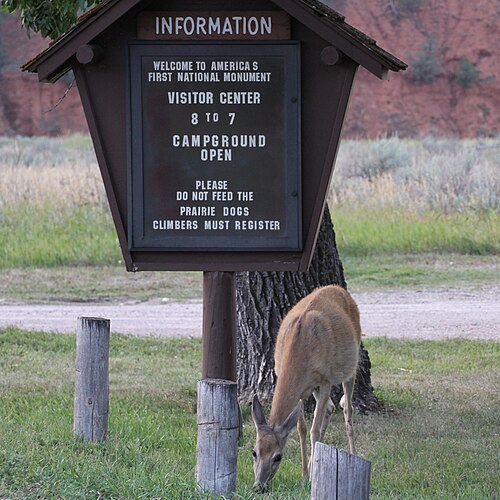
Devils Tower National Monument protects many species of wildlife, such as white-tailed deer, prairie dogs, and bald eagles.[42][43]
The 1977 movie Close Encounters of the Third Kind used the formation as a plot element and as the location of its climactic scenes.[44][45] The film's popularity resulted in a large increase in visitors to the monument and climbers of it.[46]
デビルズタワー国定公園のうち、4つの区域が国家歴史登録財に登録されている。


