
Loading article…

動物性接着剤は、レンダリングと呼ばれる工程で動物の結合組織を長時間煮沸することによって作られる接着剤です。[ 1 ]接着剤として使用されるほか、コーティングやサイジング、装飾的な構成装飾、および透明化剤としても使用されます。[ 1 ]
これらのタンパク質コロイド接着剤は、ゼラチンと同様に、皮膚、骨、腱、その他の組織由来のコラーゲンの加水分解によって形成されます。コラーゲンという言葉自体は、ギリシャ語のκόλλα(kolla )に由来し、「接着剤」を意味します。これらのタンパク質は、接着対象物と分子結合を形成します。[ 2 ]
典型的には、問題の動物は馬であり、安楽死させられた馬はしばしば「接着剤工場に送られた」と言われる。しかし、牛[ 3 ] 、ウサギ、魚[ 4 ]など、他の動物も使用されている。
動物性接着剤は古代から存在していたが、広く使われていたわけではなかった。馬の歯から作られた接着剤は6000年近く前に遡ることができるが、当時の記録には、それが完全に、あるいは広範囲に使われていたことを証明するものはない。[ 5 ]
動物性接着剤の製造手順が最初に文書化されたのは紀元前2000年頃である。紀元前1500年から1000年の間に、木製の家具や壁画に使用され、エジプトのファラオの棺にも使用されていることが確認されている。[ 6 ]証拠としては、接着剤の調製と使用を描いた石の彫刻があり、主にファラオの墓の家具に使用された。[ 7 ]エジプトの記録によると、動物性接着剤は火で溶かして作られ、ブラシで塗布された。[ 8 ]
古代ギリシャ人とローマ人は後に動物性接着剤や魚性接着剤を使って、薄い木片や層を接着するベニヤリングや象嵌細工を発展させた。 [ 6 ]ギリシャ語でタウロコラ(ταυρόκολλα) 、ラテン語でグルテン・タウリヌムとして知られる動物性接着剤は、古代には雄牛の皮から作られていた。[ 9 ]割れた陶器も動物性接着剤を使って修復され、ひび割れを埋めて欠陥を隠すことができた。[ 10 ]
紀元前 906 ~ 618 年頃、中国では魚、牛の角、鹿の角が接着剤や顔料の結合剤として使われていました。[ 11 ]唐の時代には動物性接着剤が絵具の結合剤として使われていました。兵馬俑にも同様に使われていました。[ 12 ]記録によると、煤墨の主要成分の一つはタンパク質性の接着剤でした。牛の接着剤や鹿の角の接着剤は顔料の粒子を結合させ、墨が乾燥するにつれて表面に膜を形成することで防腐剤としても機能しました。[ 9 ]饒公記などの中国人は、接着剤を薬用としても研究していました。[ 13 ]
動物性接着剤やその他の種類の接着剤の使用は、西ローマ帝国の衰退後、16世紀から18世紀にかけて木製家具が主要な工芸品として台頭するまで、ヨーロッパではほとんど見られなくなりました。[ 6 ]中世には、魚膠は絵画や写本の装飾の材料として使われ続けました。[ 14 ] 16世紀以降、動物性接着剤はバイオリンの製作に使われるようになりました。[ 7 ]
アメリカ先住民は、主に動物の残骸から煮詰めた蹄膠を、露出した表面に塗布することで、結合剤や防水コーティングとして使用していました。また、動物の皮に顔料を塗布してなめした後、模様をつけるために動物の皮膠を塗料として使用することもありました。[ 15 ]蹄膠は、毛髪の保存料など、皮以外の用途にも使用されました。アッシニボイン族は長い髪を好んだため、赤い土と蹄膠の混合物で髪の毛を塗り固めていました。[ 16 ]また、羽毛や道具をまとめるためにも使用されました。[ 17 ]

The first commercial glue factory opened in Holland circa 1700, manufacturing animal glue from hides.[6] The United States' first glue factory opened in 1899, established by the Milwaukee Tanning Industry.[5] The L.D. Davis company thrived producing animal glue during the Great Depression after shifting its focus from stenciling, selling to local box makers and other users. L.D. Davis' animal glue formula for bookbinding remains in production.[18] During the 18th and 19th centuries, ranchers disposed of old animals – horses in particular – to glue factories. The advent of synthetic adhesives heralded the collapse of the animal glue industry.
Today, animal glues are sparsely industrialized, but still used for making and restoring violin family instruments, paintings, illuminated parchment manuscripts, and other artifacts.[9]Gelatin, a form of animal glue, is found in many contemporary products, such as gelatin desserts, marshmallows, pharmaceutical capsules,[19] and photographic film and is used to reinforce sinew wrappings, wood, leather, bark and paper. Hide glue is also preferred by many luthiers over synthetic glues for its reversibility, creep-resistance and tendency to pull joints closed as it cures.
This adhesive is mostly used as glue, sizing, or varnish, although it is not as frequently used as other adhesives because it is water-soluble. Other aspects, such as difficulty of storage in a wet state, requirement for fresh raw materials (the animal skin cannot be rotten or grease-burned), make this product more difficult to obtain and use. Factories now produce other forms of adhesives, as the process for animal glue is complex.[20] Animal glues will also darken with age and shrink as they dry, giving them the potential to harm wood, paper, or works of art. Too much handling and too many changes in temperature or humidity could cause further harm.[10] Some companies, such as those in Canada, still produce animal, hide and hoof glues from horses. Recently, animal glue has been replaced by other adhesives and plastics, but remains popular for restoration.
動物性接着剤は、20世紀にポリ酢酸ビニル(PVA)などの合成接着剤やその他の樹脂系接着剤が登場するまで、何千年もの間、最も一般的な木工用接着剤でした。今日では、主に弦楽器製作、パイプオルガン製作、ピアノ修理、アンティーク修復などの特殊な用途で使用されています。ガラス工芸家は、動物性接着剤がガラスと接着する性質を利用しています。接着剤が硬化すると収縮し、ガラスを欠けさせるのです。
他の接着剤と比較すると、いくつかの利点と欠点があります。接着剤は熱いうちに塗布され、通常はブラシやヘラで塗布されます。接着剤は接着剤ポットで温められ、専用の電気ユニット、二重鍋、または単にソースパンやクロックポットを使用して接着剤の容器を温水浴させます。ほとんどの動物性接着剤は水溶性で、いずれ分離する必要が生じる可能性のある接合部に役立ちます。 [ 21 ]接着剤を脱水してより脆くし、分離しやすくするために、このような接合部にアルコールを塗布することがあります。蒸気を使用して接着剤を柔らかくし、接合部を分離することもできます。
具体的な種類としては、動物性接着剤、骨接着剤、魚膠、ウサギ皮接着剤などがある。
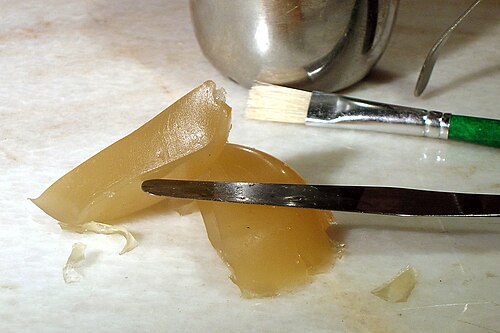

動物の皮(動物の皮)から作られた動物性接着剤は、木工によく使われます。顆粒、フレーク、または平らなシートの形で供給され、乾燥した状態で保管すれば保存期間は無期限です。水に溶かして加熱し、温かい状態で塗布します。通常、約 60 °C (140 °F) です。温度が高すぎると、動物性接着剤の強度がすぐに低下します。[ 22 ]接着剤を使用中に温かく保つために、市販の接着剤ポット、簡単な湯煎、または二重鍋を使用できます。動物性接着剤は冷えるとすぐにゲル化します。室温では、調製された動物性接着剤は固いゼラチンのような粘稠度を持ち、実際には組成が似ています。ゲル化した動物性接着剤は強度があまりないため、接着剤の温度が 50 °C (120 °F) を大きく下回る前に、接着剤を塗布し、部品をはめ込み、固定しておくことが重要です。すべての接着剤にはオープンタイムがあり、接着剤が液体で作業可能な状態を保つ時間です。オープンタイムが過ぎてから部品を接合すると、接着力が弱くなります。ニカワのオープンタイムは通常1分以下です。実際には、接着する部品を加熱し、非常に暖かい部屋で接着する必要があることが多いのですが[ 23 ] 、接着とクランプの作業を迅速に行える場合は、これらの手順を省略できます。
にかわが時折使用される場合、余った接着剤は微生物の増殖による腐敗を防ぐために冷凍庫に保管されることがあります。にかわには隙間を埋める性質がありますが[ 24 ]、エポキシ樹脂などの現代の隙間充填接着剤の方がこの点では優れています。
尿素を添加することで、室温で液体の動物性接着剤を作ることも可能です。Fine Woodworking MagazineのMark Schofield氏が行った強度試験では、「液体動物性接着剤」は、接着強度の平均において通常の動物性接着剤[ 25 ]と遜色ない結果を示しました。「しかし、製造時に様々な殺菌剤や防カビ剤で『保護』されていても、尿素が最終的に接着剤のタンパク質構造を加水分解して弱体化させるため、6か月以上経過した液体動物性接着剤は疑わしい可能性があります。」[ 22 ]
動物の皮を水に浸して「ストック」を作る。次に、ストックに石灰を加えて皮を分解する。その後、皮をすすいで石灰を取り除き、残った石灰は弱酸溶液で中和する。皮を水中で70 ℃(158 °F)前後の温度に厳密に制御しながら加熱する。「糊液」を抜き取り、さらに水を加えて、温度を上げながらこの工程を繰り返す。
接着剤液はその後乾燥され、ペレット状に砕かれる。[ 26 ]
動物性接着剤の大きな欠点、すなわち耐熱性の限界、短い可使時間、微生物に対する脆弱性は、いくつかの利点によって相殺されます。動物性接着剤による接合部は可逆的で修復可能です。接着直後の接合部は、熱と蒸気を加えることで容易に剥がすことができます。動物性接着剤は自己接着性があるため、修復者は接合部に新しい動物性接着剤を塗布して再度クランプすることができます。これに対し、PVA接着剤は硬化すると自己接着しなくなるため、修復を成功させるにはまず古い接着剤を除去する必要があり、そのためには通常、接着する材料の一部を除去する必要があります。
Hide glue creates a somewhat brittle joint, so a strong shock will often cause a very clean break along the joint. In contrast, cleaving a joint glued with PVA will usually damage the surrounding material, creating an irregular break that is more difficult to repair. This brittleness is taken advantage of by instrument makers. For example, instruments in the violin family require periodic disassembly for repairs and maintenance. The top of a violin is easily removed by prying a palette knife between the top and ribs, and running it all around the joint. The brittleness allows the top to be removed, often without significant damage to the wood. Regluing the top only requires applying new hot hide glue to the joint. If the violin top were glued on with PVA glue, removing the top would require heat and steam to disassemble the joint (causing damage to the varnish), then wood would have to be removed from the joint to ensure no cured PVA glue was remaining before regluing the top.
Hide glue also functions as its own clamp. Once the glue begins to gel, it pulls the joint together. Violin makers may glue the center seams of top and back plates together using a rubbed joint rather than using clamps. This technique involves coating half of the joint with hot hide glue, and then rubbing the other half against the joint until the hide glue starts to gel, at which point the glue becomes tacky. At this point the plate is set aside without clamps, and the hide glue pulls the joint together as it hardens.
Hide glue regains its working properties after cooling if it is reheated. This property can be used when the glue's open time does not allow the joint to be glued normally. For example, a cello maker may not be able to glue and clamp a top to the instrument's ribs in the short one-minute open time available. Instead, the builder will lay a bead of glue along the ribs, and allow it to cool. The top is then clamped to the ribs. Moving a few inches at a time, the maker inserts a heated palette knife into the joint, heating the glue. When the glue is liquefied, the palette knife is removed, and the glue cools, creating a bond. A similar process can be used to glue veneers to a substrate. The veneer and/or the substrate is coated with hot hide glue. Once the glue is cold, the veneer is positioned on the substrate. A hot object such as a clothes iron is applied to the veneer, liquefying the underlying glue. When the iron is removed, the glue cools, bonding the veneer to the substrate.
Hide glue joints do not creep under loads. PVA glues create plastic joints, which will creep over time if heavy loads are applied to them.
Hide glue is supplied in many different gram strengths, each suited to specific applications. Instrument and cabinet builders will use a range from 120 to 200 gram strength. Some hide glues are sold without the gram strength specified. Experienced users avoid this glue as the glue may be too weak or strong for the expected application.
Rabbit-skin glue is more flexible when dry than typical hide glues. It is used in the sizing or priming of oil painters' canvases. It also is used in bookbinding and as the adhesive component of some recipes for gesso and compo.
Fish glue is made from the bones or tissues of fish. Isinglass is made specifically from the swim bladders, and is collagen-based. Fish glues were used in Ancient Egypt and Classical Antiquity in the Mediterranean; they continued to be used in Europe in Late Antiquity and the Medieval period, and are still used in niche applications today. It is brittle when dried, so it has sometimes been mixed with plasticizers such as molasses and honey. It was used in art, book binding,[27] woodworking, lutherie, and for gluing paper and bone.[28]
Isinglass is a superlative grade of fish glue made by washing and drying the inner layers of the sounds (swimming bladders) of fish. The best grade, Russian isinglass, is obtained from the sturgeon.