
Loading article…

マグナウラ宮殿ホール大学としても知られるコンスタンティノープル帝国大学(ギリシャ語: Πανδιδακτήριον τῆς Μαγναύρας ) は、コンスタンティノープルにあった東ローマの教育機関で、その起源は、皇帝テオドシウス 2 世が大学を設立した西暦 425 年まで遡ることができます。パンディダクテリオン (またはパンディダクテリウム) (中世ギリシャ語: Πανδιδακτήριον )。[ 1 ]
パンディダクトリオンは、1045年[ 2 ]または1046年[ 3 ]にコンスタンティノス9世モノマコスによって再編され、法学部(Διδασκαλεῖον τῶν Νόμων)と哲学部(Γυμνάσιον)が創設された[ 4 ] 。この再編により「真の」大学となり[ 5 ]、そのため、歴史上最初の大学とみなされることもある[ 6 ] 。
コンスタンティノープルがラテン帝国に占領されていた時期(1204年~1261年)には、高度な学問はほとんど存在しなかったが、[ 7 ]パレオロゴス朝ルネサンスが始動し、市内には様々な経済学校、大学、工科大学、図書館、美術アカデミーが開設された。 [ 8 ] [ 7 ] [ 9 ] [ 10 ]コンスタンティノープル大学を含むこれら全ては、コンスタンティノープルがオスマン帝国に陥落した後に閉鎖された。[ 11 ]
ビザンツ社会は概して教育水準の高い社会であった。初等教育は広く普及しており、村レベルでも行われていたことがあり、また、当時としては珍しく男女両方が教育を受けていた。女性の文化への参加率は比較的高かった。学問はコンスタンティノープルだけでなく、アンティオキアやアレクサンドリアなどの主要都市で運営されていた機関でも奨励されていた。[ 12 ]
元々の学校はパンディダクトリオンと呼ばれ、425年に皇帝テオドシウス2世によってコンスタンティノープルのカピトリウムに設立され、31の講座がありました。ギリシャ語とラテン語の文法にそれぞれ10講座、法律に2講座、哲学に1講座、修辞学に8講座があり、そのうち5講座はギリシャ語で、3講座はラテン語で教えられていました。[ 13 ] [ 14 ]合計で、ラテン語に15講座、ギリシャ語に16講座がありました。[ 6 ] 1045/1046年以前のパンディダクトリオンの唯一の目的は、国家の行政のための公務員を教育することでした。[ 5 ] [ 15 ]しかし、1045/1046年に再編成され、法学部と哲学学部の2つの学部に分けられました。これらは別の建物に収容されました。[ 2 ]その名称にもかかわらず、これらの学校では法律や哲学だけでなく、地理、音楽、天文学、修辞学、文法、弁論術なども教えていました。[ 2 ]著名な教師には、ミカエル・プセロス、ヨハネス・クシフィリノス、ヨハネス・イタロス、ニカイアのエウストラティオス、エフェソスのミカエル、ヨハネス・マウロポウスなどがいました。[ 2 ]
ほとんどの学生にとって高等教育の主な内容は、修辞学、哲学、法律であり、その目的は、国家や教会の官僚機構を担う有能で博識な人材を育成することであった。この意味で、大学は神学校の世俗版と言える。大学はプラトン主義とアリストテレス主義の活発な哲学的伝統を維持しており、特にプラトン主義は15世紀まで約2000年にわたり途切れることなく続いた、最も長く途切れることのないプラトン学派であった。
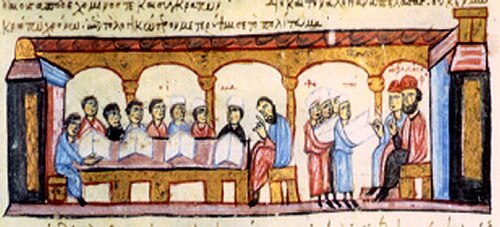
The School of Magnaura was founded in the 9th century but did not last very long,[16] and in the 11th new schools of philosophy and law were established at the Capitol School. The period of decline began with the Latin conquest of 1204 although the university survived as a non-secular institution under Church management until the Fall of Constantinople in 1453, and was later refounded as the Phanar Greek Orthodox College. The primary university of the city became a madrasa (now Istanbul University), established by Mehmet II following the conquest of the city. Both of these institutions are still operational today.
Matthaios Kamariotis, lecturer of the university, became the first director of Phanar Greek Orthodox College, which was established in 1454.[17]
The Pandidakterion refounded in 1046 is generally recognized as a "university" in that it was, like modern universities, an institution of higher learning with chairs in many fields of study, but some scholars have argued that it was not a "university" because it lacked the corporative structure of the medieval universities of Western Europe, which used the Latin term universitas magistrorum et scholarium for the communities of masters and students that came to define the institutional character of European universities.[18][19] Nonetheless, the Dictionnaire encyclopédique du Moyen Âge also identifies the Pandidakterion founded in 425 as a "university institution".[19]
ビザンツ帝国の大学。中世ギリシャ世界には、西ヨーロッパの後期中世の大学に匹敵する、自律的で継続的な高等教育機関は存在しなかった。
Le nom "université" désigne au Moyen Âge occidental uneorganization corporative des élèves et des maîtres、avec ses fonctions et privilèges、qui cultive un ensemble d'études supérieures。ビザンスの要塞コンテストの存在。テオドース大学でコンスタンティノープルの教育賞を受賞。 Par la loi de 425, l'empereur a établi l'"université de Constantinople", avec 31 professeurs rémunérés par l'État qui jouissaient du monopole des cours publics.