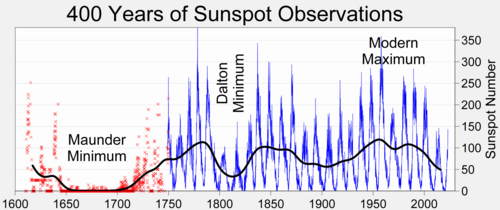
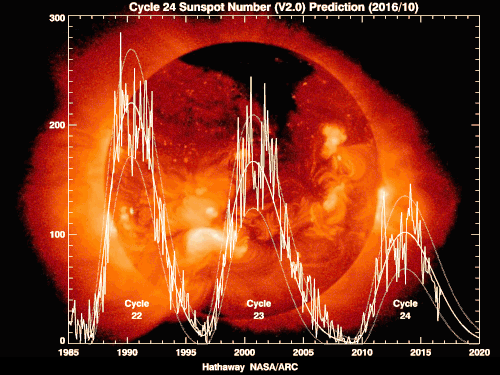
400 years of sunspot history, including the Maunder Minimum"The prediction for solar cycle 24 gave a smoothed sunspot number maximum of about 101 in the late 2013. The smoothed sunspot number reached 116.4 in April 2014. This will probably become the official maximum. This second peak surpassed the level of the first peak (98.3 in March 2012). Many cycles are double peaked but this is the first in which the second peak in sunspot number was larger than the first. We are currently over seven years into cycle 24. The predicted and observed size made this the smallest sunspot cycle since cycle 14, which had a maximum smoothed number of 107.2 in February of 1906."[1]
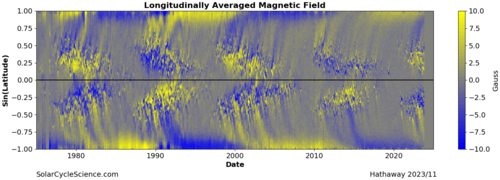
The magnetic field of the Sun flips during each solar cycle, with the flip occurring when the solar cycle is near its maximum. After two solar cycles, the Sun's magnetic field returns to its original state, completing what is known as a Hale cycle.
This cycle has been observed for centuries by changes in the Sun's appearance and by terrestrial phenomena such as aurora but was not clearly identified until 1843. Solar activity, driven by both the solar cycle and transient aperiodic processes, governs the environment of interplanetary space by creating space weather and impacting space- and ground-based technologies as well as the Earth's atmosphere and also possibly climate fluctuations on scales of centuries and longer.
Understanding and predicting the solar cycle remains one of the grand challenges in astrophysics with major ramifications for space science and the understanding of magnetohydrodynamic phenomena elsewhere in the universe.
1 2シュワーベ (1843)。「Sonnenbeobachtungen im Jahre 1843」[ 1843 年の太陽の観察]。Astronomische Nachrichten (ドイツ語)。21 : 233–236 .235 ページより: 「Vergleicht man nun die Zahl der Gruppen und der flecken-freien Tage mit einander, so findet man, dass die Sonnenflecken eine Periode von ungefähr 10 Jahren hatten」 (「[黒点の] グループの数と黒点のない日数を互いに比較すると、黒点には期間は約10年)
↑ウルフ、R. (1852)。 "Neue untersuchungen über die periode der Sonnenflecken und ihre bedeutung" [黒点の周期とその重要性に関する新たな研究]。ベルンの Mittheilungen der Naturforschenden Gesellschaft (ドイツ語)。255:249~ 270
↑ Hathaway, David H.; Wilson, Robert M. (2004). "太陽黒点記録が宇宙気候について教えてくれること" (PDF) . Solar Physics . 224 ( 1– 2): 5– 19. Bibcode : 2004SoPh..224....5H . doi : 10.1007/s11207-005-3996-8 . S2CID 55971262 . 2006年1月4日にオリジナル(PDF)からアーカイブ済み。 2007年4月19日に取得。
↑ Usoskin IG (2017). "A History of Solar Activity over Millennia". Living Reviews in Solar Physics . 14 (3) 3. arXiv : 0810.3972 . Bibcode : 2017LRSP...14....3U . doi : 10.1007/s41116-017-0006-9 . S2CID 195340740 .PDF版
↑ Lockwood M. (2013). "太陽開放磁束と惑星間条件の変動の再構築と予測" . Living Reviews in Solar Physics . 10 (4): 4. Bibcode : 2013LRSP...10....4L . doi : 10.12942/lrsp-2013-4 .PDF版
↑ Owens MJ & Forsyth RJ (2013). "太陽圏磁場" . Living Reviews in Solar Physics . 10 (5): 5. arXiv : 1002.2934 . Bibcode : 2013LRSP...10....5O . doi : 10.12942/lrsp-2013-5 . S2CID 122870891 .
↑ Kopp G (2016年7月1日). 「全太陽放射照度変動の規模と時間スケール」 . Journal of Space Weather and Space Climate . 6 : A30. arXiv : 1606.05258 . Bibcode : 2016JSWSC...6A..30K . doi : 10.1051/swsc/2016025 .
↑ Richard C. Willson (2014年5月16日) 「ACRIM3と全太陽放射照度データベース」。天体物理学と宇宙科学。352 (2): 341–352。Bibcode : 2014Ap & SS.352..341W。doi : 10.1007/s10509-014-1961-4。
↑ Amdur, T.; Huybers, P. (2023年8月16日). "A Bayesian Model for Inferring Total Solar Irradiance From Proxies and Direct Observations: Application to the ACRIM Gap" . Journal of Geophysical Research: Atmospheres . 128 (15) e2023JD038941. Bibcode : 2023JGRD..12838941A . doi : 10.1029/2023JD038941 . ISSN 2169-897X . S2CID 260264050 .
↑チャツィステルゴス、テオドシオス。クリボワ、ナタリー A.ソランキ、サミ K.コック、レン・ヨー(2025)。「SATIRE-S 放射照度再構成の再考: ウィルソン山磁力線図と Ca II K 観測の遺産」。天文学と天体物理学。696 : A204。arXiv : 2503.15903。ビブコード: 2025A & A...696A.204C。土井:10.1051/0004-6361/202554044。ISSN 0004-6361。
↑ Tinsley, Brian A.; Yu, Fangqun (2004). "Atmospheric Ionization and Clouds as Links Between Solar Activity and Climate" (PDF) . In Pap, Judit M.; Fox, Peter (eds.). Solar Variability and its Effects on Climate . Geophysical monograph series. Vol. 141. American Geophysical Union . pp. 321– 339. Bibcode : 2004GMS...141..321T . CiteSeerX 10.1.1.175.5237 . doi : 10.1029/141GM22 . ISBN978-0-87590-406-12007年6月4日にオリジナル(PDF)からアーカイブされました。 2015年8月10日に取得。「テキサス大学ダラス校物理学科」 。 2015年8月15日にオリジナルからアーカイブ済み。2015年8月10日に取得。
↑ Echer, E; Kirchhoff, VWJH; Sahai, Y; Paes Leme, N (2001). "ブラジルの低緯度観測所における全オゾンに対する太陽活動周期シグナルの研究". Advances in Space Research . 27 (12): 1983– 1986. Bibcode : 2001AdSpR..27.1983E . doi : 10.1016/S0273-1177(01)00270-8 .
↑ Labitzke K.; Matthes K. (2003). "大気中の11年周期の太陽活動変動:観測、メカニズム、モデル". The Holocene . 13 (3): 311– 7. Bibcode : 2003Holoc..13..311L . doi : 10.1191/0959683603hl623rp . S2CID 129100529 .
↑ Pablo JD Mauas & Andrea P. Buccino. 「南米の河川に対する長期的な太陽活動の影響」5ページ。Journal of Atmospheric and Solar-Ter restrial Physics on Space Climate、2010年3月。アクセス日:2014年9月20日。
↑ Zanchettin, D.; Rubino, A.; Traverso, P.; Tomasino, M. (2008). " [太陽活動の変動が北イタリアの水文十年パターンに与える影響] " . Journal of Geophysical Research . 113 (D12): D12102. Bibcode : 2008JGRD..11312102Z . doi : 10.1029/2007JD009157 . S2CID 54975234 .
↑ CD Camp & KK Tung (2007). "太陽活動周期による地表温暖化:合成平均差投影による解明" . Geophysical Research Letters . 34 (14): L14703. Bibcode : 2007GeoRL..3414703C . doi : 10.1029/2007GL030207 . S2CID 16596423 .
↑ Forster, P.; V. Ramaswamy; P. Artaxo; T. Berntsen; R. Betts; DW Fahey; J. Haywood; J. Lean; DC Lowe; G. Myhre; J. Nganga; R. Prinn; G. Raga; M. Schulz; R. Van Dorland (2007), "大気成分の変化と放射強制力: § 2.9.1 放射強制力の不確実性" , Solomon, S.; D. Qin; M. Manning; Z. Chen; M. Marquis; KB Averyt; M. Tignor; HL Miller (eds.), Contribution of Working Group I to the Fourth Assessment Report of the Intergovernmental Panel on Climate Change, 2007 , Cambridge University Press, ISBN978-0-521-88009-1
↑ Molaverdikhani, Karan; Ajabshirizadeh, A. (2016). "5つの太陽周期の2線要素(TLE)記録の評価を通して見た、10.7 cmでの太陽フラックスに対する地球の宇宙大気相互作用領域(SAIR)応答の複雑性" . Advances in Space Research . 58 (6): 924– 937. Bibcode : 2016AdSpR..58..924M . doi : 10.1016/j.asr.2016.05.035 .
↑ Yeates, Anthony R.; Nandy, Dibyendu; Mackay, Duncan H. (2008). "太陽周期予測の物理的基礎の探求:移流優勢対拡散優勢太陽対流領域におけるフラックス輸送ダイナミクスと記憶の持続性" . The Astrophysical Journal . 673 (1). 544. arXiv : 0709.1046 . Bibcode : 2008ApJ...673..544Y . doi : 10.1086/524352 .
↑ Karak, Bidya Binay; Nandy, Dibyendu (2012). "Turbulent Pumping of Magnetic Flux Reduxes Solar Cycle Memory and thus Impacts Predictability of the Sun's Activity" . The Astrophysical Journal . 761 (1). L13. arXiv : 1206.2106 . Bibcode : 2012ApJ...761L..13K . doi : 10.1088/2041-8205/761/1/L13 .
↑ Muñoz-Jaramillo, Andrés; Dasi-Espuig, María; Balmaceda, Laura A.; DeLuca, Edward E. (2013). "太陽周期の伝播、記憶、予測:1世紀にわたる磁気プロキシからの洞察" . The Astrophysical Journal Letters . 767 (2). L25. arXiv : 1304.3151 . Bibcode : 2013ApJ...767L..25M . doi : 10.1088/2041-8205/767/2/L25 .
↑ Route, Matthew (20 October 2016). "The Discovery of Solar-like Activity Cycles Beyond the End of the Main Sequence?" . The Astrophysical Journal Letters . 830 (2): 27. arXiv : 1609.07761 . Bibcode : 2016ApJ...830L..27R . doi : 10.3847/2041-8205/830/2/L27 . S2CID 119111063 .
↑ José Abreu; et al. (2012). "太陽活動に惑星の影響はあるのか?" (PDF) . Astronomy & Astrophysics . 548 : A88. Bibcode : 2012A & A...548A..88A . doi : 10.1051/0004-6361/201219997 .
↑ S. Poluianov; I. Usoskin (2014). "太陽活動に対する惑星潮汐の影響に関する仮説の批判的分析". Solar Physics . 289 (6): 2333. arXiv : 1401.3547 . Bibcode : 2014SoPh..289.2333P . doi : 10.1007/s11207-014-0475-0 . S2CID 16188804 .
↑ F. Stefani; A. Giesecke; T. Weier (2019 年 5 月). "潮汐同期型太陽ダイナモのモデル". Solar Physics . 294 (5): 60. arXiv : 1803.08692 . Bibcode : 2019SoPh..294...60S . doi : 10.1007/s11207-019-1447-1 . S2CID 73609026 .
↑ K. Petrovay (2019). "太陽活動周期予測" . Living Reviews in Solar Physics . 7 : 6. doi : 10.12942/lrsp-2010-6 . PMC 4841181 . PMID 27194963 .
Willson, Richard C.; H.S. Hudson (1991). "The Sun's luminosity over a complete solar cycle". Nature. 351 (6321): 42–4. Bibcode:1991Natur.351...42W. doi:10.1038/351042a0. S2CID4273483.
Foukal, Peter; etal. (1977). "The effects of sunspots and faculae on the solar constant". Astrophysical Journal. 215: 952. Bibcode:1977ApJ...215..952F. doi:10.1086/155431.
Dziembowski, W.A.; P.R. Goode; J. Schou (2001). "Does the sun shrink with increasing magnetic activity?". Astrophysical Journal. 553 (2): 897–904. arXiv:astro-ph/0101473. Bibcode:2001ApJ...553..897D. doi:10.1086/320976. S2CID18375710.
Stetson, H.T. (1937). Sunspots and Their Effects. New York: McGraw Hill. Bibcode:1937sate.book.....S.
Yaskell, Steven Haywood (31 December 2012). Grand Phases On The Sun: The case for a mechanism responsible for extended solar minima and maxima. Trafford Publishing. ISBN978-1-4669-6300-9.
External links
NOAA / NESDIS / NGDC (2002) Solar Variability Affecting Earth NOAA CD-ROM NGDC-05/01. This CD-ROM contains over 100 solar-terrestrial and related global data bases covering the period through April 1990.
Solanki, S.K.; Fligge, M. (2001). Wilson, A. (ed.). Long-term changes in solar irradiance. Proceedings of the 1st Solar and Space Weather Euroconference, 25–29 September 2000, Santa Cruz de Tenerife, Tenerife, Spain. The Solar Cycle and Terrestrial Climate. Vol.463. ESA Publications Division. pp.51–60. Bibcode:2000ESASP.463...51S. ISBN978-92-9092-693-1. ESA SP-463.
Recent Total Solar Irradiance dataArchived 2013-07-06 at the Wayback Machine updated every Monday







 この記事には、パブリックドメインにあるこの情報源からのテキストが含まれています。