Loading article…

The Moodswinger is a twelve-string electric zither with an additional third bridge designed by Yuri Landman. The rod which functions as the third bridge divides the strings into two sections to cause an overtone multiphonic sound. One of the copies of the instrument is part of the collection of the Musical Instrument Museum in Phoenix, Arizona.
In March 2006 Landman was contacted by the noise band Liars to make an instrument for them. After 6 months he finished two copies of The Moodswinger, an electric 12-string 3rd-bridge overtone koto, one for guitarist/drummer Aaron Hemphill and one for himself.[1] Although it closely resembles an electric guitar, it is actually a zither, as it has neither frets nor a proper neck. The pickup and electronics are built into the neck instead of in the body unlike usual electric guitars. In 2008 the Moodswinger II was released as a serial product. Jessie Stein of The Luyas owns a copy.
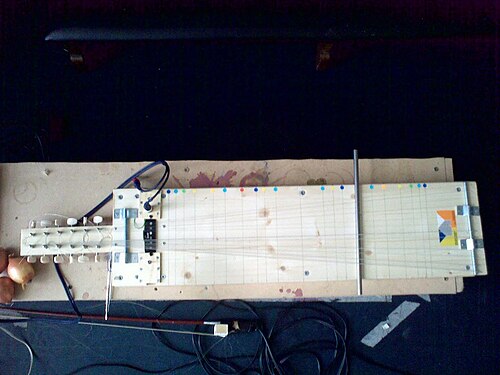
In 2009 Landman created a derivative version of the instrument called the Home Swinger, for workshops at festivals, where participants built their own copy within four hours. In 2010 the Musical Instrument Museum in Phoenix included a Moodswinger as well as a Home Swinger in their collection as two of the pieces of the Dutch section of musical instrument inventions.
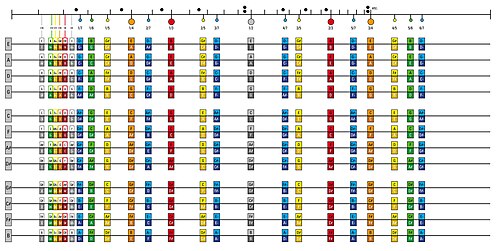
The 3rd bridge divides the strings into two segments with different pitches. Depending on where the string is played, a bell-like harmonic second tone is created. The string resonates more or less when the back side is struck, depending on the position of the 3rd bridge along the string. This can be explained by acoustic resonance and microtonality. At harmonic nodal positions, the string resonates more than at other positions. For instance, dividing the string 1/3 + 2/3 creates a clear overtone, while 24/33 + 9/33 creates an indistinct overtone. The color dotted scale indicates the simple-number ratios up to the 7 limit (on the Moodswinger II to the 8 limit.) On these positions just intonedharmonicdyads occur.
ムードスウィンガーは、非調性的な演奏技法に重点を置いています。弦上の23 のハーモニックポジションを指定するために、数学的なスケールが追加されています。この楽器には 12 本の弦があり、4 度圏で調律されているため、平均律スケールのすべての音を演奏することが常に可能です。ただし、平均律スケールは完全な平均律スケールではないため、一部のポジションには + または - の記号が付いています。[ 3 ]

この楽器の調弦は、EADGCFA#-D#-G#-C#-F#-Bという4度圏で、弦の配置を見やすくするために、4本の弦からなる3つのグループに分けられています。
この調律により、隣接する5本の弦はハーモニックペンタトニックスケールを形成し、隣接する7本の弦はメジャースケールを形成します。これらの音階はどのキーでも使用可能です。適切なキーを選択すれば、誤った音を弾くことなく、非常に簡単にフィンガーピッキングを行うことができます。

この楽器には3つの印刷された音階があり、可動式の第3ブリッジの位置合わせや演奏音符の読み取りのガイドとして使用されます。
Moodswinger IIでは、1/8、3/8、5/8、7/8の音符に青い点線が引かれています。Home Swingerでも同じ配色が採用されています。
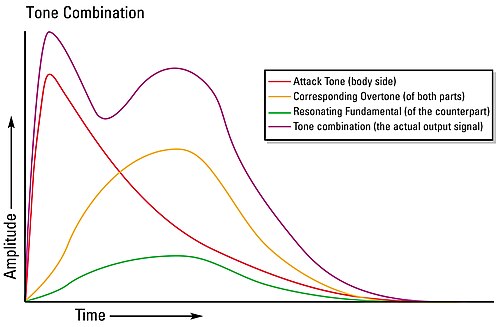
3弦ブリッジ弦の音は、3つの音の組み合わせです。ボディ側で叩かれた弦の柔らかいアタック音、両側の対応する倍音、ヘッド側の弦の共鳴する低い基本音です。下の図は、倍音(上)と対応する弦の低い音(下)の音の組み合わせを示しています。ほとんどのポジションでは、アタック音は倍音とまったく同じ音です。例外は、3/4、3/5、3/7、5/7です。3/... ポジションでは、倍音はアタック音の完全5度、5/7 ポジションでは、倍音はアタック音の長3度です。