
Loading article…
音響学において、「海の声」とも呼ばれるマイクロバロム[ 1 ] [ 2 ]は、海洋嵐[ 3 ] [ 4 ]において海洋表面波と大気との非線形相互作用によって発生する大気超低周波波の一種である[ 5 ] [ 6 ] 。通常、マイクロバロムは狭帯域でほぼ正弦波状の波形を持ち、振幅は数マイクロバールまで[ 7 ] [ 8 ] 、周期は5秒(0.2ヘルツ)に近い[ 9][10]。これらの低周波数では大気による吸収が少ないため、マイクロバロムは大気中を数千キロメートル伝播することができ、地球表面上の離れた場所にある機器でも容易に検出できる[ 5 ] [ 11 ] 。
この現象が発見されたきっかけは偶然だった。海洋水文気象観測所や船舶で活動する気象学者たちが、標準的な気象観測プローブ(水素ガスを充填した気球)の表面に近づくと人が感じる奇妙な痛みに気づいたのだ。ある探査の際、主任気象学者のV・A・ベレズキンが、ソ連のアカデミー会員であるV・V・シュレイキンにこの現象を実演した。この現象は科学者たちの間で大きな関心を集め、研究のために、人間の耳には聞こえない強力な低周波振動を記録する特殊な装置が開発された。
As a result of several series of experiments, the physical essence of this phenomenon was clarified and in 1935 when V.V. Shuleikin published his first work entirely devoted to the infrasonic nature of the “voice of the sea”. Microbaroms were first described in United States in 1939 by AmericanseismologistsHugo Benioff and Beno Gutenberg at the California Institute of Technology at Pasadena, based on observations from an electromagnetic microbarograph,[11] consisting of a wooden box with a low-frequency loudspeaker mounted on top.[12] They noted their similarity to microseisms observed on seismographs,[9] and correctly hypothesized that these signals were the result of low pressure systems in the Northeast Pacific Ocean.[11] In 1945, Swiss geoscientist L. Saxer showed the first relationship of microbaroms with wave height in ocean storms and microbarom amplitudes.[9] Following up on the theory of microseisms by M. S. Longuet-Higgins, Eric S. Posmentier proposed that the oscillations of the center of gravity of the air above the Ocean surface on which the standing waves appear were the source of microbaroms, explaining the doubling of the ocean wave frequency in the observed microbarom frequency.[13] Microbaroms are now understood to be generated by the same mechanism that makes secondary microseisms. The first quantitatively correct theory of microbarom generation is due to L. M. Brekhovskikh who showed that it is the source of microseisms in the ocean that couples to the atmosphere. This explains that most of the acoustic energy propagates near the horizontal direction at the sea level.[14]
Isolated traveling ocean surface gravity waves radiate only evanescent acoustic waves,[7] and don't generate microbaroms.[15]
The interaction of two trains of surface waves of different frequencies and directions generates wave groups. For waves propagating almost in the same direction, this gives the usual sets of waves that travel at the group speed, which is slower than phase speed of water waves. For typical ocean waves with a period around 10 seconds, this group speed is close to 10 m/s.
伝播方向が逆の場合、波群ははるかに速い速度で移動し、その速度は 2π( f 1 + f 2 )/( k 1 − k 2 ) となります。ここでk 1とk 2は相互作用する水波の波数です。周波数(したがって波数)の差が非常に小さい波列の場合、この波群のパターンは音波と同じ水平速度、つまり 300 m/s を超える速度を持ち、マイクロバロムを励起する可能性があります。
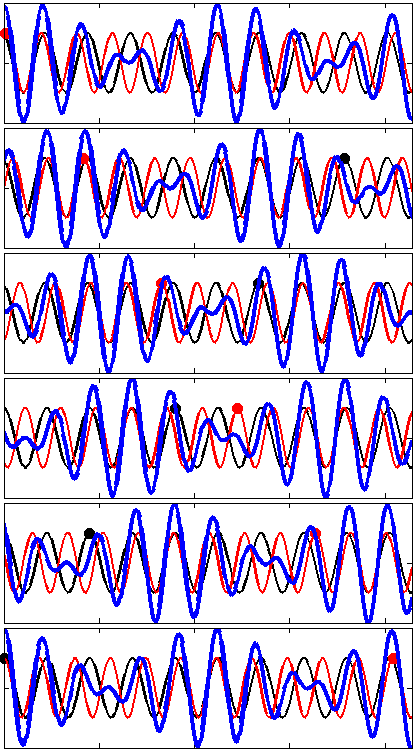
地震波と音波に関しては、深海における海洋波の運動は、主要な項では、海面にかかる圧力に等しい。[ 16 ]この圧力は、水の密度と波の軌道速度の二乗にほぼ等しい。この二乗のため、重要なのは個々の波列の振幅(図中の赤と黒の線)ではなく、波群の合計の振幅(図中の青の線)である。この「等価圧力」によって生成された海洋運動は、その後大気に伝達される。
波群が音速よりも速く伝播する場合、マイクロバロムが発生し、伝播方向は速い波群ほど垂直方向に近くなる。
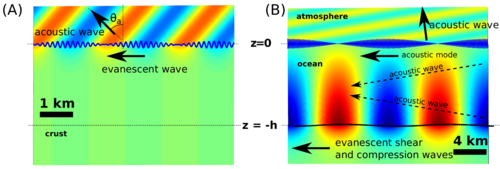
実際の海洋波は、あらゆる方向と周波数の無数の波列から構成されており、広範囲の音波を生じます。実際には、海洋から大気への伝播は、水平面から約0.5度の角度で最も強くなります。ほぼ垂直方向への伝播の場合、微小地震と同様に、水深が増幅の役割を果たすことがあります。
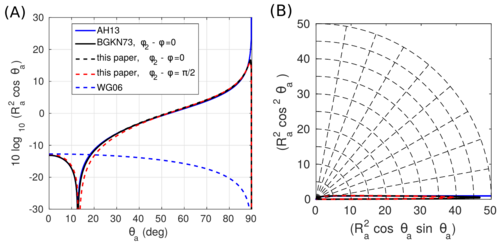
水深は、海面における垂直方向から12°以内の伝播方向を持つ音波に対してのみ重要である[ 17 ]。
反対方向に伝播するエネルギーは常に存在します。ただし、そのエネルギーは極めて低い場合があります。 大きなマイクロバロムの発生は、同じ周波数で反対方向に大きなエネルギーが存在する場合にのみ発生します。 これは、異なる嵐からの波が相互作用する場合、または嵐の風下側で、 必要な定常波条件を生成する場合に最も強くなります[ 18 ] [ 19 ]。これはクラポティスとも呼ばれます[ 15 ] 。 [ 20 ]海洋嵐が熱帯低気圧の場合、マイクロバロムは風速が最大となる眼壁付近では発生せず、嵐の後縁で嵐によって生成された波が周囲の海洋うねりと相互作用することによって発生します[ 21 ]。
マイクロバロムは、2 つの嵐の間に発生する定常波によっても発生する可能性があり、[ 18 ]あるいは、海洋のうねりが海岸で反射されるときにも発生する可能性があります。周期が約 10 秒の波は外洋に豊富に存在し、 マイクロバロムの観測された 0.2 Hz の超低周波スペクトル ピークに対応します。これは、マイクロバロムが個々の海洋波の 2 倍の周波数を示すためです。[ 18 ]研究では、非線形項を考慮した場合にのみ、結合によって伝播する大気波が発生することが示されています。[ 9 ]
マイクロバロムは、一般的に0.1~0.5Hzの持続的な低レベルの大気超低周波音の一種であり、コヒーレントなエネルギーバーストまたは連続的な振動として検出されることがある。[ 22 ] [ 11 ]マイクロバロム発生源からの平面波の到達を、間隔の狭いマイクロバログラフのフェーズドアレイから解析すると、発生源の方位角は、発生源の嵐の低圧中心を指していることがわかった。[ 23 ]同じ発生源から複数の離れた地点で波が受信された場合、三角測量によって、発生源が海洋嵐の中心付近にあることが確認できる。[ 4 ]
下部熱圏まで伝播するマイクロバロムは、大気導波路を通って運ばれるか、[ 24 ] 120 km未満および 150 km 以上の高度から地表に向かって屈折して戻るか、[ 18 ] [ 25 ] または110 ~ 140 km の高度で消散する。[ 26 ]また、惑星境界層の影響と地表風によって 下部対流圏の地表付近に捕捉されるか、上層の風によって成層圏でダクトに運ばれ、屈折、回折、または散乱によって地表に戻る可能性がある。[ 27 ] これらの対流圏および成層圏のダクトは、卓越風向に沿ってのみ生成され、[ 25 ] 時間帯や季節によって変化する可能性があり、[ 27 ] 上層の風が弱いときは音波を地表に戻さない。[ 18 ]
マイクロバロム光線の入射角によって、どの伝搬モードを経るかが決まります。天頂に向かって垂直に照射された光線は熱圏で減衰し、上層大気のその層では大きな加熱源となります。[ 26 ]中緯度では、典型的な夏の条件下では、垂直方向から約30~60度の角度で照射された光線は、125 km以上の高度で反射され、そこで反射信号が最初に大きく減衰します。[ 28 ] より浅い角度で照射された光線は、中緯度では地表 から約45 km上空の上部成層圏で反射されるか、 [ 28 ]低緯度で は60~70 kmで反射される可能性があります。[ 18 ]
Atmospheric scientists have used these effects for inverse remote sensing of the upper atmosphere using microbaroms.[24][29][30][31] Measuring the trace velocity of the reflected microbarom signal at the surface gives the propagation velocity at the reflection height, as long as the assumption that the speed of sound only varies along the vertical, and not over the horizontal, is valid.[28] If the temperature at the reflection height can be estimated with sufficient precision, the speed of sound can be determined and subtracted from the trace velocity, giving the upper-level wind speed.[28] One advantage of this method is the ability to measure continuously – other methods that can only take instantaneous measurements may have their results distorted by short-term effects.[8]
Additional atmospheric information can be deduced from microbarom amplitude if the source intensity is known. Microbaroms are produced by upward directed energy transmitted from the ocean surface through the atmosphere. The downward directed energy is transmitted through the ocean to the sea floor, where it is coupled to the Earth's crust and transmitted as microseisms with the same frequency spectrum.[8] However, unlike microbaroms, where the near vertical rays are not returned to the surface, only the near vertical rays in the ocean are coupled to the sea floor.[27] By monitoring the amplitude of received microseisms from the same source using seismographs, information on the source amplitude can be derived. Because the solid earth provides a fixed reference frame,[32] the transit time of the microseisms from the source is constant, and this provides a control for the variable transit time of the microbaroms through the moving atmosphere.[8]
Microbaroms are a significant noise source that can potentially interfere with the detection of infrasound from nuclear explosions. Accurate detection of explosions is a goal of the International Monitoring System organized under the Comprehensive Nuclear-Test-Ban Treaty (which has not entered into force).[33] It is a particular problem for detecting low-yield tests in the one-kiloton range because the frequency spectra overlap.[11]
空気/水界面の動きから生じる音響放射は、非線形効果であることが知られています。
表面重力波と音波の位相速度の不一致により、単一の表面波はエバネッセント音波のみを放射することを示す。
パサデナにあるカリフォルニア工科大学の著名なアメリカ人地震学者、ヒューゴ・ベニオフとベノ・グーテンベルクは、超低周波音を検出するための計測機器と応用技術の両方を開発した。初期の計測機器は、低周波スピーカーを上部に取り付けた木製の箱で構成されていた。
孤立した進行性海洋波は音響放射をしない。マイクロバロム放射には定常波条件が必要である...
バロムは、ほぼ反対方向に伝播し、周波数が似ている海洋表面波の非線形相互作用によって生成される超低周波波です。このような相互作用は、一般的に、外洋に豊富に存在する周期が約 10 秒の海洋波の間で発生し、観測された 0.2 Hz の超低周波スペクトルピークに対応します。
この過程では、異なる方向の波の干渉が発生し、定常水波、いわゆるクラポティスが形成されます。これらの波を調査して位置を特定するために、海底に変動する圧力をかける(「ポンプ」する)ために固有の特性を利用し、微小地震振動を発生させ、大気中に超低周波音を放射することが提案されています。
ハリケーンによって発生するマイクロバロムバンド (約 0.2 Hz) の超低周波音信号は、風が最も強い目の近くで発生しているようには見えないことが多い。本論文は、嵐によって発生した波動場と周囲のうねり場との相互作用を通じて、嵐の後縁に沿って微小気圧(および微小地震)の発生に適した条件が生じる可能性があることを示唆している。
...海洋波によって発生する背景雑音は、マイクロバロムと呼ばれる小さな大気の轟音の絶え間ない連打を生み出します。
データに対して平面波の到達に最小二乗法を適用すると、見かけ上の音源方位は嵐の低気圧中心の中心を指していることがわかります。
上層大気の状態を監視するために使用できます。…熱圏ダクトを伝播していることを示しています。…
はしばしば2つの回転領域があり、したがって2つの異なる位相を支えることになる。
干渉する海洋波によって生成されるマイクロバロムとして知られる 0.2 Hz の超低周波音は、下部熱圏に伝播し、110 ~ 140 km の間で散逸します。
Observed arrivals with a low apparent horizontal phase velocity may be refracted in the thermosphere or the stratosphere.... The presence of these tropospheric and stratospheric ducts is dependent on the intensity and direction of the winds, and thus they may be sporadic or seasonal.
Greater resolution than that reproduced here shows that rays with angles of incidence <64° are not reflected below 125 km, at which height dissipation effects strongly attenuate the signal (Donn and Rind).
Atmospheric scientists have employed naturally generated, low-frequency sound (microbaroms) to probe the upper layers of the atmosphere in an inverse fashion.
マイクロバロムは、上層大気をプローブするための継続的に利用可能な自然のメカニズムを提供する。
地球の地殻は時間的に不変な媒体とみなすことができる。これにより、マイクロバロムとマイクロ地震を比較することで、音響チャネルのモニタリングを行うことができる。