
Loading article…
| bar | |
|---|---|
 An aluminium cylinder of wall thickness 5 millimetres (0.20 in) after an external pressure of 700 bar was applied to it | |
| General information | |
| Unit system | metric system |
| Unit of | pressure |
| Symbol | bar |
| Conversions | |
| 1 bar in ... | ... is equal to ... |
| SI units | 100 kPa |
| CGS units | 106 Ba |
| US customary units | 14.50377 psi |
| Atmospheres | 0.986923 atm |
The bar (symbol bar) is a metric unit of pressure defined as 100000 Pa (100 kPa or 1000 hPa), though not part of the International System of Units (SI). A pressure of 1 bar is slightly less than the average atmospheric pressure on Earth at sea level (approximately 1.013 bar).[1][2] By the barometric formula, 1 bar is roughly the atmospheric pressure on Earth at an altitude of 111 metres at 15 °C.
The bar and the millibar (symbol mbar) were introduced by the Norwegian meteorologistVilhelm Bjerknes, a founder of the modern practice of weather forecasting, with the bar defined as one megadyne per square centimetre.[3]
The SI brochure lists the symbol and value for the bar but it is not an SI unit.[1] The bar has been legally recognised in countries of the European Union since 2004.[2] The US National Institute of Standards and Technology (NIST) deprecates its use except for "limited use in meteorology" and lists it as one of several units that "must not be introduced in fields where they are not presently used".[4] The International Astronomical Union (IAU) also lists it under "Non-SI units and symbols whose continued use is deprecated".[5]
Units derived from the bar include the megabar (symbol: Mbar), kilobar (symbol: kbar), decibar (symbol: dbar), centibar (symbol: cbar), and millibar (symbol: mbar). The microbar (symbol: μbar) is used in acoustics.
The bar is defined using the SI derived unit, pascal: 1 bar ≡ 100000 Pa ≡ 100000 N/m2.
Thus, 1 bar is equal to:
Conversion of bars to pascals:
The word bar has its origin in the Ancient Greek word βάρος (baros), meaning weight. The unit's official symbol is bar; the earlier symbol b is deprecated and conflicts with the uses of b denoting the unit barn or bit, but it is still encountered, especially as mb (rather than the proper mbar) to denote the millibar. Between 1793 and 1795, the word bar was used for a unit of mass (equal to the modern tonne) in an early version of the metric system.[8]
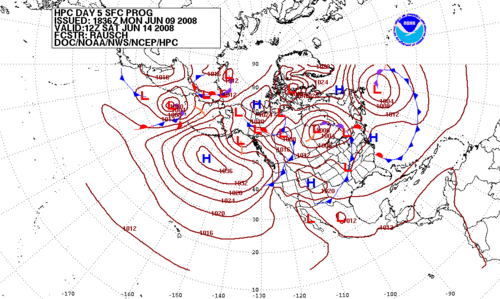

Atmospheric air pressure where standard atmospheric pressure is defined as 1013.25 mbar, 101.325 kPa, 1.013 25 bar、これは約14.7ポンド/平方インチです。ミリバールはSI単位ではありませんが、世界中の気象学者や天気予報士は、その値が便利なため、長い間気圧をミリバールで測定してきました。SI 単位の登場以来、一部の気象学者は、数値的にミリバールと等しいヘクトパスカル(記号 hPa) を使用し始めました。同じ理由で、ヘクトパスカルは、ほとんどの国で航空における気圧を表す標準単位として使用されています。たとえば、カナダ気象局は、天気図でキロパスカルとヘクトパスカルを使用しています。[ 9 ] [ 10 ]対照的に、アメリカ人は、米国のハリケーンやその他のサイクロン性暴風雨の報告でミリバールを使用することに慣れています。[ 11 ] [ 12 ]
淡水では、デシバール単位の圧力変化とメートル単位の水深変化の間には、おおよその数値的な等価性があります。具体的には、水深が1メートル増加すると、圧力が1デシバール増加します。1.019 716 m 。海水中では、重力変動、緯度、ジオポテンシャル異常に関して、圧力は経験式に従ってメートル深度に変換できます。[ 13 ] その結果、デシバールは海洋学で一般的に使用されています。
スキューバダイビングでは、圧力を表す単位としてバールが最も広く使われており、例えば200 バールは標準的なスキューバタンクの満タン時の圧力に相当し、海水深10メートルごとに1 バールの圧力が加わる。
エンジニアは圧力の単位として一般的にバールを使用します。パスカルを使用すると非常に大きな数値を扱うことになるためです。真空の測定や真空工学においては、残留圧力は通常ミリバールで表されますが、歴史的にはトルや水銀柱ミリメートル(mmHg)が一般的でした。
爆燃によって生じる圧力は、しばしばバール単位で表されます。[ 14 ]
自動車分野では、ターボチャージャーの過給圧は米国以外ではバール(bar)で表されることが多い。タイヤの空気圧もバールで表されることが多い。油圧機械の部品は、最大システム油圧(通常数百バール)で定格が定められている。例えば、産業用固定機械では300バールが一般的である。
海運業界では、冷却水システムなどの配管システムの圧力は、しばしばバール(bar)で測定される。
Unicodeには「mb」(U+33D4 ㏔ SQUARE MB SMALL)、「bar」(U+3374 ㍴ SQUARE BAR)、 「ミリバール」 (U+334A ㍊ SQUARE MIRIBAARU ; 「ミリバール」はカタカナで表記)の文字がありますが、これらは従来のアジア言語のエンコーディングとの互換性のためにのみ存在し、新しい文書で使用することを意図したものではありません。
キロバール(100 MPaに相当)は、地質学、特に実験岩石学 において一般的に用いられる単位である。
絶対圧力を表すのに略語「bar(a)」と「bara」が、ゲージ圧力を表すのに「bar(g)」と「barg」が使われることがあります。この用法は推奨されていませんが、石油業界では依然として使われています(多くの場合、大文字の「BarG」と「BarA」で表記されます)。ゲージ圧力は現在の周囲圧力に対する相対値であり、周囲圧力は絶対値で約 50 mbar 変動する可能性があるため、「BarG」と「BarA」は相互に変換できません。「2 bar のゲージ圧力」や「2-bar ゲージ」などのより詳細な説明が推奨されます。[ 2 ] [ 15 ]
bar .... 一部の著者は bar を
barye
(1 dyne per square cmimeter)
と同義語として使用しています。 ...
barye ....
bar
または
microbar
と呼ばれることもあります
。 ....
microbar
(
略語 μ
b ).... 英国文学では
barye
という用語
が使用されています。.... 残念ながら、かつて bar は音響学で 1 dyne per square cmimeter を意味するために使用されていましたが、これはもはや正しくありません。
Richards と AE Kennelly は、1平方センチメートルあたり 1 ダインの圧力を表すために「bar」という用語を使用した。