
Loading article…
インドの路面電車は19世紀後半に設立されました。馬車鉄道は1873年にコルカタで導入され、ムンバイとチェンナイでは1874年に、ナーシクでは1889年に運行が開始されました。チェンナイでは1895年に電気路面電車が運行を開始し、カンプールとデリーにも路面電車が導入されました。コルカタの路面電車を除き、1933年から1964年の間にインドのすべての都市で路面電車は廃止されました。[ 1 ]

西ベンガル州コルカタ(旧カルカッタ)の路面電車は、西ベンガル交通公社(WBTC)によって運行されています。これはインドで唯一運行されている路面電車ネットワークであり[ 2 ]、1902年から運行されているアジア最古の電気路面電車です[ 3 ]。路面電車は全部で257両あり、かつては125両がコルカタの街路を毎日運行していましたが、現在では毎日運行しているのは25両のみです[ 4 ] 。単層連接車両は200人の乗客(座席60席)を運ぶことができます。
インドで最初の馬車鉄道は、 1873年2月24日にシールダーとアルメニアン・ガート・ストリート間の2.4マイル(3.9km )の距離を走った。このサービスは同年11月20日に廃止された。[ 5 ]カルカッタ路面電車会社は1880年12月22日にロンドンで設立され、登録された。メートルゲージの馬車鉄道の線路は、ボウバザール・ストリート、ダルハウジー・スクエア、ストランド・ロードを経由してシールダーからアルメニアン・ガートまで敷設された。この路線は1880年11月1日にリポン総督によって開通された。 [ 5 ] 1882年には、路面電車を牽引するために蒸気機関車が試験的に導入された。19世紀末までに、同社は166両の路面電車、1,000頭の馬、7両の蒸気機関車、19マイルの路面電車の線路を所有していた。[ 5 ] 1900年、路面電車の電化と線路の標準軌4フィート8 + 1/2インチ(1,435 mm)への改修が始まった。[ 5 ] 1902年、カルカッタ初の電気路面電車が3月27日にエスプラネードからキダーポールまで、6月14日にエスプラネードからカリガートまで運行した。
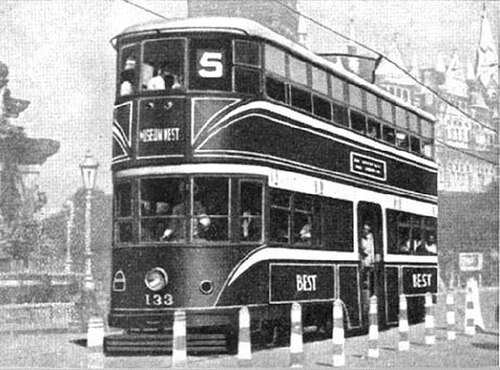
A mass public-transport system for Mumbai (then Bombay) was proposed in 1865 by an American company, which applied for a licence to operate a horse-drawntram system. Although a licence was granted, the project was never realised due to the city's economic depression.
The Bombay Tramway Company was set up in 1873. After a contract was signed between the Bombay Tramway Company, the municipality and the Stearns and Kitteredge company, the Bombay Presidency enacted the Bombay Tramways Act, 1874 licensing the company to run a horsecar tram service in the city.[6] On 9 May 1874, the first horse-drawn carriage made its début in the city, plying the Colaba–Pydhone via Crawford Market, and Bori Bunder to Pydhonie via Kalbadevi routes. The initial fare was three annas (12 paise pre-decimalisation), and no tickets were issued. As the service became increasingly popular, the fare was reduced to two annas (8 pre-decimalisation paise). Later that year, tickets were issued to curb increasing ticket-less travel.[7] Stearns and Kitteredge reportedly had a stable of 1,360 horses over the lifetime of the service.[8]
In 1899, the Bombay Tramway Company applied to the municipality to operate electric trams. In 1904, the British Electric Traction Company applied for a license to supply electricity to the city with the Brush Electrical Engineering Company its agent. It received the Bombay electric license on 31 July 1905, signed by Bombay Tramways Company, the Bombay Municipality and the Brush Electrical Company. In 1905, the Bombay Electric Supply and Tramway Company (BEST) was formed. BEST received a monopoly on electric supply and an electric tram service in the city, and bought the Bombay Tramway Company's assets for ₹9,850,000.[9] Two years later, the first electric tram debuted in the city. Later that year, a 4,300 kilowatts (5,800 hp)steam power generator was commissioned at Wari Bunder. In 1916, a power purchase from Tata Power (a private company) began, and by 1925, all power generation was outsourced from Tata.[10] To ease rush-hour traffic, double-decker trams were introduced in September, 1920. The trams met travellers' needs until the betterment of the city's train network, and the service closed on 31 March 1964.[11]
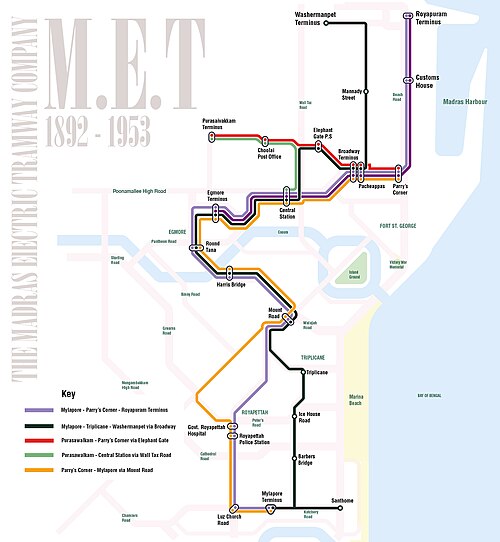
Chennai (then Madras) was the third city in India to get a tramway for passenger carriage. The first horse-drawntram service in Madras began operations in June, 1874, shortly after the opening of the tramway in Bombay. The tramway used metre gauge tracks and operated on several routes, the chief of them being a route between Royapuram and Triplicane. The tramway was in service for a few years, but like the early horse-drawn trams in Calcutta, it had to be discontinued due to poor financial returns.
Tramways saw a revival in the city with the opening of the Madras Electric Tramways in 1895, connecting the docks and the inland areas, carrying goods and passengers. When the system began on 7 May 1895, it was India's oldest electric tram system and it is the firstelectric tram system in India. The original conduit system was replaced by a conventional overhead wire system after a series of destructive monsoons. The trams could carry heavy loads and were popular, with thousands of riders daily. The route included Mount Road, Parry's Corner, Poonamallee Road and the Ripon Building. At its height in 1921, 97 cars ran on 24 kilometres (15 mi) of track. The tram company went bankrupt about 1950, and the system closed on 12 April 1953.[11]
Nashik was the fourth city in India after Chennai, Kolkata and Mumbai to get trams in 1889. Trams in Nashik (then Nasik) were built in 1889 as 2 ft 6 in (762 mm)narrow gauge. The consulting engineer was Everard Calthrop, later known with the Barsi Light Railway. Originally, the tram used two carriages pulled by four horses. It ran from the present Old Municipal Corporation building on Main Road to the Nasik Road railway station, a distance of 8 to 10 km. The stretch between Nashik and Nashik Road was jungle-covered, and the only mode of transport from the station to the city was horse-drawn carriage or one of two taxis. The tram originated from the Old Municipal Corporation building located on Main Road, and terminated at the Nashik Road railway station (8–10 km). It passed through the areas of Ganjamal (the now defunct bus stop was earlier a tram stop) and behind Fame Multiplex. Brady's; a private company funded the project and later introduced India's first petrol engine driven tram under the aegis of Nasik Tramway Co. The tramway closed down in around 1933 owing to the successive years of famine and plague, it had run into heavy losses.[12][13][14]
In June 1907, trams were introduced in Kanpur (then Cawnpore). There were 4 miles (6.4 km) of track and 20 single-deck open trams. The single-track line connected the railway station with Sirsaya Ghat on the banks of the Ganges. Photographs of Cawnpore trams are rare. The introductory stock was electric-traction single-coach; single-coach trams were also used in Delhi, Mumbai and Chennai. The service was discontinued on 16 May 1933.[11]
The Cochin State Forest Tramway was a 1,000 mm (3 ft 3+3⁄8 in) metre gauge[15][16][17] forest tramway running from the Parambikulam Wildlife Sanctuary in Palakkad district to Chalakudy in Thrissur district. Operating from 1907 to 1963, it served then Cochin state (now part of Kerala) and brought teak and rosewood from forests for global shipment.[18][19]

Trams in Delhi began operation on 6 March 1908. At its zenith in 1921, there were 24 open cars on 15 kilometres (9.3 mi) of track. Jama Masjid, Chandni Chowk, Chawri Bazaar, Katra Badiyan, Lal Kuan, Delhi and Fatehpuri were linked with Sabzi Mandi, Sadar Bazar, Paharganj, Ajmeri Gate, Bara Hindu Rao and Tis Hazari.[20] The system closed in 1963 due to urban congestion.[11]
Patna had horse-drawn trams as urban transport.[21] The tram in Patna ran in the populated area of Ashok Rajpath, from Patna City to Bankipore, with its western terminus at Sabzibagh (opposite the Pirbahore police station). It was discontinued in 1903, due to low ridership, and plans to extend the route westward never materialised.
Bhavnagar had a 2 ft 6 in (762 mm) narrow-gauge tram built by Bhavnagar State. The first section was built in 1926 from Bhavnagar south to Talaja, and was extended to Mahuva in 1938. The total length of the tramway was 67.5 miles (108.6 km). The tramway used small 4-8-0 locomotives later classified as T class. In 1947, the tramway was taken over by the Saurashtra Railway, and later by the Western Railway.[22] It was closed during the 1960s.
{{cite news}}: CS1 maint: deprecated archival service (link)