A wrestler will make themselves dead weight, to prevent their opponent from lifting them up for a move. Though usually planned in a match, it can also be deliberately done by a wrestler who does not want to be lifted for a move, which can make the move harder to be properly executed and can cause a higher risk of injury to either one of the wrestlers.
powdering
The act of forcefully exiting the ring.
pre-show
Also kickoff show
A free television program aired prior to a pay-per-view event (usually carried via outlets such as television provider barker channels, live streaming on a promotion's website or social media platforms, or on a promotion's normal television outlet). It functions similarly to pre-game shows in televised sports, containing previews and analysis of the pay-per-view's matches, and recaps of the storylines that led up to the event. They may also include one or more preliminary undercard matches.
program
A series of matches in which the same wrestlers face each other, usually due to the two being scripted in a feud.
promo
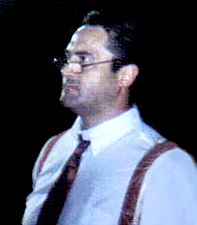
John "Bradshaw" Layfield (right) cutting a promo
An in-character interview or monologue.[1] Often includes either an in-ring or backstage interview or some other type of skit by wrestlers and other performers to advance a storyline or feud.[1] The act of performing a promo is referred to as "cutting", as in "cutting a promo". When the promo is aimed at a specific opponent (which can be an individual, tag team, stable, or faction), it is said to be cut "on" the target. A promo is an essential part of any wrestling show and is named as such as it is meant to "promote" an upcoming show or a future segment on the current show.[39]
protected
An aspect of the business which is consciously presented in a way that will make it look as strong and credible as possible. Wrestlers can be protected by booking them in a way which emphasizes their strengths and hides their weaknesses as a performer, while a move can be protected by having opponents sell strongly and rarely kick out.
pull apart
A brawl so vicious that the combatants need to be pulled apart by others.
The worked rising of a wrestler's status in the eyes of the fans. Compare burial
put over
The act of one wrestler helping to boost the status of another, most often by losing a match or by selling their opponent as a credible threat.
R
rasslin'
Also wrasslin', southern style or, more specifically, Memphis style.
Originally, along with "grunt-and-groan", used by the mainstream media when presenting a derisive story on professional wrestling, which often stereotyped the participants and audience. Now refers to a style of wrestling popular in the Mid-South region of Tennessee, Mississippi, and Arkansas (primary city is Memphis, Tennessee), and as a result, the southeastern United States, which emphasizes kayfabe and stiffness, generally with fewer squash matches and longer feuds, hence the more recent "southern style" or to be specific compared to the Carolinas (Jim Crockett) or Georgia styles, "Memphis style".
receipt
A term for returning a particularly stiff move back to a wrestler. This is usually done when one wrestler is being legitimately hit by his/her opponent's blows, and the wrestler being hit will send a legitimate move or hit back to the opponent as a wordless reminder to not hit so hard. Can also be used to refer to other aspects of the wrestling presentation, such as going into business for him/herself in a promo.
ref bump
A scenario where the referee of the match takes a bump and is removed from the match due to being (in kayfabe) knocked out, temporarily or permanently. This usually occurs to allow a storyline to progress (such as a run-in by a third party or turn by a second).
rematch clause
Also return clause.
When a champion loses their title to another, this may be invoked as a storyline plot device to procure a title rematch in the near future (often the next pay-per-view event) in order to continue a feud. In recent years, this clause has often been explicitly ignored in storylines.
repackage
To give a wrestler a new gimmick.
rest hold
Ted DiBiase Jr. performing a rest hold on Daniel Bryan
A loose hold applied during a match, during which wrestlers catch their breath or plan the next series of spots together.[1]
rib
A practical joke played by or on a wrestler.[1]
ring general
An experienced wrestler who knows how to work a match to its full potential.
ring psychology
The process of wrestling a match in such a way that the crowd becomes emotionally involved. Performing an engaging match requires acting skills and a good grasp of dramatic timing.[41]
ring rat
Similar to a groupie, one who frequents wrestling events to pursue sex with wrestlers.[1][42]
ring rust
A detriment to wrestling ability resulting from lack of practice during a hiatus.
Road Warrior Pop
A loud roar of approval that a wrestler receives from the fans when making their entrance to the ring, in reference to popular tag team the Road Warriors, also known as Legion of Doom.
rope break
A break of the pin count or submission when a wrestler has his hands or feet on the rope or under the rope.
rub
Helping a less popular wrestler get over by associating them with a more prominent or popular wrestler. An example of this being when The Hurricane won against The Rock during a time in which The Rock was one of the highest ranking wrestlers, while The Hurricane was a mid-carder.[43]
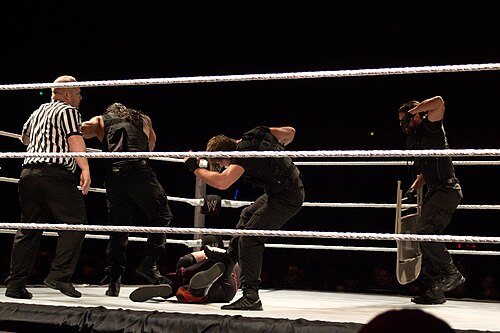
The nWo performing a run-in during WrestleMania 31
The unexpected entry of a new wrestler(s) or returning wrestler in a match already in progress.[1] Run-ins are usually made by heels, typically to further a feud with a face.[1] This is usually done with a beat down. Sometimes a face will do a run-in to protect another face from a heel who is cheating or overly punishing the weaker opponent, often beginning a feud.
rushed finish
Also audible finish.
A match finish which occurs sooner (and often differently) than planned. It is used when a wrestler is legitimately injured and cannot continue as planned, when the match is approaching its time limit (or a television segment is running long), or after a botch significantly changes the plot of the match. The term "audible" is also used, referring to the finish being known to happen upon verbal instruction from outside the ring.
S
sandbag
Also potato-sacking.
To sabotage a throw by letting one's body go limp instead of cooperating, which makes the throw much harder, if not impossible, to execute. This move is typically done deliberately to make the attacker appear weak or unskilled, but can also be the result of a botch. Sandbagging can be dangerous, as many moves require specific actions by the target to lower the risk of injury.[1]
schmoz/schmozz
A match that ends in chaos rather than in a decisive finish, usually due to a number of wrestlers not involved in the match running in and preventing a clean finish, often designed to end a match or angle.
A wrestler whom Pro Wrestling Illustrated referred to as a babyface as in its early years of circulation.
screwjob
An unfair and controversial finish, often involving cheating or outside interference.[1] A worked screwjob is part of the story and is used to generate heat or sympathy while allowing a popular babyface to lose without losing credibility. A shoot screwjob occurs when the finish is changed without informing the losing wrestler. One famous instance of this was the Montreal Screwjob at the 1997 Survivor Series, when Shawn Michaels won the WWF Championship from Bret Hart after Vince McMahon ordered referee Earl Hebner to ring the bell.
A person accompanying, or "seconding", a wrestler to a match.[44] Typically a manager, valet, enforcer, tag team partner or stablemate, the second is typically listed on the card alongside the wrestler they are supporting.
sell
To react to something in a way which makes it appear believable and legitimate to the audience.[1] Typically refers to the physical action by a wrestler of making an opponent's moves look impactful, but it can be used to refer to any aspect of the worked presentation, notably including commentator reactions.[45]Compare no-sell and over-sell.
shitcan
To forcefully throw a wrestler from inside the ring to the floor outside through the ropes.
shoot
When a wrestler or personality deliberately goes off-script, either by making candid comments or remarks during an interview, breaking kayfabe, or legitimately attacking an opponent.
shoot style
A style of professional wrestling that originates in Japan. Shoot style wrestling employs stiff strikes, realistic submission holds, and occasionally a round system or other specific rules and ways to win in an attempt to give professional wrestling a legitimate sports-like feel. Satoru Sayama and Akira Maeda in the UWF and Nobuhiko Takada in the UWFi popularized the style.
signature move
A move a wrestler regularly performs, for which the wrestler is well known. Also, a term used for a special move done before their finisher.[46]
slow burn
A storyline that develops over a long period.
smark
Short for "smart mark". Someone who has inside knowledge of the wrestling business, but is not speaking from their own personal experience with the business and has typically obtained that knowledge through dirt sheets. Often used as a term of derision for know-it-all fans.[30]
smart
Having inside knowledge of the wrestling business. Originally used to refer to those who were aware of the existence of kayfabe and the scripted nature of professional wrestling. The act of teaching someone inside knowledge of the wrestling business is referred to as "smartening up" someone.[1][2]
snug
To apply real pressure to a hold, either to make it appear more realistic to the audience, or to exact supremacy or revenge over an opponent.[30]Compare stiff.
sports entertainment
The term WWE uses to describe both its own product and professional wrestling as a whole. It was first used by the promotion in the 1980s and is intended to acknowledge wrestling's roots in competitive sport and dramatic theater.
spot
Any planned action or series of actions in a match.[1] Variations include the highspot, comeback spot, hope spot, and take-home spot. Compare missed spot.
spotfest
A match which consists mainly or entirely of pre-planned spots, normally with little flow and no logical transitions between moves and with little or no storytelling. Often used as a derisory term for matches which are seen to prioritize high-impact stunts over ring psychology.
spotmonkey
Derogatory term used to denote a wrestler who is believed to rely heavily on highspots in order to mask a lack of basic wrestling ability.
squared circle
The wrestling ring.
squash
An extremely one-sided match.[1] Sometimes called Tomato-can match. Squashes generally feature star wrestlers or wrestlers receiving a push quickly and easily defeating jobbers, usually to help get a gimmick or moveset[definition needed] over.
stable
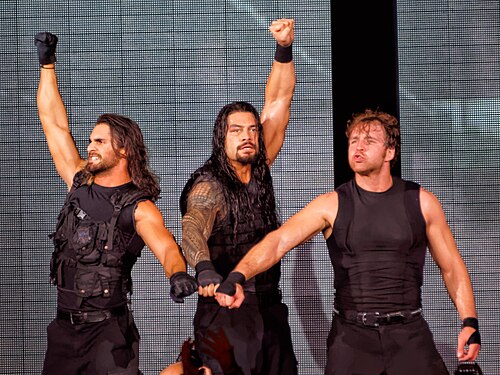
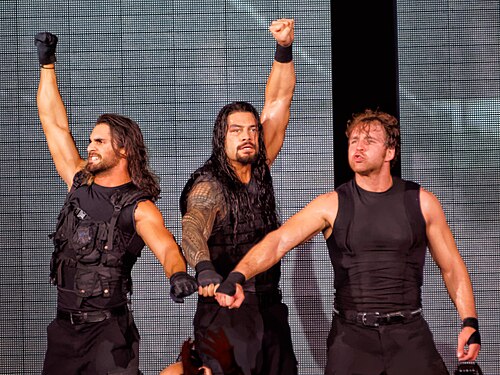
Stables can vary in size, from three-man units like The Shield (pictured) who feature similar outfits, to large groups with varying membership such as The Heenan Family. Dean Ambrose (right) played the de facto leader and mouthpiece of the group,[47][48] while Bobby Heenan was the spokesperson of The Heenan Family.
A team of three or more wrestlers, usually heels, who generally share common motives, allies and adversaries within a storyline (or through multiple storylines) and are often presented as having the same or very similar gimmicks. Stables sometimes have several members partake in more separate activities, such as Owen Hart and the British Bulldog having their own tag team while also being part of the larger Hart Foundation. This is also rather common in Japanese promotions, where large stables (such as Chaos and Bullet Club) will also have various teams and sub-groups within them. A stable differs from a faction in that a stable consists of wrestlers who share a common leader, for example as a manager or valet, who directs the wrestlers and speaks for them.
stick
A microphone ("the stick"), used to deliver a promo.[49]
stiff
Using excessive force when executing a move, deliberately or accidentally, thus causing the opponent increased legitimate pain.[1][50]
The act of causing physical harm to prospective professional wrestlers, usually by the means of submission holds. In the kayfabe period, this served to protect the wrestling business from accusations of "being fake", to instill humility in newer members of the locker room, & helped to weed out those who could not take punishment. A professional wrestling trainer notable for "stretching" his recruits was Stu Hart, in the infamous Hart Dungeon.[52] Other wrestlers in various territories who were used to test potential newcomers were Danny Hodge, Bob Roop, and "Dr. Death" Steve Williams.
strike
1. Any contact made by one wrestler to their opponent (e.g., punches, kicks, chops, etc.).
2. A violation of WWE's wellness policy, with three strikes in an 18-month period resulting in a wrestler being released from the promotion.
strong style
A Japanese-inspired professional wrestling style that is worked, yet aims to deliver realistic performances, through stiff martial arts strikes and worked shoots.[1]
super finisher
A move rarely used by a wrestler, but one that almost always ends a match. Some notable examples include Randy Orton's Punt Kick and Kenta Kobashi's Burning Hammer. Kenny Omega's One Winged Angel is also an example of a very protected finisher with his often tag-team partner Kota Ibushi being the only person known to have kicked-out of the move.
A sudden change in the direction of a storyline to surprise the fans. Often, it involves one wrestler turning on an ally in order to join a supposed mutual enemy. Swerves frequently start feuds between the former allies. This also refers to when a booker leads fans to believe that something is going to happen (or someone could appear) at a show, before doing something entirely different.[1]
T
tease
To indicate a turn. A face teases a heel turn if they start exhibiting heel behaviors and a heel indicates a face turn if they start exhibiting face behaviors or fall victim to the misdeeds of a more nefarious heel.
technical wrestling
A style of wrestling focused more on holds, takedowns, submissions, and grappling.
technician
A wrestler who employs or masters so called technical wrestling style. Bret Hart is a commonly cited example of a great technical wrestler.[53]
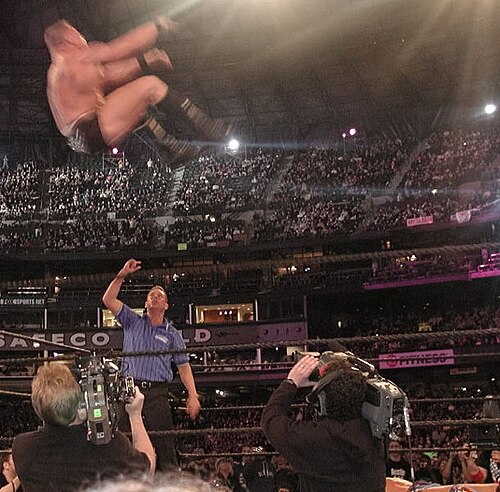
The TitanTron (background) at Money in the Bank in July 2011
A video screen above the entrance stage area, used for showing entrance videos, backstage segments, promos, and the match-in-progress for audience members seated too far back from the ring. A play on the name of Sony's JumboTron and Titan Sports, the then-parent company of the World Wrestling Federation (WWF), the TitanTron was introduced as part of WWF's Raw set in the mid-1990s. The concept has since been adapted by other major promotions, such as World Championship Wrestling, which used the TurnerTron (which was sometimes called NitroVision).
trainer
An individual who trains someone as a professional wrestler, generally a former or current wrestler themselves.
transitional champion
A short-reigning champion who serves to move the title indirectly from one wrestler to a third. They are usually used when the title is to be moved between two faces, to avoid requiring them to wrestle each other (to avoid burying one, to save the match up for a bigger show, or, more rarely, when the wrestlers refuse to work with each other).
turn
A switch in alignment of a wrestler's character. Turns involve a wrestler going from face to heel or vice versa.[1] There are two types of turns, the hard turn (which occurs quickly and acts as a surprise device) and the soft turn (a gradual shift in character). Transitioning from a face into a heel is called a 'heel turn' and the opposite is called a 'face turn'.
tweener
A morally ambiguous wrestler who is neither a face nor heel (an in-betweener),[1] also sometimes describes a heel who is usually cheered or a face who is usually jeered, especially when two faces or two heels face each other. (See also: antihero)
U
Unified
The state of two or more championships when merged by one champion.
V
vacant
The state of a championship not held by any wrestlers.
valet
A person, usually female, who accompanies a performer to the ring.[54] Usually serves to titillate or agitate the crowd, or to interfere in the match.[54]
vanilla midget
A derogatory term created by Kevin Nash to describe wrestlers who are good ring-workers, but believed to be too small and boring to ever succeed on a large stage.
vignette
Any piece of video footage featuring characters or events which is shown to the audience for the purposes of entertainment or edification. Usually meant to introduce a debuting character, to get a wrestler over before their TV wrestling debut or to signify an impending return.
visual fall
A pinfall that the referee does not see, but the crowd does. It is usually followed by a late kick-out when the referee eventually sees the pinfall and starts counting. It is used to heighten the drama of a match by showing that the pinning wrestler had done enough to win by pinfall.
W
work
1. (noun): Anything planned to happen,[3] or a "rationalized lie".[1] The opposite of shoot.
2. (verb): To methodically attack a single body part over the course of a match or an entire angle, setting up an appropriate finisher.
3. (verb): To deceive or manipulate an audience in order to elicit a desired response.
worked shoot
The phenomenon of a wrestler seemingly going "off script", often revealing elements of out-of-universe reality, but actually doing so as a fully planned part of the show. A notable example of a worked shoot is CM Punk's pipebomb promo on the June 27, 2011, episode of Monday Night Raw.[55]
worker
Another term for professional wrestler. Often used in the context of describing in-ring skill level (e.g., "He is a good/bad worker").
workrate
The in-ring performance level a wrestler puts into their matches, judged by a combination of skill and effort. A wrestler considered talented in the ring has a "high workrate".
wrestler's court
A term used often to describe kangaroo courts held backstage with a congregation of wrestlers; this is often used to settle backstage disputes and transgressions between performers and (sometimes) staff such as writers. In WWE, The Undertaker is known as being the "judge, jury, and executioner" and JBL the "prosecuting attorney" of wrestler's court during their full-time tenures in the company. Punishments for those found "guilty" often included the purchase of the night's alcohol or rental cars.[56]
write off
Also write off television.
To book an angle and/or match so as to explain in kayfabe a wrestler's upcoming (and usually inconvenient) absence, usually in the form of being "injured".
X
X division
A high-flying, high-risk, fast-paced style of professional wrestling which was originated in Total Nonstop Action Wrestling (TNA). Rather than emphasizing the fact that most wrestlers who perform this style are under 220 lb (100 kg) by calling it a cruiserweight division, they decided to emphasize the high-risk nature of the moves that these wrestlers perform, removing all restraints placed on its wrestlers, and allowing them to perform almost stunt-like wrestling moves.
X signal
A signal used by referees during a match to indicate that a wrestler is unable to continue and may need medical attention. The referee will cross their arms and, if necessary, point to the injured wrestler. Since many fans are aware of the significance of the signal, and with referees often now having direct communication with producers backstage, it is now sometimes used in kayfabe fashion, to sell a storyline injury.
X-Pac heat
When fans jeer at a wrestler because they dislike the wrestler personally as opposed to the character he or she plays in the ring. Named after Sean Waltman, known as X-Pac, who was believed to have "overstayed his welcome" by some fans, and so was jeered regardless of whether he was a face or heel character. Compare go away heat.
Y
young boy
Also young lion.
A rookie, particularly in Japanese professional wrestling. The term "young lion" is used for the trainees from the New Japan Pro-Wrestling dojo; although they usually perform at NJPW shows, typically on the lower card, they are also assigned other tasks such as security around the ring.
References
^ a b c d e f g h i j k l m n o p q r s t u v w x y z aa ab ac ad ae af ag ah ai aj ak al am an ao ap aq ar as at au av aw ax ay az ba bb bc bd be bf bg bh bi bj bk bl bm bn bo bp bq br bs bt bu bv bw bx by"Torch Glossary of Insider Terms". PWTorch.com. 2000. Archived from the original on June 6, 2011. Retrieved July 10, 2007.
^ a b c d e f g h i j k l m n o p q r sShoemaker, David (August 13, 2014). "Grantland Dictionary: Pro Wrestling Edition". Grantland. Retrieved November 11, 2019.
^ a b c d e f g hKerrick, George E. (Summer 1980). "The Jargon of Professional Wrestling". American Speech. 55 (2): 142–145. doi:10.2307/3050508. JSTOR 3050508.
^Caldwell, James (April 1, 2015). "ROH news: New Japan's top star announced for ROH vs. New Japan tour, ROH releases "Field of Honor" details". Pro Wrestling Torch. Retrieved June 11, 2016.
^全日諏訪魔VS大日関本シングル対決実現. Nikkan Sports (in Japanese). December 19, 2011. Retrieved June 11, 2016.
^Nicholas Sammond, Steel Chair to the Head: The Pleasure and Pain of Professional Wrestling (2004).
^"MJF Addresses Potential WWE Move Ahead Of 'Bidding War Of 2024'". WrestleTalk. 16 November 2023. Retrieved 2023-12-16.
^"Latest On MJF's Future: AEW Vs. WWE Bidding War". WhatCulture. 21 November 2023. Retrieved 2023-12-16.
^"Bill Watts shoot interview page 2". KayfabeMemories.com. Retrieved August 20, 2021. Lawler & Jarrett came over to Mid-South, watched some of the TV, and noted that there were no "blowjobs". Watts through they meant literally, but indeed they were referring to pretty boy teams to draw in the Backstreet Boy demographic.
^"Celebrate TakeOver 25 With The Best GIFs From The 25 NXT Live Specials". Uproxx.com. May 30, 2019.
^"Joey Janela's Spring Break 3 Part One Recap: Deathmatch, Jungle Boy Returns, Virgil Appears". Wrestlinginc.com. April 6, 2019.
^Segarra, Jason (25 September 2017). "WWE No Mercy 2017 review: A good run that stumbles before the goal line". Aiptcomics.com.
^"SHIMMER 62 live results: Cheerleader Melissa defends against LuFisto". Ringbellesarchive.wordpress.com. April 5, 2014.
^"Across the Pond Wrestling: Event Review: FCP Breaking into Heaven - Clint Margera v Pete Dunne 2 *Falls Count Anywhere". Archived from the original on 2019-10-19. Retrieved 2019-03-18.
^Bichelman, Jamie Evan (June 23, 2023). "Jay Hunter has no time for stereotypes". The Times of Israel. Retrieved 2023-12-02.
^Foley, Mick. Have A Nice Day: A Tale of Blood and Sweatsocks (p.65)
^Ross, Jim (May 5, 2015). "Samoa Joe on Ross Report podcast tonight". JR's BarBQ. Archived from the original on June 4, 2016. Retrieved July 30, 2016.
^Clapp, John (February 17, 2013). "WWE Champion The Rock def. CM Punk". WWE. Archived from the original on February 21, 2013. Retrieved July 30, 2016.
^Whatever Happened to Gorgeous George by Joe Jares, Tempo Books, 1974, p. 85.
^ a bHarley Race, Ricky Steamboat, Les Thatcher. The Professional Wrestlers' Workout & Instructional Guide (p.106)
^ a bStone Cold Steve Austin. The Stone Cold Truth (p.90)
^Stone Cold Steve Austin. The Stone Cold Truth (p.83)
^"Wrestling Booker's Glossary of pro wrestling terms". Archived from the original on June 13, 2008. Retrieved April 11, 2008.
^Justin Barrasso (August 13, 2021). "Hiroshi Tanahashi Headline Match in L.A. Could Prop Open the 'Forbidden Door'". Sports Illustrated. Retrieved February 14, 2021.
^Solomon, Brian (2015). Pro Wrestling FAQ: All That's Left to Know About the World's Most Entertaining Spectacle. Backbeat Books. p. 190. ISBN 978-1-61713-627-6.
^"Orange Cassidy Kid Pins Cody After AEW Dynamite Tapings (Video), AEW Renames Go Position In Honor Of Dusty Rhodes". Wrestlezone. October 17, 2019.
^"5 Wrestling moves banned by WWE". Fox Sports. December 20, 2018. Archived from the original on January 2, 2019. Retrieved January 9, 2020.
^ a b c"Grantland Dictionary: Pro Wrestling Edition". grantland.com. August 13, 2014. Retrieved October 24, 2014.
^Rueter, Sean (26 May 2018). "Are you a Mark?". Cageside Seats. Vox Media. Retrieved 25 July 2020.
^Seagull, Justin (July 16, 2017). "10 Biggest "Jannettys" In Wrestling History". WhatCulture.com.
^"Pro Wrestling Primer: Glossary of terms". The Evil Eye Blog. 2009. Retrieved December 7, 2014.
^Fisher, Jon (9 October 2015). "5 Underrated microphone workers of all-time in WWE history". www.sportskeeda.com. Retrieved 2022-04-29.
^Mancuso, Ryan (September 11, 2006). "Complete Playbook: The Great Muta Vol. 2 Revenge of Muta Commercial Tape". 411mania.com. Retrieved October 24, 2007.
^Cory Kilgannon (March 15, 2012). "From Inside a Bad-Guy Wrestler, a Brutal Artist Screamed for Release". The New York Times. Retrieved January 14, 2016.
^"Young WWE fan Nicholas teams with Braun Strowman against The Bar". YouTube. WWE. April 8, 2018. Archived from the original on 2021-10-28. Retrieved April 9, 2018.
^"WWE WrestleMania 34 results: Braun Strowman picks 10 year old WWE fan 'Nicholas' as mystery partner". Forbes. Retrieved 9 April 2018.
^Illuminati, Chris (February 23, 2017). "The Slow Death of the Great Professional Wrestling Promo". Rolling Stone.
^Barrasso, Justin (November 3, 2020). "Ring of Honor's Jonathan Gresham Revitalizes Technical Wrestling With Return of Pure Championship". Sports Illustrated. Retrieved August 21, 2021. 'Ring of Honor, it's all about sport. That's the genre, pure wrestling. That is what makes us unique, and I kept telling the office that we needed this market of our own. A lot of fans feel the same. They want their wrestling to be pure, technical wrestling, so let's fill that void.' [Italics added].
^John Powell (June 18, 2000). "Booker T: Wrestling's consummate performer". SLAM! Wrestling. Archived from the original on January 26, 2016. Retrieved 2008-06-17.
^Ross, Jim; J.R.'s Family Bar-B-Q® (December 24, 2013). "#RAW Christmas Feedback..." J.R.'s Place blog. Archived from the original on December 26, 2013. Retrieved December 25, 2013.
^"AAA Triplemania 2017 today, complete lineup". Pro Wrestling Insider. Retrieved 18 December 2017.
^X-Pac on: Yokozuna. YouTube. 31 December 2014. Archived from the original on 2019-08-30.
^Kaelberer, Angie Peterson (2003). The Hardy Boyz: Pro Wrestlers Matt and Jeff Hardy. Capstone Press. p. 44. ISBN 0-7368-2142-2.
^Khan, Steve (22 June 2016). "Examining Dean Ambrose's roller coaster ride to the top of WWE". Wrestling Observer. Retrieved 18 July 2017.
^"The Shield vs. The Wyatt Family: Tale of the Tape". WWE. Retrieved June 29, 2016.
^O'Brien, Alan (June 14, 2016). "WWE Raw hits & misses: strong top-of-the-hour segments highlight a dull go-home show". F4WOnline.com. Retrieved August 17, 2021. Styles' bitter rejoindre, delivered forcefully with convincing fire, was even more impactful as it further banished the notion that the former IWGP champion can't hang with the best on the stick.
^Sammond, Nicholas (2005). Steel Chair to the Head: The Pleasure and Pain of Professional Wrestling. Duke University Press. pp. 211–212. ISBN 0-8223-8682-8.
^"Heart to Hart: 90 Minutes on the Phone with Bret 'The Hitman' Hart". offthetracks.co.nz. Archived from the original on 2018-04-03. Retrieved 2018-04-02.
^Beaston, Erik (17 April 2016). "10 Greatest Wrestling Technicians In WWE History". WhatCulture.com.
^ a bJeff Clark (September 7, 2007). "The Luchagors Drop a Powerbomb". Stomp and Stammer. Retrieved 2007-10-02.
^The Masked Man (David Shoemaker) (June 28, 2011). "Punk'd". Grantland. Archived from the original on January 21, 2013.
^"WWE Network – Tales From the Deadman". Watch.wwe.com.
Further reading
Beekman, Scott. Ringside: A history of professional wrestling in America (Greenwood, 2006)
Foley, Mick (2000). Have a Nice Day: A Tale of Blood and Sweatsocks. HarperCollins. ISBN 0-06-103101-1.
Harley Race; Ricky Steamboat; Les Thatcher (2005). The Professional Wrestlers' Workout & Instructional Guide. Sports Publishing LLC. ISBN 1-58261-947-6.
Kerrick, George E. "The jargon of professional wrestling". American Speech (1980): 142–145. JSTOR
Laurer, Joanie (2001). If They Only Knew. ReaganBooks. ISBN 0-06-109895-7.
Mazer, Sharon. Professional wrestling: sport and spectacle (Univ. Press of Mississippi, 1998)
Murray, Thomas E. "The language of bodybuilding". American Speech (1984): 195–206. in JSTOR
Stone Cold Steve Austin; Jim Ross (2003). The Stone Cold Truth. Pocket Books. ISBN 0-7434-7720-0.
External links
Total Wrestling Terms
Wrestling Booker's Glossary of pro wrestling terms at the Wayback Machine (archived June 13, 2008)