
Loading article…

β- ラクタム(β-ラクタム)環は4員環のラクタムである。[ 1 ]ラクタムは環状アミドであり、β-ラクタムは窒素原子がカルボニル基に対してβ炭素原子に結合していることからそのように命名されている。最も単純なβ-ラクタムは2-アゼチジノンである。β-ラクタムは、多くのβ-ラクタム系抗生物質に見られるように、医薬品の重要な構造単位である。[ 2 ] [ 3 ] 1970年までは、β-ラクタムの研究のほとんどはペニシリンおよびセファロスポリン群に関するものであったが、それ以降、非常に多様な構造が記述されている。[ 4 ]


β-ラクタム環は、いくつかの抗生物質ファミリーのコア構造の一部であり、主なものとしてはペニシリン、セファロスポリン、カルバペネム、モノバクタムがあり、これらはβ-ラクタム系抗生物質とも呼ばれます。これらの抗生物質のほぼすべては、細菌の細胞壁生合成を阻害することによって作用します。これは細菌に対して致命的な効果がありますが、特定の細菌集団には通常、β-ラクタム系抗生物質に耐性のあるサブグループが含まれています。細菌の耐性は、β-ラクタム環を切断する酵素であるβ-ラクタマーゼを産生する多くの遺伝子のいずれかの発現の結果として発生します。さまざまな細菌種で1,800種類以上のβ-ラクタマーゼ酵素が記録されています。[ 5 ]これらの酵素は、化学構造と触媒効率が大きく異なります。[ 6 ]細菌集団にこのような耐性サブグループが存在する場合、β-ラクタムによる治療は、耐性株の蔓延を招き、結果として病原性を高める可能性があります。β-ラクタム系抗生物質は最も重要な抗生物質クラスの1つと考えられていますが、臨床的耐性が生じやすいです。β-ラクタムは、ペニシリン結合タンパク質(PBP)として知られる酵素群の天然に存在するd-Ala-d-Ala基質を模倣することによって抗生物質特性を発揮します。PBPは、細菌の細胞壁のペプチドグリカン部分を架橋する機能を持っています。[ 7 ]
β-ラクタム環は、コレステロール吸収阻害薬であるエゼチミブなど、他のいくつかの薬剤にも見られる。
最初の合成β-ラクタムは、1907年にヘルマン・シュタウディンガーによって、アニリンとベンズアルデヒドのシッフ塩基とジフェニルケテン[ 8 ] [ 9 ]を[2+2]環化付加反応させることで合成された(Phはフェニル官能基を示す)。

β-ラクタムの合成には多くの方法が開発されてきた。[ 10 ] [ 11 ] [ 12 ]
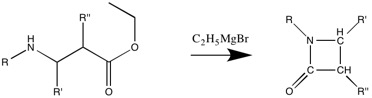
The Breckpot β-lactam synthesis[13] produces substituted β-lactams by the cyclization of beta amino acid esters by use of a Grignard reagent.[14]Mukaiyama's reagent is also used in modified Breckpot synthesis.[13]
Due to ring strain, β-lactams are more readily hydrolyzed than linear amides or larger lactams. This strain is further increased by fusion to a second ring, as found in most β-lactam antibiotics. This trend is due to the amide character of the β-lactam being reduced by the aplanarity of the system. The nitrogen atom of an ideal amide is sp2-hybridized due to resonance, and sp2-hybridized atoms have trigonal planar bond geometry. As a pyramidal bond geometry is forced upon the nitrogen atom by the ring strain, the resonance of the amide bond is reduced, and the carbonyl becomes more ketone-like. Nobel laureateRobert Burns Woodward described a parameter h as a measure of the height of the trigonal pyramid defined by the nitrogen (as the apex) and its three adjacent atoms. h corresponds to the strength of the β-lactam bond with lower numbers (more planar; more like ideal amides) being stronger and less reactive.[15] Monobactams have h values between 0.05 and 0.10 angstroms (Å). Cephems have h values in of 0.20–0.25 Å. Penams have values in the range 0.40–0.50 Å, while carbapenems and clavams have values of 0.50–0.60 Å, being the most reactive of the β-lactams toward hydrolysis.[16]