Loading article…
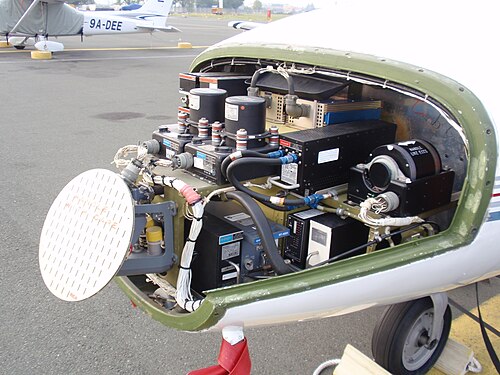

アビオニクス(航空と電子機器の合成語)は、航空機で使用される電子システムのことです。アビオニクスシステムには、通信、航法、複数のシステムの表示と管理、および個々の機能を実行するために航空機に搭載される数百ものシステムが含まれます。これらは、警察ヘリコプターのサーチライトのような単純なものから、空中早期警戒プラットフォームの戦術システムのような複雑なものまであります。[ 1 ]
「アビオニクス」という用語は、1949年に アビエーション・ウィーク&スペース・テクノロジー誌の上級編集者であるフィリップ・J・クラスによって「航空電子機器」の合成語として造語されました。[ 2 ] [ 3 ]
無線通信は第一次世界大戦の直前に航空機で初めて使用されました。[ 4 ] 最初の空中無線機はツェッペリン飛行船に搭載されていましたが、軍はより重い航空機に搭載できる軽量無線機の開発を促し、空中偵察複葉機が撃墜された場合に観測結果をすぐに報告できるようにしました。飛行機からの最初の実験的な無線送信は、 1910年8月に米国海軍によって行われました。最初の航空機無線機は無線電信で送信されました。これには、モールス信号でメッセージを綴るために電信キーを操作する2人目の乗員がいる2人乗りの航空機が必要でした。第一次世界大戦中、 1917年に三極真空管の開発により振幅変調音声双方向無線機が可能になりました(TM(三極管)を参照)。これは、単座航空機のパイロットが飛行中に使用できるほどシンプルでした。
Radar, the central technology used today in aircraft navigation and air traffic control, was developed by several nations, mainly in secret, as an air defense system in the 1930s during the runup to World War II. Many modern avionics have their origins in World War II wartime developments. For example, autopilot systems that are commonplace today began as specialized systems to help bomber planes fly steadily enough to hit precision targets from high altitudes.[5] Britain's 1940 decision to share its radar technology with its U.S. ally, particularly the magnetronvacuum tube, in the famous Tizard Mission, significantly shortened the war.[6] Modern avionics is a substantial portion of military aircraft spending. Aircraft like the F-15E and the now retired F-14 have roughly 20 percent of their budget spent on avionics. Most modern helicopters now have budget splits of 60/40 in favour of avionics.[7]
The civilian market has also seen a growth in cost of avionics. Flight control systems (fly-by-wire) and new navigation needs brought on by tighter airspaces, have pushed up development costs. The major change has been the recent boom in consumer flying. As more people begin to use planes as their primary method of transportation, more elaborate methods of controlling aircraft safely in these high restrictive airspaces have been invented.[8]
Avionics plays a heavy role in modernization initiatives like the Federal Aviation Administration's (FAA) Next Generation Air Transportation System project in the United States and the Single European Sky ATM Research (SESAR) initiative in Europe. The Joint Planning and Development Office put forth a roadmap for avionics in six areas:[9]
The Aircraft Electronics Association reports $1.73 billion avionics sales for the first three quarters of 2017 in business and general aviation, a 4.1% yearly improvement: 73.5% came from North America, forward-fit represented 42.3% while 57.7% were retrofits as the U.S. deadline of January 1, 2020 for mandatory ADS-B out approach.[10]
The cockpit or, in larger aircraft, under the cockpit of an aircraft or in a movable nosecone, is a typical location for avionic bay equipment, including control, monitoring, communication, navigation, weather, and anti-collision systems. The majority of aircraft power their avionics using 14- or 28‑volt DC electrical systems; however, larger, more sophisticated aircraft (such as airliners or military combat aircraft) have AC systems operating at 115 volts 400 Hz, AC.[11] There are several major vendors of flight avionics, including The Boeing Company, Panasonic Avionics Corporation, Honeywell (which now owns Bendix/King), Universal Avionics Systems Corporation, Rockwell Collins (now Collins Aerospace), Thales Group, GE Aviation Systems, Garmin, Raytheon, Parker Hannifin, UTC Aerospace Systems (now Collins Aerospace), Selex ES (now Leonardo), Shadin Avionics, Avidyne Corporation and Israel Aerospace Industries.
International standards for avionics equipment are prepared by the Airlines Electronic Engineering Committee and published by ARINC.
Communications connect the flight deck to the ground and the flight deck to the passengers. On‑board communications are provided by public-address systems and aircraft intercoms.
The VHF aviation communication system works on the airband of 118.000 MHz to 136.975 MHz. Each channel is spaced from the adjacent ones by 8.33 kHz in Europe, 25 kHz elsewhere. VHF is also used for line of sight communication such as aircraft-to-aircraft and aircraft-to-ATC. Amplitude modulation is used, and the conversation is performed in simplex mode. Aircraft communication can also take place using HF (especially for trans-oceanic flights) or satellite communication.
航空航法とは、地球表面上または地表上空における位置と方向を決定することです。航空電子機器は、衛星航法システム( GPS、WAAS、EGNOS、GBAS/LAASなど)、慣性航法システム(INS)、地上無線航法システム( VORやLORANなど)、またはこれらの組み合わせを使用できます。GPSなどの一部の航法システムは、位置を自動的に計算し、移動地図ディスプレイに飛行乗務員に表示します。VORやLORANなどの旧式の地上航法システムでは、パイロットまたは航法士が紙の地図上に信号の交点をプロットして航空機の位置を特定する必要がありますが、最新のシステムは位置を自動的に計算し、移動地図ディスプレイに飛行乗務員に表示します。

グラスコックピットの最初の兆候は、飛行に適した陰極線管(CRT) スクリーンが電気機械式のディスプレイ、計器、および計器類に取って代わり始めた 1970 年代に現れました。「グラス」コックピットとは、計器やその他のアナログ ディスプレイの代わりにコンピューター モニターを使用することを指します。航空機には、次第に多くのディスプレイ、ダイヤル、および情報ダッシュボードが搭載されるようになり、最終的にはスペースとパイロットの注意を奪い合うようになりました。1970 年代には、平均的な航空機には 100 を超えるコックピット計器とコントロールがありました。[ 12 ]グラスコックピットは、1985 年にガルフストリームG-IV プライベート ジェット で実現し始めました。グラスコックピットの重要な課題の 1 つは、どれだけのコントロールを自動化し、どれだけのコントロールをパイロットが手動で行う必要があるかのバランスを取ることです。一般的に、パイロットに常に情報を提供しながら、飛行操作を自動化しようとします。[ 12 ]
航空機には飛行を自動的に制御する手段がある。オートパイロットは第一次世界大戦中にローレンス・スペリーによって初めて発明され、爆撃機を安定させて25,000フィートから正確な目標に命中させるために開発された。アメリカ軍が初めてオートパイロットを採用した際、ハネウェルのエンジニアが緊急時にオートパイロットを解除できるようボルトカッターを持って後部座席に座っていた。現在では、ほとんどの民間航空機には離着陸時のパイロットのミスや作業負荷を軽減するために航空機飛行制御システムが装備されている。[ 5 ]
最初のシンプルな商用オートパイロットは、方位と高度を制御するために使用され、推力や操縦翼面などの制御権限は限られていました。ヘリコプターでは、自動安定化が同様の方法で使用されていました。最初のシステムは電気機械式でした。フライ・バイ・ワイヤと(従来の油圧式ではなく)電気作動式の操縦翼面の登場により、安全性が向上しました。ディスプレイや計器と同様に、電気機械式の重要なデバイスには寿命がありました。安全性が極めて重要なシステムでは、ソフトウェアは非常に厳密にテストされます。
燃料量表示システム(FQIS)は、船内の燃料量を監視するシステムです。FQISのコンピュータは、静電容量管、温度センサー、密度計、液面センサーなどの様々なセンサーを用いて、船内に残っている燃料の質量を計算します。
燃料制御監視システム(FCMS)は、同様の方法で船内に残っている燃料を報告するだけでなく、ポンプやバルブを制御することで、様々なタンク間の燃料移送も管理します。
航空交通管制を補完するため、大型輸送機の大半と多くの小型機は、付近の航空機の位置を検知し、空中衝突を回避するための指示を提供する交通警報・衝突回避システム(TCAS)を使用している。小型機は、TPASのようなよりシンプルな交通警報システムを使用する場合もある。TPASは受動的(他の航空機のトランスポンダーに積極的に問い合わせを行わない)であり、衝突回避のための助言は提供しない。
制御された飛行による地形衝突( CFIT )を回避するために、航空機はレーダー高度計を主要な要素とする地上接近警報システム(GPWS)などのシステムを使用します。GPWSの主な弱点の1つは、「前方」情報がないことです。これは、GPWSが地形からの高度を「下方」にしか提供しないためです。この弱点を克服するために、現代の航空機は地形認識警報システム(TAWS)を使用します。
Commercial aircraft cockpit data recorders, commonly known as "black boxes", store flight information and audio from the cockpit. They are often recovered from an aircraft after a crash to determine control settings and other parameters during the incident.
Weather systems such as weather radar (typically Arinc 708 on commercial aircraft) and lightning detectors are important for aircraft flying at night or in instrument meteorological conditions, where it is not possible for pilots to see the weather ahead. Heavy precipitation (as sensed by radar) or severe turbulence (as sensed by lightning activity) are both indications of strong convective activity and severe turbulence, and weather systems allow pilots to deviate around these areas.
Lightning detectors like the Stormscope or Strikefinder have become inexpensive enough that they are practical for light aircraft. In addition to radar and lightning detection, observations and extended radar pictures (such as NEXRAD) are now available through satellite data connections, allowing pilots to see weather conditions far beyond the range of their own in-flight systems. Modern displays allow weather information to be integrated with moving maps, terrain, and traffic onto a single screen, greatly simplifying navigation.
Modern weather systems also include wind shear and turbulence detection and terrain and traffic warning systems.[13] In‑plane weather avionics are especially popular in Africa, India, and other countries where air-travel is a growing market, but ground support is not as well developed.[14]
There has been a progression towards centralized control of the multiple complex systems fitted to aircraft, including engine monitoring and management. Health and usage monitoring systems (HUMS) are integrated with aircraft management computers to give maintainers early warnings of parts that will need replacement.
The integrated modular avionics concept proposes an integrated architecture with application software portable across an assembly of common hardware modules. It has been used in fourth generation jet fighters and the latest generation of airliners.
Military aircraft have been designed either to deliver a weapon or to be the eyes and ears of other weapon systems. The vast array of sensors available to the military is used for whatever tactical means required. As with aircraft management, the bigger sensor platforms (like the E‑3D, JSTARS, ASTOR, Nimrod MRA4, Merlin HM Mk 1) have mission-management computers.
Police and EMS aircraft also carry sophisticated tactical sensors.
While aircraft communications provide the backbone for safe flight, the tactical systems are designed to withstand the rigors of the battlefield. UHF, VHF Tactical (30–88 MHz) and SatCom systems combined with ECCM methods, and cryptography secure the communications. Data links such as Link 11, 16, 22 and BOWMAN, JTRS and even TETRA provide the means of transmitting data (such as images, targeting information etc.).
Airborne radar was one of the first tactical sensors. The benefit of altitude providing range has meant a significant focus on airborne radar technologies. Radars include airborne early warning, anti-submarine warfare, and even weather radar (Arinc 708) and ground tracking/proximity radar.
The military uses radar in fast jets to help pilots fly at low levels. While the civil market has had weather radar for a while,[15] there are strict rules about using it to navigate the aircraft.[16]
Dipping sonar fitted to a range of military helicopters allows the helicopter to protect shipping assets from submarines or surface threats. Maritime support aircraft can drop active and passive sonar devices (sonobuoys) and these are also used to determine the location of enemy submarines.
Electro-optic systems include devices such as the head-up display (HUD), forward looking infrared (FLIR), infrared search and track and other passive infrared devices (Passive infrared sensor). These are all used to provide imagery and information to the flight crew. This imagery is used for everything from search and rescue to navigational aids and target acquisition.
Electronic support measures and defensive aids systems are used extensively to gather information about threats or possible threats. They can be used to launch devices (in some cases automatically) to counter direct threats against the aircraft. They are also used to determine the state of a threat and identify it.
The avionics systems in military, commercial and advanced models of civilian aircraft are interconnected using an avionics databus. Common avionics databus protocols, with their primary application, include: