
Loading article…
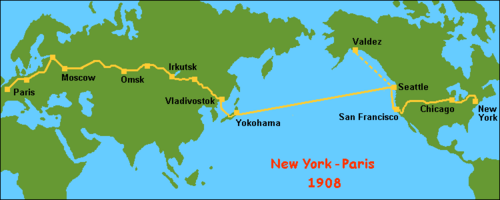


1908年のニューヨーク・パリレースは、ドライバーたちがニューヨークからパリまで走破することを目指す自動車競技でした。当時の自動車技術と道路インフラの状況を考えると、これは相当な難題でした。6組の参加者のうち、完走できたのはわずか3組でした。優勝したのは、1907年製のトーマス・フライヤーを駆るアメリカチームでした。
1907年の北京からパリへの自動車レースは、これらの新しい機械のさらに大胆なテストを促した。翌年のコースは、アメリカのニューヨーク市からフランスのパリまでで、アラスカ州ノームからベーリング海峡を横断してシベリアのイースト岬まで150マイル(240km )の船旅が計画されていた。[ 1 ]
レースは1908年2月12日にタイムズスクエアで始まった。4カ国を代表する6台の車がスタートラインに立ち、169日間に及ぶ試練に挑んだ(所要時間で言えば、史上最長のモータースポーツイベントとなった)。レースに参加した国は、ドイツ、フランス、イタリア、アメリカ合衆国だった。フランスからは3台の車(ド・ディオン・ブートン、モトブロック、シゼール・ノーダン)が参加し、ドイツ、イタリア、アメリカ合衆国からはそれぞれプロトス、ズスト、トーマスが参加した。午前11時15分、号砲がレース開始の合図となった。競技者の前には舗装道路はほとんどなく、世界の多くの地域では道路が全くなかった。道路が見つからない場合、チームはしばしば数百マイルにわたってバルーンタイヤを履いた車同士を連結させて機関車のレールをまたいで走行した。
アメリカ製のトーマス・フライヤー号は、アメリカ国内区間の終盤で首位に立ち、サンフランシスコに41日8時間15分で到着した[ 2 ]。これは、冬に自動車でアメリカを横断した最初の事例だった。
The route then took them to Valdez, Alaska, by ship. The Thomas crew found impossible conditions in Alaska and the race was rerouted across the Pacific by steamer to Japan where the Americans made their way across to the Sea of Japan. The race then went on to Vladivostok, Siberia, by ship, to begin crossing the continents of Asia and Europe. Only three of the competitors made it past Vladivostok: the Protos, the Züst, and the Thomas.
The wet plains of Siberia and Manchuria during the spring thaw made progress difficult. At several points, forward movement was often measured in feet rather than miles per hour. Eventually, the roads improved as Europe approached and the Thomas Flyer arrived in Paris on July 30, 1908, having covered approx 16,700 km to win the race. The Germans, whose Protos car was driven by Hans Koeppen, had arrived in Paris four days earlier, but were penalized a total of thirty days for not going through Japan and for shipping the Protos part of the way by railcar. That gave the win to the Americans, represented by driver George Schuster, who remains the only American to travel the full distance from New York to Paris.[3] The winning margin was 26 days, still the largest winning margin in any motorsport event ever. The Italians arrived much later and finished third in September 1908.
The race was of international interest with daily front-page coverage by The New York Times (a cosponsor of the race with the Parisian newspaper Le Matin). The significance of the event extended far beyond the race itself. Together with the Peking to Paris race, which had taken place the year before, it established the reliability of the automobile as a dependable means of transportation, eventually taking the automobile from an amusement of the rich to a reliable and viable means of long-distance transportation for the masses. It also led to the call for improved roads to be constructed in many parts of the world.
The winning driver, George Schuster, was inducted into the Automotive Hall of Fame on October 12, 2010.
The winning Thomas Flyer is on display in Reno, Nevada, at the National Automobile Museum, alongside the trophy.
計画されていたグレートレース2008は、中国を通過するための承認と許可が取り消されたため中止となったが、2011年に2度目の試みが行われた。ワールドレース2011は2011年4月14日にタイムズスクエアで始まり、参加者は1908年にニューヨークからパリまで辿ったルートを再現しようとした。[ 4 ]最終的に、スタートした車両のうち4台、1929年型フォード モデルA、1932年型フォード 3ウィンドウ クーペ、1967年型フォルクスワーゲン ビートル、そしてマルチ燃料の2007年型シボレー コルベットが、2011年7月21日にパリのエッフェル塔に到達した。2011年のレースには、1908年のニューヨークからパリまでのレースの優勝ドライバー、ジョージ・シュスターの曾孫であるジェフ・マールが参加した。 [ 5 ]