
Loading article…
ヴァルムとは、ローマ軍の陣地の要塞全体、あるいはその一部を指す。ヴァルムは通常、土塁または芝土塁(アッガー)の上に木製の柵を設け、その外側に深い堀(フォッサ)を掘った構造であった。ヴァルムという名称は、ヴァルス(杭)に由来し、本来はアッガーの上部の外縁に沿って設けられた柵を意味するが、一般的には要塞全体を指す言葉として用いられる。
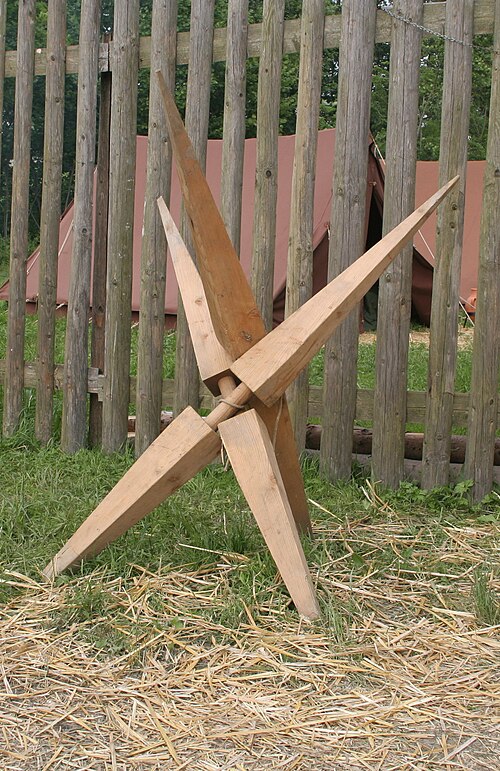
柵を構成する杭状のヴァッリ(χάρακες)については、ポリュビオス(『古代史』第18巻18章1節、抜粋第17巻14節)とリウィウス(『リウィウス』第33巻5節)が、ギリシア人とローマ人のヴァッリを比較し、後者のほうが優れていると述べている。ヴァッリには、どちらも若い木、または側枝のついた大きな木の枝が使われた。しかし、ギリシア人のヴァッリは、ローマ人のヴァッリよりもはるかに大きく、枝の数も多かった。ローマ人のヴァッリは、2本か3本、多くても4本の枝しかなく、しかも通常は同じ側にあった。ギリシア人は、ヴァッリをアガーにかなりの間隔を置いて配置し、その間の隙間を枝で埋めた。一方、ローマ人はヴァッリを密接に固定し、枝を絡ませ、先端を丁寧に尖らせた。そのため、ギリシャのヴァルスは大きな枝をつかんで簡単に引き抜くことができ、取り外すとヴァルスに大きな開口部が残った。一方、ローマのヴァルスは便利な取っ手がなく、引き抜くのに非常に大きな力が必要で、取り外しても残る開口部はごくわずかだった。ギリシャのヴァルスは現場で切り出されたが、ローマ人は事前に準備していた(ポリュビオス lc; ウェルギリウス ゲオルギオス iii.346, 347; キケロ トゥスキュラ ii.16)。ヴァルスは丈夫な木材であれば何でも作られたが、オークが好まれた。
行軍中、各兵士は長さ1.5メートル(5フィート)以上で両端が尖った丈夫な木の杭を3~4本携行していた。発掘調査では、これらの杭が多数発見されており、中央がくびれている、つまり「くびれ」があることが十分に良好な状態で保存されている。これらの杭を単独で、一時的な行軍陣地の周囲に築かれた土塁の柵として使うことは不可能だったことは明らかである。杭と杭の間には、攻撃者が容易に通り抜けられるほどの隙間ができてしまうだろう。一つの説は、この「くびれ」によって、杭を3本ずつゆるく結び合わせて、土塁(アガー)の上に設置できる一種の鉄菱やチェコのハリネズミのようなものを作ることができたというものである。おそらく、木の枝やイバラの茂みなど、手近にあるもので補強されていたのだろう。

In the operations of a siege, when the place could not be taken by storm, and it became necessary to establish a blockade, this was done by drawing defences similar to those of a camp around the town, which was then said to be circumvallatum. Such a circumvallation, besides cutting off all communication between the town and the surrounding country, formed a defence against the sallies of the besieged. There was often a double line of fortifications, the inner against the town, and the outer against a force that might attempt to raise the siege. In this case the army was encamped between the two lines of works.
This kind of circumvallation, which the Greeks called ἀποτειχισμός and περιτειχισμός, was employed by the Peloponnesians in the siege of Plataea (Thucyd. ii.78, iii.20‑23). Their lines consisted of two walls (apparently of turf) at the distance of 16 feet, which surrounded the city in the form of a circle. Between the walls were the huts of the besiegers. The walls had battlements (ἐπάλξεις), and at every ten battlements was a tower, filling up by its depth the whole space between the walls. There was a passage for the besiegers through the middle of each tower. On the outside of each wall was a ditch (τάφρος). This description would almost exactly answer for the Roman mode of circumvallation, of which some of the best examples are that of Carthage in modern-day Tunisia by Scipio (Appian, Punic. 119, &c.), that of Numantia in modern-day Spain by Scipio (Appian, Hispan. 90), and that of Alesia in modern-day France by Caesar (Bell. Gall. vii.72, 73). The towers in such lines were similar to those used in attacking fortified places, but not so high, and of course not moveable. (Lipsius, de Milit. Rom. v.5, in Oper. iii. pp156, 157; Poliorc. ii.1, in Oper. iii.283).
The vallum-building technique was later taken by neighbouring people, such as the Byzantines and the Goths.
Examples of valla include:
The word vallus is sometimes used as equivalent to vallum (Caesar, Bell. Civ. iii.63).