Loading article…
The 1910 United States census, conducted by the Census Bureau on April 15, 1910, determined the resident population of the United States to be 92,228,496, an increase of 21 percent over the 76,212,168 persons enumerated during the 1900 census. The 1910 census switched from a portrait page orientation to a landscape orientation.
This was the last census in which Texas did not record any top 50 largest cities by population, despite being the 5th most populous state at the time. It was also the first census in which all the top 50 largest cities had population over 100,000.
The 1910 census was the first to use metropolitan districts, the predecessor to modern metropolitan statistical areas, which were defined for all cities with at least 200,000 people.[1]
Dr. Edward Dana Durand, then-head of the Bureau of Corporations, was appointed in 1909 to oversee the census.[2] $14 million were allocated to conduct the census.[2]
The 1910 census collected the following information:[3]
Full documentation for the 1910 census, including census forms and enumerator instructions, is available from the Integrated Public Use Microdata Series.
The column titles in the census form are as follows:
LOCATION. Street, avenue, road, etc. House number (in cities or towns). 1. Number of dwelling house in order of visitation. 2. Number of family in order of visitation.
3. NAME of each person whose place of abode on April 15, 1910, was in this family.
Enter surname first, then the given name and middle initial, if any.
Include every person living on April 15, 1910. Omit children born since April 15, 1910.
RELATION.
4. Relationship of this person to the head of the family.
PERSONAL DESCRIPTION.
5. Sex.
6. Color or race.
7. Age at last birthday.
8. Whether single, married, widowed, or divorced.
9. Number of years of present marriage.
10. 母親の子供の数:生まれた子供の数。
11. 母親の子供の数:現在生存している子供の数。
出生地。
記載されている各人の出生地と両親の出生地を記入してください。米国生まれの場合は州または準州を、外国生まれの場合は国名を記入してください。
12. この人物の出生地。
13. この人物の父親の出生地。
14. この人物の母親の出生地。
市民権。
15. 米国への移住年。
16. 帰化者か外国人かを問わず。
17. 英語を話せるかどうか。話せない場合は、話せる言語を記入してください。
職業。
18. この人の職業または仕事、または特定の種類の仕事。例えば、紡績工、販売員、労働者など。
19. この人が働いている産業、事業、または施設の一般的な性質(例:綿紡績工場、雑貨店、農場など)。
20. 雇用主として、従業員として、または自営業として働く場合。
従業員の場合 – 21. 1910年4月15日に失業していたかどうか。
22. 1909年における休業週数。
教育。
23.読み書きができるかどうか。
24.字を書くことができるかどうか。
25. 1909年9月1日以降に学校に通ったことがある。
住宅の所有権。
26. 所有または賃貸。
27. 所有権が完全または抵当権付きである。
28. 農場または家。
29. 農場スケジュールの数。
30. 北軍または南軍の陸軍または海軍の生存者であるかどうか。
31. 両眼失明の有無。
32. 聴覚障害や言語障害の有無。

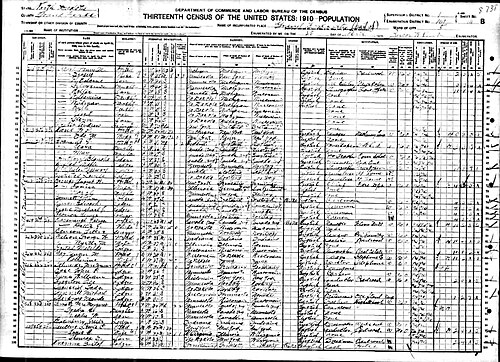
オリジナルの国勢調査の集計シートは、 1940年代に国勢調査局によってマイクロフィルム化され、その後、オリジナルのシートは破棄されました。[ 8 ]マイクロフィルム化された国勢調査は、国立公文書館でロール状で入手できます。また、いくつかの組織が、マイクロフィルム化された国勢調査の画像とデジタル索引をオンラインで公開しています。
1910年国勢調査のミクロデータは、統合公共利用ミクロデータシリーズを通じて無料で入手可能です。小地域ごとの集計データと電子境界ファイルは、国立歴史地理情報システムからダウンロードできます。