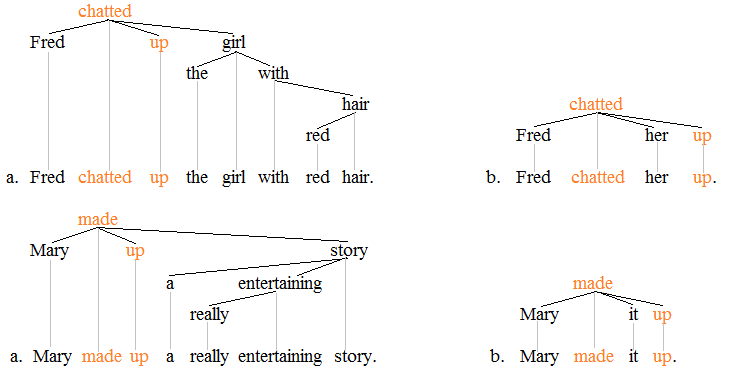
この構文でよく使われる助詞には、to、in、into、out、up、down、at、on、off、under、against などがあります。[ e ]これらの単語はすべて前置詞としても使用できますが、前置詞としての用法は異なり、現代の辞書では、例えばto (助詞)とto (前置詞)を別々の語彙としてリストしている場合があります。[ f ]助詞動詞構文では、前置詞句の一部として使用されていないため、前置詞として解釈することはできません。
f. よく考えてください。– overは名詞句が後に続かないため、前置詞にはなり得ません。
g. 誰がこの計画を思いついたのか? – up の後に名詞句が続きますが、動詞 ( think up ) に結びついており、名詞 (* up this scheme ) には結びついていないため、前置詞ではありません。
動詞+前置詞(前置詞動詞)
多くの動詞は、副詞的な働きをする前置詞句によって補完されることがある。
a.テーブルの上に立たないでください。
This construction is sometimes also taught as a phrasal verb, but only when the combination of verb and preposition is not intuitive to the learner:
b. Don't stand on ceremony.
Further examples:
c. I ran into an old friend. – into is a preposition that introduces the prepositional phrase into an old friend.
d. She takes after her mother. – after is a preposition that introduces the prepositional phrase after her mother.
e. Sam passes for a linguist. – for is a preposition that introduces the prepositional phrase for a linguist.
f. You should stand by your friend. – by is a preposition that introduces the prepositional phrase by your friend
Sometimes, both phenomena can occur in the same context.
a. Who can put up with that? – up is a particle and with is a preposition.[11]
b. She looks forward to a rest. – forward is a particle and to is a preposition.
c. The other tanks bore down on my Panther. – down is a particle and on is a preposition.
d. They really teed off on me. – off is a particle and on is a preposition.
e. We loaded up on snacks. – up is a particle and on is a preposition
f. Susan had to sit in for me. – in is a particle and for is a preposition.
In general, the discrete meanings associated with phrasal verbs cannot be readily understood solely by construing the sum of their respective parts: the meaning of pick up is distinct from the various meanings of pick and up, and may acquire disparate meanings depending on its contextual usage. Similarly, the meaning of hang out is not conspicuously related to a particular definition of hang or out.
Distinguishing phrasal verb types
粒子動詞が他動詞の場合、粒子と前置詞を区別するのが難しい場合があります。[ 12 ] [ g ]多くの場合有効な簡単な診断方法は、前置詞/粒子を名詞の後ろに移動できるかどうかを検討することです。英語の前置詞は名詞の後ろに置かれることはないので、動詞 - P - 名詞を動詞 - 名詞 - Pに変更できる場合、P は前置詞ではなく粒子でなければなりません。[ h ]しかし、粒子動詞の場合でも、粒子を移動できるとは限りません。たとえば、名詞ではなく代名詞が後に続く場合や、固定されたコロケーションがある場合などです。2 つ目の診断方法は、句の途中で息継ぎをしなければならない場合、本能的な区切りがどこになるかを考えることです。粒子は自然に前の動詞とグループ化され、前置詞は後の名詞句とグループ化されます。[ i ]これらの 2 つのアプローチを示す次の例では、アスタリスクは不可能な形式を示します。
a.スーザンに頼ってもいいですよ。– on は前置詞です。自然な区切りは「bank | on Susan」です。
b. *スーザンは頼りになる。– 前置詞は名詞の後に続くことはできません。
a. You can take on Susan. – on は助詞です。自然な分割は「take on | Susan」です。
b. You can take Susan on . – 助詞は助詞動詞の目的語の後に続くことができます。
a. 彼はその状況を乗り越えた。 – overは前置詞です。自然な区切りは「get | over the situation」です。
b. *彼はその状況を克服した。– 前置詞は名詞の後に続くことはできません。
a. 彼はその状況をじっくり考えた。 – overは助詞です。自然な区切りは「think over | the situation」です。
a.Ik moet de Lamp aansteken - 「ランプをつけなければなりません」: aan- / an-は不定詞の接頭辞です。
b. Ik steek de lamp aan - 「私はランプをつけます」: aan / an は主節の最後に独立して置かれます。
これらの言語では、助詞は他の種類の副詞に適用される規則と同じ規則に従って、動詞の語幹の前または後に現れることができます。動詞の前に来る場合、綴りの慣例として2つの部分を1つの単語として書きます。これは辞書形である不定詞で起こるため、助詞は伝統的に特定の状況下で分離する接頭辞として考えられています。動詞と強く共起する副詞/助詞と見なすことも同様に可能です。分離可能な動詞であるドイツ語のankommen(到着する)と、動詞と副詞がランダムに組み合わされたbald kommen (すぐに来る)を比較してください。
c. Ich komme an / komme bald. - 「私はもうすぐ到着します / もうすぐ来ます」 - 現在形、英語と同様に動詞の後に前置詞が続く
d. Ich kam an / kam bald. - 「私はすぐに到着した/すぐに来た」 - 過去形、英語と同様に動詞の後に助詞が続く
e. ...ダス・イッチ・アンコム/ハゲ・コム。- 「...もうすぐ到着します。」 - 現在、従属節の最後の位置にある動詞
f. Ich will ankommen / bald kommen. - 「私はすぐに到着したい/すぐに来たい」 - 単純不定詞、前置詞
g. Ich hoffe anzukommen / bald zu kommen. - 「すぐに到着することを願っています/すぐに来ます。」 - 不定詞とマーカーも接頭辞付き
h. Ich bin angekommen / ハゲコメン。- 「到着しました/すぐに来ます。」 - 完全、助詞の接頭辞付き
↑ Jeanette S. DeCarrico 英語の構造:形式と機能の研究 – 第1巻 – 80ページ – 2000年 "4.6.3 前置詞句動詞 – 前置詞が後に続く句動詞も存在します。これらの構造は前置詞句動詞または多語動詞と呼ばれます。例としては、put up with (例: I can't put up with) があります。"
↑ Farrell, Patrick (2005). "英語の動詞-前置詞構文: 構成要素と順序" . Language . 81 (1): 96– 137. doi : 10.1353/lan.2005.0017 . ISSN 1535-0665 . S2CID 119715102 .
↑ Ron Cowan – The Teacher's Grammar of English: A Course Book and Reference 2008 Page 176「副詞挿入テスト– 先に述べたように、自動詞句動詞は通常、動詞と前置詞の間に副詞を挿入することを許しません。他動詞句動詞も同様で、(25a)と(25b)がそれを示しています。対照的に、前置詞句動詞は副詞の挿入を許します。(25c)がそれを示しています。(25) a. He turned quickly off the light. = 分離可能な句動詞。b. He ran unexpectedly into his cousin = 分離不可能な句動詞。c. He stared intently at the target = 前置詞句動詞。 関係節テスト 関係代名詞が前置詞の目的語である関係節では、(26)に示す2つのパターンが許されます。(26) a. The man彼らが待っていた男性は遅れた。b. 彼らが待っていた男性は遅れた。(26a)では、前置詞 for は角括弧で囲まれた関係節の末尾にあるが、(26b)は、この前置詞が関係代名詞 whom の前の節の先頭にも現れることを示している。