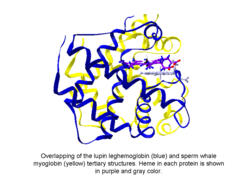
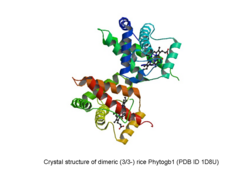
Like other globins, heme-Fe in Phytogbs is coordinated at the proximal region by a His amino acid (named as proximal His). The distal region of heme-Fe can be occupied by either a variety of ligands (such as oxygen and nitric oxide) or a distal (frequently a His) amino acid, giving place to penta- or hexa-coordinate Phytogbs, respectively. The Phytogbs2, SymPhytogbs and Lbs are predominantly penta-coordinate whereas Phytogbs1 are predominantly hexa-coordinate and Phytogbs0 and Phytogbs3 are a combination of penta- and hexa-coordinate.[4] Heme-Fe coordination is essential for Phytogb (and other globins) function because it regulates the rate of ligand-binding and –releasing as consequence of the kinetic constants kon and koff, respectively. For example, the affinity of soybean Lb and rice Phytogb1 for O2 (KO2) is moderate and very high because kon is 130 and 68 mM−1 s−1, koff is 5.6 and 0.038 s−1 and KO2 (i.e. the O2-affinity resulting from kon/koff) is 23 and 1800 mM−1, respectively.[11] This indicates that soybean Lb could function as an O2-storage or –transport protein and that the function of rice Phytogb1 (and other hexa-coordinate Phytogbs) could be other than O2-transport because the high affinity of this protein for O2 results from an extremely low koff constant.[12]
Synthesis and postulated functions
Like other globins, penta-coordinate Phytogbs reversibly bind and transport O2. The function of Lbs in nodules was elucidated in 1974 by Wittenberg, Appleby and others.[13] In nodules the concentration of Lbs is very high as they correspond to ~30% of the total soluble proteins. The apparent function of Lbs in nodules is to facilitate the diffusion of O2 to the respiring bacteroids for nitrogen-fixation. At the same time, Lb contributes to maintain low O2-levels (~10 nM) to avoid inactivation of the O2-sensitive nitrogenase that fixes the atmospheric nitrogen.[14]
↑ Kubo H.、Uber hamoprotein aus den wurzelknollchen von Leguminosen、Acta Phytochim。 (東京)、11(1939)195-200。
↑Vainshtein B. K., Harutyunyan E. H., Kuranova I. P., Borisov V. V., N.I.Sosfenov, Pavlovsky A. G., Grebenko A. I., Konareva N. V., Structure of leghaemoglobin from lupin root nodules at 5 A resolution., Nature, 254 (1975) 163-164
123456789Becana, Manuel; Yruela, Inmaculada; Sarath, Gautam; Catalán, Pilar; Hargrove, Mark S. (September 2020). "Plant hemoglobins: a journey from unicellular green algae to vascular plants". New Phytologist. 227 (6): 1618–1635. doi:10.1111/nph.16444. hdl:10261/219101. PMID31960995.
1234Hill R.; Hargrove M. S.; Arredondo-Peter R (2016). "Phytoglobin: a novel nomenclature for plant globins accepted by the globin community at the 2014 XVIII conference on Oxygen-Binding and Sensing Proteins". F1000Research. 5: 212. doi:10.12688/f1000research.8133.1. PMC4792203. PMID26998237.– Phylogeny is from 2007 and quite rough. This article uses the Becana (2020) phylogeny.
↑Martínez-Ocampo F., Vázquez-Limón C., Arredondo-Peter R., Detection, PCR-amplification and characterization of a 4 intron-containing non-symbiotic hemoglobin gene from the moss Physcomitrella patens., Global J. Biochem., 3 (2012) 12
↑Hardison R. C., A brief history of hemoglobins: plant, animal, protist, and bacteria., Proc. Natl. Acad. Sci. USA., 93 (1996) 5675-5679
↑Go M., Correlation of DNA exonic regions with protein structural units in haemoglobin., Nature, 291 (1981) 90-92.
↑Hyldig-Nielsen J. J., Jensen E., Paludan K., Wiborg O., Garret R., Joergersen P. L., Marker K. A., The primary structures of two leghemoglobin genes from soybean, Nucleic Acids Res., 10 (1982) 689-701.
↑Hargrove M., Brucker E. A., Stec B., Sarath G., Arredondo-Peter R., Klucas R. V., Olson J. S., PhilipsJr. G. N., Crystal structure of a non-symbiotic hemoglobin., Structure, 8 (2000) 1005-1014.
↑Reeder B. J., Hough M. A., The structure of a class 3 nonsymbiotic plant haemoglobin from Arabidopsis thaliana reveals a novel N-terminal helical extension., Acta Crystallogr., D70 (2014) 1411-1418.
↑Arredondo-Peter R., Hargrove M. S., Moran J. F., Sarath G., Klucas R. V., Plant hemoglobins, Plant Physiol., 118 (1998) 1121-1126.
↑Arredondo-Peter R., Hargrove M. S., Sarath G., Moran J. F., Lohrman J., Olson J. S., Klucas R. V., Rice hemoglobins: gene cloning, analysis and oxygen-binding kinetics of a recombinant protein synthesized in Escherichia coli., Plant Physiol., 115 (1997) 1259-1266
↑Wittenberg J. B., Bergersen F. J., Appleby C. A., Turner G. L., Facilitated oxygen diffusion: the role of leghemoglobin in nitrogen fixation by bacteroids isolated from soybean root nodules., J. Biol. Chem., 249 (1974) 4057-4066
↑Appleby C. A., Leghemoglobin and Rhizobium respiration., Annu. Rev. Plant Physiol., 35 (1984) 443-478
↑Smagghe B. J., Trent J. T., Hargrove M. S., NO dioxygenase activity in hemoglobins is ubiquitous in vitro, but limited by reduction in vivo., PLoS One, 3 (2008) doi: 10.1371/journal.pone.0002039.
↑Hill R. D., Non-symbiotic haemoglobins-What´s happening beyond nitric oxide scavenging?, AoB Plants, Pls004 (2012) doi: 10.1093/aobpla/pls1004
↑Igamberdiev, A.U.; Baron, K.; Manac'h-Little, N.; Stoimenova, M.; Hill, R.D. (2005). "The Haemoglobin/Nitric Oxide Cycle: Involvement in Flooding Stress and Effects on Hormone Signalling". Annals of Botany. 96 (4): 557–564. doi:10.1093/aob/mci210. ISSN0305-7364. PMC4247025. PMID16027133.
↑Igamberdiev, A.U.; Hill, R.D. (2004). "Nitrate, NO and haemoglobin in plant adaptation to hypoxia: an alternative to classic fermentation pathways". Journal of Experimental Botany. 55 (408): 2473–2482. doi:10.1093/jxb/erh272. ISSN0022-0957. PMID15448180.
↑Garrocho-Villegas V., Arredondo-Peter R., Molecular cloning and characterization of a moss (Ceratodon purpureus) non-symbiotic hemoglobin provides insight into the early evolution of plant non-symbiotic hemoglobins., Mol. Biol. Evol., 25 (2008) 1482-1487.
↑Ross E. J. H., Shearman L., Mathiesen M., Zhou J., Arredondo-Peter R., Sarath G., Klucas R. V., Non-symbiotic hemoglobins are synthesized during germination and in differentiating cell types., Protoplasma, 218 (2001) 125-133.
↑Watts R. A., Hunt P. W., Hvitved A. N., Hargrove M. S., Peacock W. J., Dennis E. S., A hemoglobin from plants homologous to truncated hemoglobins of microorganisms., Proc. Natl. Acad. Sci. USA., 98 (2001) 10119-10124.
↑ Taylor ER、Nie XZ、MacGregor AW、Hill RD、「穀物ヘモグロビン遺伝子は嫌気条件下で種子および根組織で発現する」、Plant Mol. Biol.、24 (1994) 853-862
↑ Lira-Ruan V., Sarath G., Klucas RV, Arredondo-Peter R., 通常およびストレス条件下で生育するイネ( Oryza sativa var. Jackson)植物におけるヘモグロビンの合成、Plant Sci.、161(2001)279-287。