In the mid-1980's, JPL mission planners noted that MSR had been "pushed by budgetary and other pressures into the '90s," and that the round trip would "impose large propulsion requirements."[15] They presented a notional mass budget for a concept that would launch a 9.5-metric-ton payload from Earth, including a Mars orbiter for Earth return, and a lander having a 400-kg rover and a "Mars return vehicle" that would mass over 2 metric tons. A 20-kg sample canister would arrive at Earth containing 5kg of samples including scientific-quality cores drilled from every type of Mars terrain.
In the late 1980s, multiple NASA centers contributed to a proposed Mars Rover Sample Return mission (MRSR).[16][17] As described by JPL authors, one option for MRSR relied on a single launch of a 12-ton package including a Mars orbiter and Earth return vehicle, a 700-kg rover, and a 2.7-ton Mars ascent vehicle (MAV) which would use pump-fed liquid propulsion for a significant mass saving.[18] A 20-kg sample package on the MAV was to contain 5kg of Mars soil. A Johnson Space Center author subsequently referred to a launch from Earth in 1998 with a MAV mass in the range 1400 to 1500kg including a pump-fed first stage and a pressure-fed second stage.[19]
1990 onward
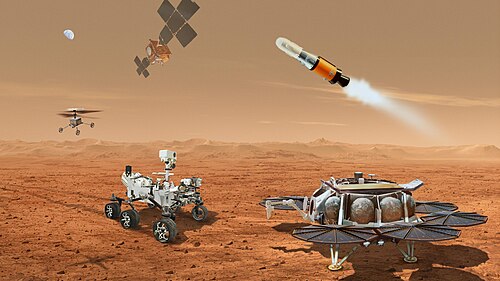
Artist concept of a Mars sample-return mission, 1993
The United States' Mars Exploration Program, formed after Mars Observer's failure in September 1993, supported a Mars sample return.[20] One architecture was proposed by Glenn J. MacPherson in the early 2000s.[2]
In 1996, the possibility of life on Mars was raised when apparent microfossils were thought to have been found in the Martian meteorite ALH84001. This hypothesis was eventually rejected, but led to a renewed interest in a Mars sample return.[21]
The sample-return mission would be tasked with preventing contact between the Martian environment and the exterior of the sample containers.[85][89]
In order to eliminate the risk of parachute failure, the current plan is to use the thermal protection system to cushion the capsule upon impact (at terminal velocity). The sample container would be designed to withstand the force of impact.[89] To receive the returned samples, NASA proposed a custom Biosafety Level 4 containment facility, the Mars Sample-Return Receiving facility (MSRRF).[91]
Other scientists and engineers, notably Robert Zubrin of the Mars Society, argued in the Journal of Cosmology that contamination risk is functionally zero leaving little need to worry. They cite, among other things, lack of any known incident although trillions of kilograms of material have been exchanged between Mars and Earth via meteorite impacts.[92]
The International Committee Against Mars Sample Return (ICAMSR) is an advocacy group led by Barry DiGregorio, that campaigns against a Mars sample-return mission. While ICAMSR acknowledges a low probability for biohazards, it considers the proposed containment measures to be unsafe. ICAMSR advocates more in situ studies on Mars, and preliminary biohazard testing at the International Space Station before the samples are brought to Earth.[93][94] DiGregorio also supports a view that several pathogens – such as common viruses – originate in space and probably caused some mass extinctions and pandemics.[95][96] These claims connecting terrestrial disease and extraterrestrial pathogens have been rejected by the scientific community.[95]
↑Chang, Kenneth (28 July 2020). "Bringing Mars Rocks to Earth: Our Greatest Interplanetary Circus Act – NASA and the European Space Agency plan to toss rocks from one spacecraft to another before the samples finally land on Earth in 2031". The New York Times. Archived from the original on 26 June 2023. Retrieved 28 July 2020.
12Treiman, Allan H.; Wadhwa, Meenakshi; Shearer, Charles K. Jr.; MacPherson, Glenn J.; Papike, James J.; Wasserburg, Gerald J.; Floss, Christine; Rutherford, Malcolm J.; Flynn, George J.; Papanastassiou, Dimitri; Westphal, Andrew; Neal, Clive; Jones, John H.; Harvey, Ralph P.; Schwenzer, Suzsanne. Groundbreaking Sample Return from Mars: The Next Giant Leap in Understanding the Red Planet(PDF) (Technical report). Archived(PDF) from the original on 15 June 2022.
↑David, Leonard (23 June 2022). "Controversy Grows Over whether Mars Samples Endanger Earth – Planetary scientists are eager to bring Red Planet rocks, soil and even air to Earth, but critics fear the risk of contaminating our world's biosphere". Scientific American. Archived from the original on 26 August 2023. Retrieved 25 June 2022.
12"Mars Sample Return Campaign". mars.nasa.gov. NASA. Archived from the original on 15 June 2022. Retrieved 15 June 2022.
↑"NASA's Perseverance Rover Collects First Mars Rock Sample". Jet Propulsion Laboratory. 6 September 2021. Archived from the original on 13 August 2023. Retrieved 29 March 2022.
12"Beyond 2009: Mars Sample Return". Jet Propulsion Laboratory. Archived from the original on 18 May 2008. Retrieved 26 May 2008. This article incorporates text from this source, which is in the public domain.
123Thee International Mars Architecture for the Return of Samples (iMARS) Working Group (1 June 2008). Preliminary Planning for an International Mars Sample Return Mission(PDF) (Technical report). NASA. Archived(PDF) from the original on 25 June 2022. Retrieved 29 August 2021.
↑ Jones, SM; Jurewicz, JG; Wiens, R.; Yen, A.; Leshin, LA (2008). Ground Truth From Mars (2008) – Mars Sample Return at 6 Kilometers per Second: Practical, Low Cost, Low Risk, and Ready (PDF) (Technical report). Universities Space Research Association (USRA). Archived (PDF) from the original on 4 April 2023. Retrieved 30 September 2012 .
↑"MarsNews.com: Mars Sample Return". 27 February 2015. Archived from the original on 27 February 2015.
↑"NASA and ESA Establish a Mars Exploration Joint Initiative". NASA. 8 July 2009. Archived from the original on 27 December 2022. This article incorporates text from this source, which is in the public domain.
↑Christensen, Phil (April 2010). "Planetary Science Decadal Survey: MSR Lander Mission". JPL. NASA. Retrieved 24 August 2012. This article incorporates text from this source, which is in the public domain.
↑"Date set for Mars sample mission". BBC. 10 July 2008. Archived from the original on 27 December 2022.
↑"Mars Sample Return: bridging robotic and human exploration". European Space Agency. 21 July 2008. Archived from the original on 1 March 2012. Retrieved 18 November 2008.
12Wal, Michael (22 August 2012). "International cooperation called key to planet exploration". NBC News. Archived from the original on 27 December 2022.
↑"Exploring Our Solar System: The Asteroids Act as a Key Step". www.govinfo.gov. United States Government Publishing Office. 10 September 2014. Archived from the original on 27 December 2022.
↑Foust, Jeff (20 July 2016). "Mars 2020 rover mission to cost more than US$2 billion". SpaceNews.
↑Evans, Kim (13 October 2015). "NASA Eyes Sample-Return Capability for Post-2020 Mars Orbiter". Denver Museum of Nature and Science. Archived from the original on 31 August 2017. Retrieved 10 November 2015.
↑Mattingly, Richard (March 2010). "Mission Concept Study: Planetary Science Decadal Survey – MSR Orbiter Mission (Including Mars Returned Sample Handling)"(PDF). NASA. Archived from the original(PDF) on 29 September 2015. This article incorporates text from this source, which is in the public domain.
↑Howell, Elizabeth (22 December 2022). "NASA's Mars Perseverance rover sample tubes look like Star Wars lightsabers". Space.com. Archived from the original on 5 August 2023. Retrieved 19 January 2023.
↑"Welcome to 'Octavia E. Butler Landing'". NASA. 5 March 2021. Retrieved 5 March 2021.
↑Voosen, Paul (31 July 2021). "Mars rover's sampling campaign begins". Science. 373 (6554). AAAS: 477. Bibcode:2021Sci...373..477V. doi:10.1126/science.373.6554.477. PMID34326215. S2CID236514399. Retrieved 1 August 2021.
↑"On the Eve of Perseverance's First Sample". mars.nasa.gov. NASA. 5 August 2021. Archived from the original on 7 February 2023. Retrieved 12 August 2021.
↑mars.nasa.gov. "Perseverance Rover Mars Rock Samples". NASA Mars Exploration. Archived from the original on 11 November 2022. Retrieved 25 December 2023.
↑"Nobody Tell Elmo About Issole". nasa.gov. 4 February 2022. Retrieved 11 February 2022.
↑mars.nasa.gov (26 August 2021). "NASA's Perseverance Plans Next Sample Attempt". NASA's Mars Exploration Program. Retrieved 27 August 2021.
↑mars.nasa.gov (6 September 2021). "Perseverance Sample Tube 266". NASA's Mars Exploration Program. Retrieved 9 September 2021.
↑Smith, Marcia (13 November 2023). "NASA "Pauses" Mars Sample Return Program While Assessing Options". spacepolicyonline.com. Retrieved 18 November 2023.
↑"ExoMars to pave the way for soil sample return". russianspaceweb.com.
123European Science Foundation – Mars Sample Return backward contamination – Strategic advice and requirementsArchived 2 June 2016 at the Wayback Machine July 2012, ISBN978-2-918428-67-1 – see Back Planetary Protection section (for more details of the document see abstract) This article incorporates text from this source, which is in the public domain.
↑Joshua Lederberg Parasites Face a Perpetual Dilemma Volume 65, Number 2, 1999/ American Society for Microbiology News 77 This article incorporates text from this source, which is in the public domain.
↑Assessment of Planetary Protection Requirements for Mars Sample Return Missions (Report). National Research Council. 2009.
↑Mars Sample Return: Issues and Recommendations Task Group on Issues in Sample Return, National Academies Press, Washington, D.C. (1997) This article incorporates text from this source, which is in the public domain.
123"Mars Sample Return Discussions"(PDF). 23 February 2010. Archived(PDF) from the original on 16 February 2013. Retrieved 12 August 2013. Mars Sample Return Discussions As presented on 23 February 2010 This article incorporates text from this source, which is in the public domain.
↑"Treaty on Principles Governing the Activities of States in the Exploration and Use of Outer Space, including the Moon and Other Celestial Bodies"(PDF). United Nations Office for Outer Space Affairs. 19 December 1966. Archived(PDF) from the original on 16 May 2023. Retrieved 13 July 2013.
↑Atlas, Ronald (2008). "Mars Sample Return Receiving Facility"(PDF). NASA. Archived(PDF) from the original on 21 March 2021.
↑Zubrin, Robert (2010). "Human Mars Exploration: The Time Is Now". Journal of Cosmology. 12: 3549–3557. Archived from the original on 20 November 2010.





 This article incorporates text from this source, which is in the public domain.