
Loading article…
In logic and philosophy, a formal fallacy[a] is a pattern of reasoning with a flaw in its logical structure (the logical relationship between the premises and the conclusion). A formal fallacy is contrasted with an informal fallacy. A formal fallacy must have an invalid logical form and thus be unsound. An informal fallacy, however, may have a valid logical form and yet be unsound because one or more premises are false. An argument can be both a formal fallacy and an informal fallacy. In everyday conversation, the term logical fallacy usually refers to a formal fallacy. While "the logical argument is a non sequitur" is synonymous with "the logical argument is invalid", the term non sequitur typically refers to those types of invalid arguments which do not constitute formal fallacies covered by particular terms (e.g., affirming the consequent). In other words, in practice, "non sequitur" refers to an unnamed formal fallacy.
Propositional logic[2] is concerned with the meanings of sentences and the relationships between them. It focuses on the role of logical operators, called propositional connectives, in determining whether a sentence is true. An error in the sequence will result in a deductive argument that is invalid. The argument itself could have true premises, but still have a false conclusion.[3] Thus, a formal fallacy is a fallacy in which deduction goes wrong, and is no longer a logical process. This may not affect the truth of the conclusion, since validity and truth are separate in formal logic.
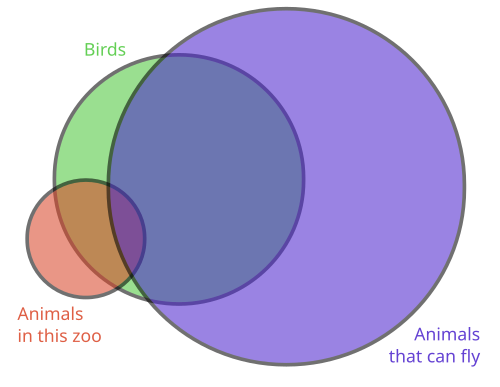
In the strictest sense, a logical fallacy is the incorrect application of a valid logical principle or an application of a nonexistent principle, such as reasoning that:
This is fallacious: a zoo could have a large proportion of flightless birds. There is no logical principle that states:
An easy way to show the above inference as invalid is by using Euler diagrams. In logical parlance, the inference is invalid, since under at least one interpretation of the predicates it is not validity preserving.
人は論理のルールを適用することにしばしば困難を感じる。例えば、次のような三段論法が正しいと言う人がいるが、実際には正しくない。
「その生き物」は確かに鳥かもしれないが、その結論は前提から導き出されるものではない。カメなど、くちばしを持つ他の動物も存在する。このような誤りは、人々が前提を逆転させてしまうために起こる。[ 4 ]この場合、「すべての鳥にはくちばしがある」が「くちばしを持つ生き物はすべて鳥である」に変わってしまう。鳥以外のくちばしを持つ生き物の存在を知っている人はほとんどいないため、逆転した前提はもっともらしく思えるが、これは与えられた前提ではない。このように、演繹的誤謬は、個々には論理的に見えるかもしれないが、組み合わせると誤りであることが明らかになる点によって形成される。
数学的誤謬は特殊なケースであり、意図的に無効な数学的証明であり、その誤りはしばしば巧妙で、何らかの方法で隠蔽されている。数学的誤謬は通常、教育目的で作成され、提示され、明白な矛盾に対する偽の証明という形をとることが多い。
日常会話において、論理の飛躍とは、後半部分が前半部分と全く関係のない発言のことである。例えば、次のような場合である。
人生は人生、楽しみは楽しみ。でも、金魚が死ぬと、あたりは静まり返ってしまう。