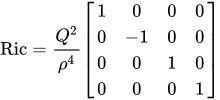
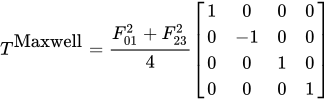
The 1967 paper introducing Boyer–Lindquist coordinates by Richard W. Lindquist[1] was also a posthumous publication for Dr. Robert Hamilton Boyer, who was killed in the 1966 University of Texas tower shooting at age 33.[3][4]
Note that in geometrized units , , and all have units of length. This line element describes the Kerr–Newman metric. Here, is to be interpreted as the mass of the black hole, as seen by an observer at infinity, is interpreted as the angular momentum, and the electric charge. These are all meant to be constant parameters, held fixed. The name of the discriminant arises because it appears as the discriminant of the quadratic equation bounding the time-like motion of particles orbiting the black hole, i.e. defining the ergosphere.
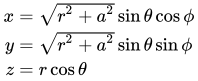
The coordinate transformation from Boyer–Lindquist coordinates , , to Cartesian coordinates , , is given (for ) by:[5]
Vierbein
The vierbeinone-forms can be read off directly from the line element:
where which is outside the outer horizon, between the inner and outer horizons, and inside the inner horizon. The line element is given by
1 2 Boyer, Robert H.; Lindquist, Richard W. (1967). "Maximal Analytic Extension of the Kerr Metric". Journal of Mathematical Physics . 8 (2): 265–281 . Bibcode : 1967JMP.....8..265B . doi : 10.1063/1.1705193 .




![{\displaystyle ds^{2}=-\left(1-{\frac {2Mr-Q^{2}}{\rho ^{2}}}\right)dt^{2}+{\frac {\rho ^{2}}{\Delta }}dr^{2}+\rho ^{2}d\theta ^{2}+\left[r^{2}+a^{2}+{\frac {\left(2Mr-Q^{2}\right)a^{2}\sin ^{2}\theta }{\rho ^{2}}}\right]\sin ^{2}\theta \,d\phi ^{2}-{\frac {2\left(2Mr-Q^{2}\right)a\sin ^{2}\theta }{\rho ^{2}}}\,d\phi dt}](https://wikimedia.org/api/rest_v1/media/math/render/svg/1b330c0d51b9a2da09671ff9f9fd1e5dd007914f)













![{\displaystyle \omega ^{01}={\frac {1}{\rho ^{3}}}\left[{\frac {-2Mr^{2}+2rQ^{2}+a^{2}[M+r+(Mr)\cos 2\theta ]}{2{\sqrt {\Delta }}}}\,\sigma ^{0}+ra\sin \theta \,\sigma ^{3}\right]}](https://wikimedia.org/api/rest_v1/media/math/render/svg/b11457f940eba8df7672b71be9ce22a80cd6c168)
![{\displaystyle \omega ^{02}={\frac {a\cos \theta }{\rho ^{3}}}\left[a\sin \theta \,\sigma ^{0}+{\sqrt {\Delta }}\,\sigma ^{3}\right]}](https://wikimedia.org/api/rest_v1/media/math/render/svg/3c7c31236f9d76e29c9fa13eb100ed1e31188165)
![{\displaystyle \omega ^{03}={\frac {a}{\rho ^{3}}}\left[r\sin \theta \,\sigma ^{1}-{\sqrt {\Delta }}\cos \theta \,\sigma ^{2}\right]}](https://wikimedia.org/api/rest_v1/media/math/render/svg/1e98f258c4059db453cce5abc495211c69d8209f)
![{\displaystyle \omega ^{12}={\frac {1}{\rho ^{3}}}\left[a^{2}\sin \theta \cos \theta \,\sigma ^{1}+r{\sqrt {\Delta }}\,\sigma ^{2}\right]}](https://wikimedia.org/api/rest_v1/media/math/render/svg/adbc10b5230ab3d47c098a4aa4ecafd8ca768c67)
![{\displaystyle \omega ^{13}={\frac {r}{\rho ^{3}}}\left[a\sin \theta \,\sigma ^{0}+{\sqrt {\Delta }}\,\sigma ^{3}\right]}](https://wikimedia.org/api/rest_v1/media/math/render/svg/05e227a5c7b9cfbdba3f20330541b5e3d6ceb3a7)
![{\displaystyle \omega ^{23}={\frac {\cot \theta }{\rho ^{3}}}\left[a{\sqrt {\Delta }}\sin \theta \,\sigma ^{0}+(r^{2}+a^{2})\,\sigma ^{3}\right]}](https://wikimedia.org/api/rest_v1/media/math/render/svg/fd2fcf153aadf5dcf66600ef49ced9500a3c78bf)