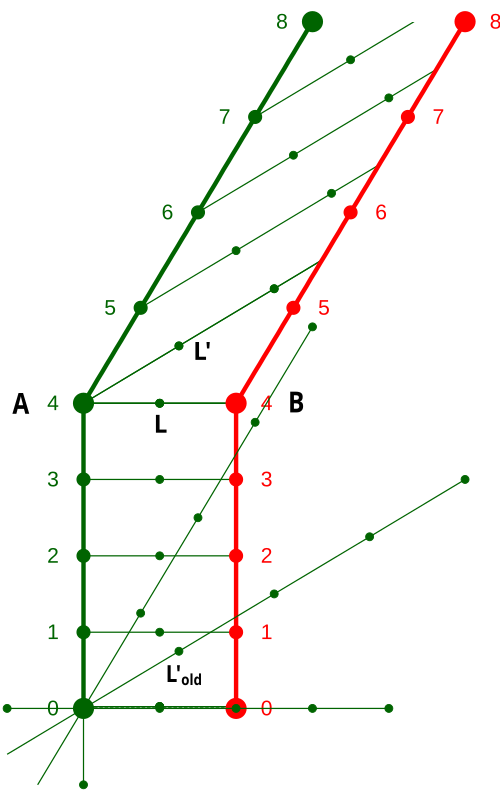
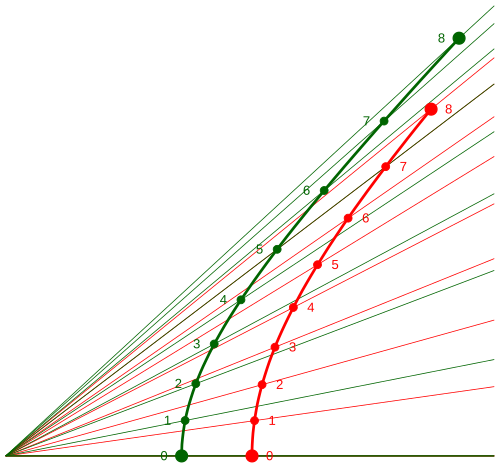
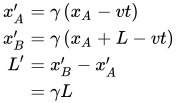
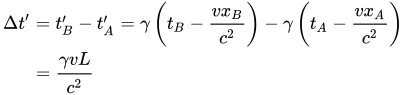
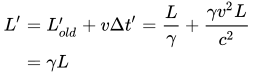
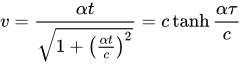
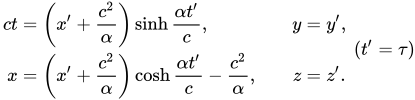
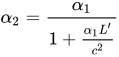
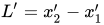
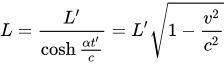
ベルの宇宙船のパラドックスは、特殊相対性理論における思考実験です。これは、1959 年に E. Dewan と M. Beran によって初めて記述されました[ 1 ]が、1976 年にJohn Stewart Bell がこのアイデアをさらに発展させたことで、より広く知られるようになりました[ 2 ]。繊細な糸が、慣性系Sで最初は静止している2 隻の宇宙船の間に垂れ下がっています。それらは、S で測定すると、同じ方向に同時に等しく加速し始め、S から見ると常に同じ速度になります。したがって、それらはすべて同じローレンツ収縮を受け、全体のアセンブリは開始時の長さに対して S フレームで等しく収縮しているように見えます。一見すると、加速中に糸が切れることはないように見えるかもしれません。
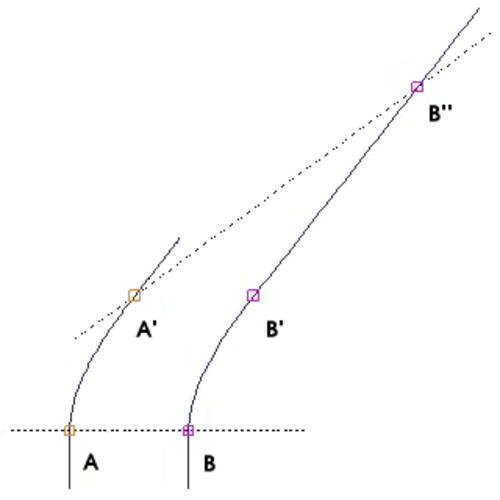
ベルの思考実験では、3 隻の宇宙船 A、B、C は、共通の慣性座標系で最初は静止しており、B と C は A から等距離にある。次に、A から B と C に同時に信号が送られ、B と C は垂直方向に加速し始める (同じ加速プロファイルが事前にプログラムされている) が、A は元の座標系で静止したままである。ベルによれば、これは B と C (A の静止座標系から見た場合) が「常に同じ速度を持ち、互いに一定の距離だけずれたままになる」ことを意味する。ここで、B と C の間に脆い糸が結ばれているとすると、長さの収縮により糸の長さが足りなくなり、切れてしまう。ベルは、「自然な収縮を人為的に阻止すると、耐え難いストレスがかかる」と結論付けた。[ 2 ]
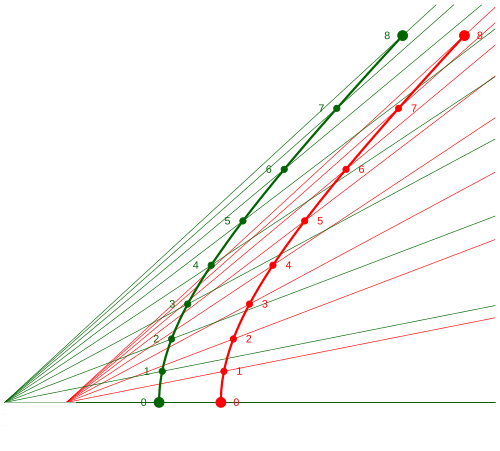
しかし、Petkov (2009) [ 6 ]と Franklin (2009) [ 3 ]はこのパラドックスを異なるように解釈している。彼らは、ロケットの座標系における加速度の不均等によって弦が切断され、その結果、両座標系間の静止長が増加するという結果には同意した(解析セクションのミンコフスキー図を参照)。しかし、彼らは、これらの応力が S における長さの収縮によって引き起こされるという考えを否定した。これは、彼らの意見では、長さの収縮には「物理的な実在」はなく、単にローレンツ変換、つまりそれ自体では応力を全く引き起こすことができない4 次元空間における回転の結果にすぎないからである。したがって、S を含むすべての参照系におけるこのような応力の発生と弦の切断は、相対論的加速度のみの影響であると考えられる。[ 3 ] [ 6 ]
分析
Paul Nawrocki (1962) gives three arguments why the string should not break,[7] while Edmond Dewan (1963) showed in a reply that his original analysis still remains valid.[8] Many years later and after Bell's book, Matsuda and Kinoshita reported receiving much criticism after publishing an article on their independently rediscovered version of the paradox in a Japanese journal. Matsuda and Kinoshita do not cite specific papers, however, stating only that these objections were written in Japanese.[9]
However, in most publications it is agreed that the string will break, with some reformulations, modifications and different scenarios, such as by Evett & Wangsness (1960),[10] Dewan (1963),[8] Romain (1963),[11] Evett (1972),[12] Gershtein & Logunov (1998),[13] Tartaglia & Ruggiero (2003),[14] Cornwell (2005),[15] Flores (2005),[16] Semay (2006),[17] Styer (2007),[18] Freund (2008),[19] Redzic (2008),[20] Peregoudov (2009),[21] Redžić (2009),[22] Gu (2009),[23] Petkov (2009),[6] Franklin (2009),[3] Miller (2010),[24] Fernflores (2011),[25] Kassner (2012),[26] Natario (2014),[27] Lewis, Barnes & Sticka (2018),[28] Bokor (2018).[29] A similar problem was also discussed in relation to angular accelerations: Grøn (1979),[30] MacGregor (1981),[31] Grøn (1982, 2003).[32][33]
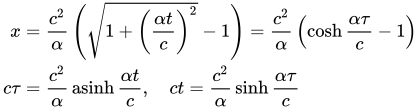
Immediate acceleration
Minkowski diagram: Length between the ships in S′ after acceleration is longer than the previous length in S′, and longer than the unchanged length Sでは、細い線は「同時性の線」です。
↑ Evett, Arthur A.; Wangsness, Roald K. (1960). "相対論的に移動するロケットの分離に関する注記". American Journal of Physics . 28 (6): 566. Bibcode : 1960AmJPh..28..566E . doi : 10.1119/1.1935893 .
↑ Romain, Jacques E. (1963). "相対論的パラドックスへの幾何学的アプローチ". American Journal of Physics . 31 (8): 576–585 . Bibcode : 1963AmJPh..31..576R . doi : 10.1119/1.1969686 .
↑ Evett, Arthur A. ( 1972). "相対論的ロケットに関する議論問題". American Journal of Physics . 40 (8): 1170–1171 . Bibcode : 1972AmJPh..40.1170E . doi : 10.1119/1.1986781 .
↑ Gershtein, SS; Logunov, AA (1998). "JS Bell の問題". Physics of Particles and Nuclei . 29 (5): 463– 468. Bibcode : 1998PPN....29..463G . doi : 10.1134/1.953086 .
1 2 Tartaglia, A.; Ruggiero, ML (2003). "Lorentz contraction and accelerated systems". European Journal of Physics . 24 (2): 215–220 . arXiv : gr-qc/0301050 . Bibcode : 2003EJPh...24..215T . doi : 10.1088/0143-0807/24/2/361 . S2CID 34419796 .
↑ Cornwell, DT (2005). "Forces due to contraction on a cord spanning between two spaceships". EPL . 71 (5): 699– 704. Bibcode : 2005EL.....71..699C . doi : 10.1209/epl/i2005-10143-x . S2CID 250803675 .
1 2 Flores, Francisco J. (2005). "Bellの宇宙船:有用な相対論的パラドックス" . Physics Education . 40 (6): 500– 503. Bibcode : 2005PhyEd..40..500F . doi : 10.1088/0031-9120/40/6/F03 . S2CID 250831812 .
1 2 Semay, Claude (2006). "Observer with a constant proper acceleration". European Journal of Physics . 27 (5): 1157–1167 . arXiv : physics/0601179 . Bibcode : 2006EJPh...27.1157S . doi : 10.1088/0143-0807/27/5/015 . S2CID 119369417 .
1 2 Styer, Daniel F. (2007). "2 つの動く時計はどのようにして同期がずれるのか?トラック、糸、そして双子の物語". American Journal of Physics . 75 (9): 805–814 . Bibcode : 2007AmJPh..75..805S . doi : 10.1119/1.2733691 .
↑ Miller, DJ (2010). "特殊相対性理論への構成的アプローチ". American Journal of Physics . 78 (6): 633–638 . arXiv : 0907.0902 . Bibcode : 2010AmJPh..78..633M . doi : 10.1119 / 1.3298908 . S2CID 20444859 .
↑ Fernflores, Francisco (2011). "Bell's Spaceships Problem and the Foundations of Special Relativity" . International Studies in the Philosophy of Science . 25 (4): 351–370 . doi : 10.1080/02698595.2011.623364 . S2CID 17932190 .
↑ Kassner, Klaus (2012). "回転円盤とその非回転対応物の空間幾何学". American Journal of Physics . 80 (9): 772–781 . arXiv : 1109.2488 . Bibcode : 2012AmJPh..80..772K . doi : 10.1119/1.4730925 . S2CID 119245750 .
↑ Natario, J. (2014). "Relativistic elasticity of rigid rods and strings". General Relativity and Gravitation . 46 (11): 1816. arXiv : 1406.0634 . doi : 10.1007/s10714-014-1816-x . S2CID 118377841 .
12Nikolić, Hrvoje (6 April 1999). "Relativistic contraction of an accelerated rod". American Journal of Physics. 67 (11): 1007–1012. arXiv:physics/9810017. Bibcode:1999AmJPh..67.1007N. doi:10.1119/1.19161. S2CID9547599.
123Kirk T. McDonald (2022). "Constant Acceleration and the Equivalence Principle"(PDF).
External links
Michael Weiss; Don Koks (1995–2017): Bell's Spaceship Paradox, USENET Relativity FAQ
Mathieu Rouaud (2022): Einstein’s Elevator: World Lines, Michelson–Morley Experiment and Relativistic Paradox. Another relativistic paradox in an accelerated reference frame with three rockets: a particle of matter seems to go faster than light.
Categories:
Theory of relativity
Physical paradoxes
Thought experiments in physics
Relativistic paradoxes
Hidden categories:
Articles with short description
Short description is different from Wikidata
CS1 maint: location missing publisher
CS1: long volume value
CS1 maint: multiple names: authors list
Pages using multiple image with unknown parameters