Loading article…
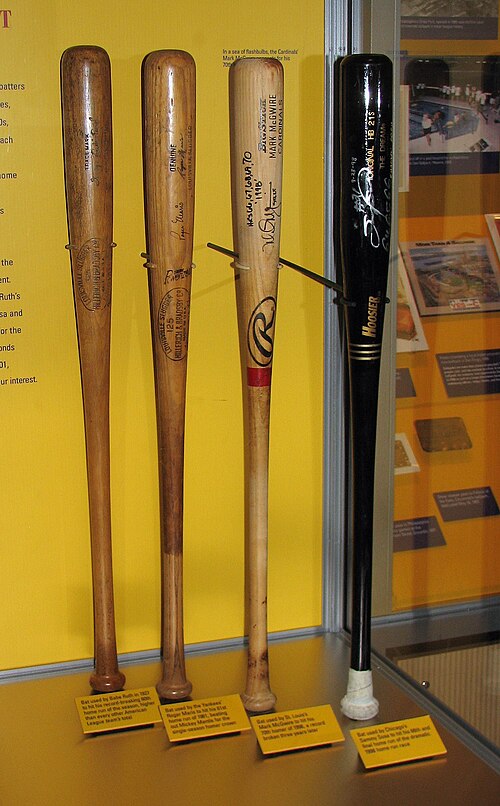
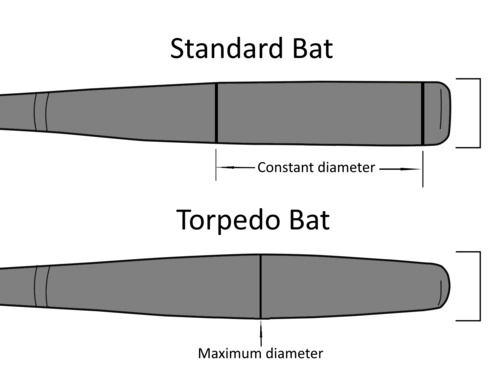
A baseball bat is a smooth wooden or metal club used in the sport of baseball to hit the ball after it is thrown by the pitcher. By regulation it may be no more than 2.61 inches (6.6 cm) in diameter at the thickest part and no more than 42 inches (1.067 m) in length.[1] Although historically bats approaching 3 pounds (1.4 kg) or 48 oz were used,[2][3] modern bats of 33 ounces (0.94 kg) are common, topping out at 34 to 36 ounces (0.96 to 1.02 kg).[2]
A baseball bat is divided into several regions. The "barrel" is the thick part of the bat, where it is meant to hit the ball. The part of the barrel best for hitting the ball, according to construction and swinging style, is often called the "sweet spot." The end of the barrel is called the "top", "end", or "cap" of the bat. Opposite the cap, the barrel narrows until it meets the "handle", which is comparatively thin, so that batters can comfortably grip the bat in their hands. Sometimes, especially on metal bats, the handle is wrapped with a rubber or tape "grip". Finally, below the handle is the "knob" of the bat, a wider piece that keeps the bat from slipping from a batter's hands.
バットの「バットドロップ」とは、バットの重量(オンス)から長さ(インチ)を引いた値です。例えば、30オンス、長さ33インチのバットのバットドロップはマイナス3(30 - 33 = - 3)です。バットドロップが大きいほど、単位長さあたりの質量が小さくなるため、スイングスピードが上がります。一方、ドロップが小さいほど、ボールに伝わる運動量が増えるため、パワーが増します。[ 4 ]
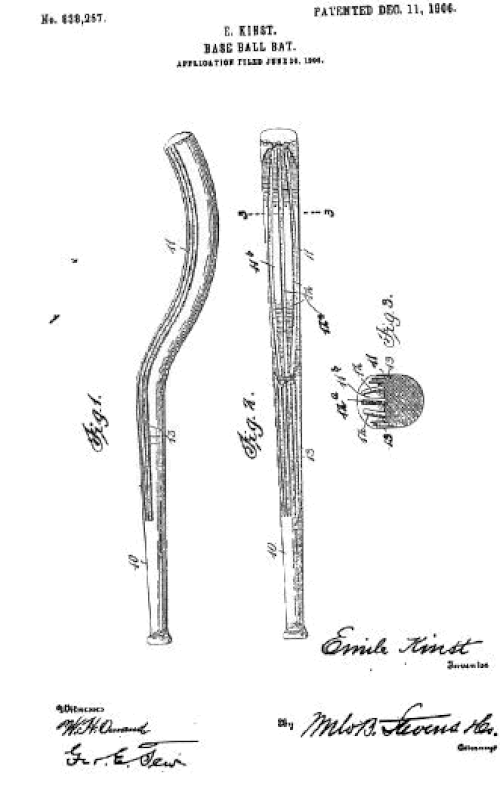
バットの形状は時代とともに洗練されてきた。19世紀半ばには、野球の打者はバットを自分で削ったり形を整えたりしていたため、形状、サイズ、重量に非常に多様なバットが存在した。例えば、平たいバット、丸いバット、短いバット、太いバットなどがあった。初期のバットは、現代の規格バットよりもはるかに重く大きかった。19世紀には、様々な形状やグリップのデザインが試された。現代のバットは、デザインがはるかに均一になっている。
Baseball bats are made of either hardwood or a metal alloy (typically aluminum). Most wooden bats are made from ash; other woods include maple, hickory, and bamboo. Hickory has fallen into disfavor over its greater weight, which slows down bat speed, while maple bats gained popularity following the introduction of the first MLB-sanctioned model in 1997.[9] The first player to use one was Joe Carter of the Toronto Blue Jays.[10]Barry Bonds used maple bats the seasons he broke baseball's single-season home run record in 2001, and the career home run record in 2007.[10] In 2010, the increased tendency of maple bats to shatter caused Major League Baseball to examine their use, banning some models in minor league play.[11][12]
Manufacturers position each bat's label over the mechanically weaker side of the wood.[13] To reduce chance of fracture,[13] and maybe deliver more energy to the ball,[14] a bat is intended to be held so the label faces sky or ground when it strikes the ball during a horizontal swing.[13] In this orientation, the bat is considered stiffer and less likely to break.[15]
Different types of wood will fracture differently.[16] For bats made of ash, labels will generally be where the grain spacing is widest. For maple bats they will usually be positioned where grain is tightest.
Maple bats in particular were once known (circa 2008) to potentially shatter in a way that resulted in many sharp edges, sometimes creating more dangerous projectiles when breaking.[13][17] Maple bat manufacture evolved significantly, in cooperation with Major League Baseball, paying special attention to grain slope, and including an ink spot test to confirm safest wood grain orientation.[15]
Based on consistent anecdotal reports of sales at sporting goods stores, and because of the Emerald ash borer epidemic, maple appears to be displacing ash as most popular new baseball bat material in the United States. Next and rising in popularity is bamboo, which has more isotropic fine grain, great strength, and less weight for a bat of any given size.
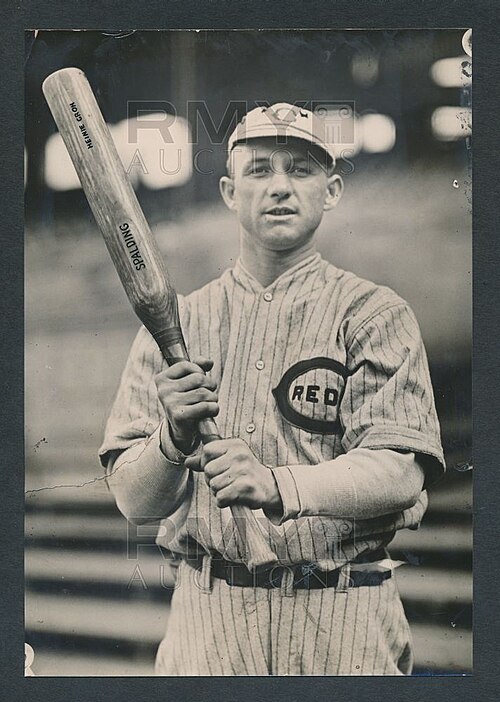
リーグの基準内では、個々のバリエーションに十分な自由度があり、多くの打者は自分のバットの形状、または成功した打者が使用した形状に落ち着きます。以前は、バットは精密な校正ポイントのあるテンプレートから手作業で旋盤加工されていましたが、最近では固定された金属テンプレートに機械で旋盤加工されています。歴史的に重要なテンプレートは、バット製造業者の保管庫に保管されている場合があります。たとえば、メジャーリーグの選手の間で人気になったベーブ・ルースのテンプレートは、ルイビル・スラッガーのアーカイブのR43です。[ 18 ]ルースは1920年代の標準よりも細いグリップを好み、彼の成功によりほとんどの人がそれに倣いました。[ 18 ]ルースは異常に大きなバットを使用しており、キャリアを通じて徐々にサイズを小さくしていきました。1920年には、アッシュ材で作られた、細身のグリップの40インチ、54オンスのバットを使用していました。[ 19 ] 1928年に彼はこう書いた。「数シーズン前は、長さが長くて重心が先端にある54オンスのバットを使っていた。今は46オンスのクラブを使っている。そして、新しいバットを作ってもらうたびに、さらに1オンスずつ減らしている。」[ 20 ]
基本的なバットが旋盤加工されると、木材の最も良い面とは反対側に、製造者名、シリアル番号、そして多くの場合、そのバットを推薦する選手のサインが焼き印されます。ホーナス・ワグナーは、バットを推薦しサインをした最初の選手でした。次に、ほとんどのバットには丸いヘッドが付けられますが、約30%の選手は、1970年代初頭にホセ・カルデナルによってメジャーリーグに導入された、ヘッドにカップ状のくぼみが作られた「カップバランス」ヘッドを好みます。[ 18 ]これによりバットが軽くなり、重心がグリップ側に移動します。最後に、バットは、ナチュラル、赤、黒、ツートンの青と白など、いくつかの標準色のいずれかで染色されます。
アジアから偶然持ち込まれた外来種の甲虫であるエメラルドカミキリムシは、米国東部で5000万本以上のホワイトアッシュの木を枯らし、2017年には野球のバットの製造に使われるニューヨーク州アディロンダック山脈の林を脅かした。[ 21 ]
アメリカのメジャーリーグでは、ルール1.10(a)に次のように記載されています。[ 22 ]
バットは、最も太い部分の直径が2.61インチ以下、長さが42インチ以下の、滑らかで丸い棒でなければならない。バットは一枚の無垢材で作られていなければならない。
Bats are not allowed to be hollowed or corked—that is, filled with an alien substance such as cork which reduces the weight. This corking is thought to increase bat speed without greatly reducing hitting power, though this idea was challenged as unlikely on the Discovery Channel series MythBusters.[23]
Both wooden and metal alloy (generally aluminum) bats are generally permitted in amateur baseball. Metal alloy bats are generally regarded as being capable of hitting a ball faster and farther with the same power. However, increasing numbers of "wooden bat leagues" have emerged in recent years, reflecting a trend back to wood over safety concerns and, in the case of collegiate summer baseball wood-bat leagues, to better prepare players for the professional leagues that require wood bats. Metal alloy bats can send a ball towards an unprotected pitcher's head up to 60 ft 6 in (18.44 m) away at a velocity far too high for the pitcher to get out of the way in time. Some amateur baseball organizations enforce bat manufacturing and testing standards which attempt to limit maximum ball speed for wood and non-wood bats.[24][25][26]
In high school baseball in the United States:
In some 12-year-old-and-under youth leagues (such as Little League baseball), the bat may not be more than 2+1⁄4 inches (57 mm) in diameter.[28] However, in many other leagues (like PONY League Baseball, and Cal Ripken League Baseball), the bat may not be more than 2+3⁄4 inches (70 mm) in diameter.[29]
There are limitations to how much and where a baseball player may apply pine tar to a baseball bat. According to Rule 1.10(c) of the Major League Baseball Rulebook, it is not allowed more than 18 inches up from the bottom handle. An infamous example of the rule in execution is the Pine Tar Incident on July 24, 1983. Rules 1.10 and 6.06 were later changed to reflect the intent of Major League Baseball, as exemplified by the league president's ruling. Rule 1.10 now only requires that the bat be removed from the game if discovered after being used in a game; it no longer necessitates any change to the results of any play which may have taken place.
Rule 6.06 refers only to bats that are "altered or tampered with in such a way to improve the distance factor or cause an unusual reaction on the baseball. This includes, bats that are filled, flat-surfaced, nailed, hollowed, grooved or covered with a substance such as paraffin, wax, etc." It no longer makes any mention of an "illegally batted ball". In 2001, MLB approved the use of Gorilla Gold Grip Enhancer in major and minor league games as an alternative to pine tar.[30][31]
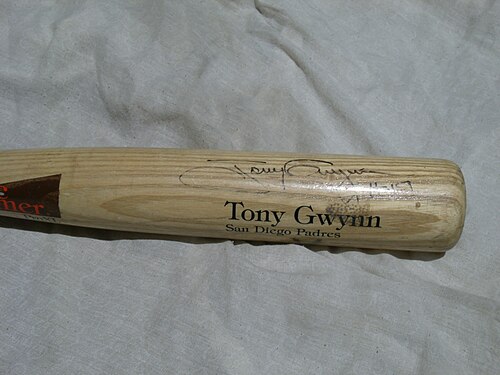
Players can be very particular about their bats. Ted Williams cleaned his bats with alcohol every night and periodically took them to the post office to weigh them. "Bats pick up condensation and dirt lying around on the ground," he wrote, "They can gain an ounce or more in a surprisingly short time." Ichiro Suzuki also took great care that his bats did not accumulate moisture and thus gain weight: he stored his bats in humidors, one in the club house and another, a portable one, for the road. Rod Carew fought moisture by storing his bats in a box full of sawdust in the warmest part of his house. "The sawdust acts as a buffer between the bats and the environment," he explained, "absorbing any moisture before it can seep into the wood."[32]
Many players "bone" their bats, meaning that before games, they rub their bats repeatedly with a hard object, believing this closes the pores on the wood and hardens the bat. Animal bones are a popular boning material, but rolling pins, soda bottles and the edge of a porcelain sink have also been used. Pete Rose had his own way of hardening his bats: he soaked them in a tub of motor oil in his basement then hung them up to dry.[32]

A fungo bat is a specially designed bat used by baseball and softball coaches in practice. It is a light bat swung by a coach, used to hit balls to players who are practice fielding these hits. The etymology of the word fungo (/ˈfʌŋɡoʊ/) is uncertain, but the Oxford English Dictionary suggests it is derived from the Scotsfung: "to pitch, toss, or fling".[33]
Fungo bats are longer and lighter than regulation bats, with a smaller diameter. Typical fungo bats are 34 to 37 inches (86 to 94 cm) long and weigh 17 to 24 ounces (480 to 680 g). Longer bats are preferred for outfield practice and shorter bats for infield practice.[34] The reduced weight allows a coach to hit many balls without tiring. It also lets them swing the bat one-handed, as they often throw the "pitches" to themselves with their free hand.[35][36]
Baseball bats are sometimes used as weapons by civilians,[37] criminals, protesters,[38] and mobsters.[39] Baseball bats are effective weapons because they are inexpensive compared to other weapons, and, unlike many other weapons, they can be carried without raising suspicion or violating laws, due to their primary purpose as sports equipment.[40][41]
Baseball bats have also been used as weapons in various forms of entertainment. As a professional wrestler, Mick Foley sometimes brandished a baseball bat wrapped in barbed wire, which he named "Barbie". Other pro wrestlers have used baseball bats as weapons, and wrestling video games sometimes include bats as special weapons.[42][43]
Bats are common weapons in fiction as well. Negan, a character on the TV show The Walking Dead carried a barbed wire-wrapped baseball bat named "Lucille", which Jeffrey Dean Morgan has compared to Mick Foley's "Barbie".[44]Harley Quinn, as a member of the Suicide Squad, carries a baseball bat.[45]