
Loading article…
電磁四元ポテンシャルは、電磁場を導出できる相対論的ベクトル関数です。これは、電気スカラーポテンシャルと磁気ベクトルポテンシャルの両方を単一の四元ベクトルに組み合わせたものです。[ 1 ]
特定の基準系およびゲージにおいて測定した場合、電磁四元ポテンシャルの第1成分は慣習的に電気スカラーポテンシャルとされ、他の3つの成分は磁気ベクトルポテンシャルを構成する。スカラーポテンシャルとベクトルポテンシャルはどちらも基準系に依存するが、電磁四元ポテンシャルはローレンツ共変である。
他のポテンシャルと同様に、電磁四元ポテンシャルも、ゲージの選択に応じて、同じ電磁場に対応するものが多数存在する。
この記事では、テンソル添え字表記とミンコフスキー計量符号規約(+ − − −)を使用します。表記の詳細については、ベクトルの共変性と反変性、および添え字の上げ下げに関する項目も参照してください。数式はSI単位系とガウスcgs単位系で示されています。
反変電磁四元電位は次のように定義できる。[ 2 ]
ここで、ϕは電位、 Aは磁気ポテンシャル(ベクトルポテンシャル)です。Aαの単位は、 SIではV・s・m⁻¹、Gaussian-CGSではMx・cm⁻¹です。
これら4つの電位に関連する電場と磁場は次のとおりです。[ 3 ]
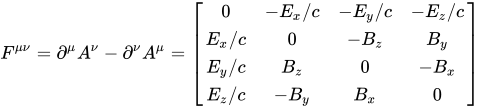
特殊相対性理論では、電場と磁場はローレンツ変換によって変換されます。これは、2階テンソルである電磁テンソルの形で表すことができます。ミンコフスキー計量規約(+ − − −)を用いた電磁テンソルの16個の反変成分は、電磁4元ポテンシャルと4元勾配を用いて次のように表されます。
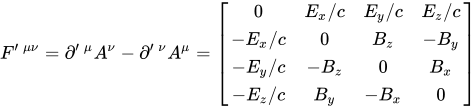
当該署名が(− + + +)である場合:
This essentially defines the four-potential in terms of physically observable quantities, as well as reducing to the above definition.
Often, the Lorenz gauge condition in an inertial frame of reference is employed to simplify Maxwell's equations as:[2]
where Jα are the components of the four-current, and
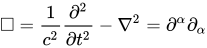
is the d'Alembertian operator. In terms of the scalar and vector potentials, this last equation becomes:
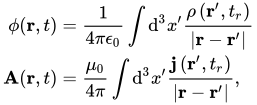
For a given charge and current distribution, ρ(r, t) and j(r, t), the solutions to these equations in SI units are:[3]
where
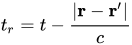
is the retarded time. This is sometimes also expressed with
where the square brackets are meant to indicate that the time should be evaluated at the retarded time. Of course, since the above equations are simply the solution to an inhomogeneousdifferential equation, any solution to the homogeneous equation can be added to these to satisfy the boundary conditions. These homogeneous solutions in general represent waves propagating from sources outside the boundary.
When the integrals above are evaluated for typical cases, e.g. of an oscillating current (or charge), they are found to give both a magnetic field component varying according to r−2 (the induction field) and a component decreasing as r−1 (the radiation field).
When flattened to a one-form (in tensor notation, ), the four-potential (normally written as a vector or, in tensor notation) can be decomposed via the Hodge decomposition theorem as the sum of an exact, a coexact, and a harmonic form,
There is gauge freedom in A in that of the three forms in this decomposition, only the coexact form has any effect on the electromagnetic tensor
Exact forms are closed, as are harmonic forms over an appropriate domain, so and , always. So regardless of what and are, we are left with simply
In infinite flat Minkowski space, every closed form is exact. Therefore the term vanishes. Every gauge transform of can thus be written as

![{\displaystyle \rho \left(\mathbf {r} ',t_{r}\right)=\left[\rho \left(\mathbf {r} ',t\right)\right],}](https://wikimedia.org/api/rest_v1/media/math/render/svg/1fcb30230b9322034e9cf7f2b43ae2e8440b7614)





