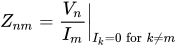
一般的なマルチポートネットワークの定義では、各ポートには1 からNまでの整数nが割り当てられると想定されます。ここで、Nはポートの総数です。ポートnの場合、関連する Z パラメータの定義は、ポート電流とポート電圧で表されます。そしてそれぞれ。
すべてのポートについて、電圧はZパラメータ行列で定義され、電流は次の行列方程式で定義されます。
where Z is an N × N matrix the elements of which can be indexed using conventional matrix notation. In general the elements of the Z-parameter matrix are complex numbers and functions of frequency. For a one-port network, the Z-matrix reduces to a single element, being the ordinary impedance measured between the two terminals. The Z-parameters are also known as the open circuit parameters because they are measured or calculated by applying current to one port and determining the resulting voltages at all the ports while the undriven ports are terminated into open circuits.
Two-port networks
The equivalent circuit for Z-parameters of a two-port network.The equivalent circuit for Z-parameters of a reciprocal two-port network.
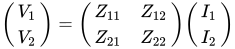
The Z-parameter matrix for the two-port network is probably the most common. In this case the relationship between the port currents, port voltages and the Z-parameter matrix is given by:
.
where
For the general case of an N-port network,
Impedance relations
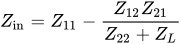
The input impedance of a two-port network is given by:
where ZL is the impedance of the load connected to port two.
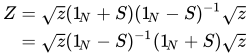
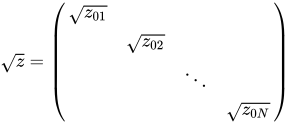
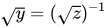
and is the corresponding diagonal matrix of square roots of characteristic admittances. In these expressions the matrices represented by the bracketed factors commute and so, as shown above, may be written in either order.[5][note 1]
Two port
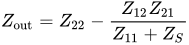
In the special case of a two-port network, with the same characteristic impedance at each port, the above expressions reduce to
Where
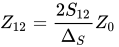
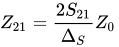
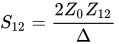
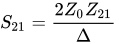
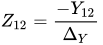
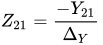
The two-port S-parameters may be obtained from the equivalent two-port Z-parameters by means of the following expressions[6]
where
The above expressions will generally use complex numbers for and . Note that the value of can become 0 for specific values of so the division by in the calculations of may lead to a division by 0.
1 2 3 Russer, Peter (2003).電磁気学、マイクロ波回路および通信工学のためのアンテナ設計. Artech House. p. 420. ISBN1-58053-532-1。
↑ Simon Ramo; John R. Whinnery; Theodore Van Duzer (1994-02-09). Fields and Waves in Communication Electronics . Wiley. pp. 537–541 . ISBN978-0-471-58551-0。