
Loading article…

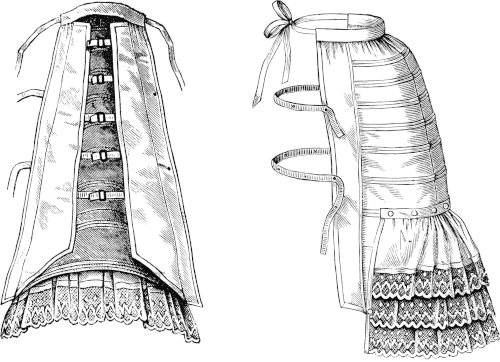
バッスルとは、 19世紀中頃から後半にかけて女性のドレスの後ろ側にボリュームを出したり、ドレープを支えたりするために使われた、パッド入りの下着またはワイヤーフレームのことです。 [ 1 ] [ 2 ]バッスルはスカートの後ろ、ウエストのすぐ下に着用し、スカートが地面に引きずられないようにします。重い生地はスカートの後ろ側を引っ張って平らにしてしまう傾向がありました。そのため、ペチコートを着けた女性のスカートは、日常的に着用しているだけで(座ったり動いたりするだけで)形が崩れてしまうのです。
歴史を通じて、女性はスカートの形を整えてヒップの後ろを強調するためにさまざまな方法を用いてきました。歴史的に「バムロール」、「ベアラー」、「コルクランプ」などと呼ばれたパッド入りのクッションは、ヨーロッパで人気があった多くの方法の1つです。これらは16世紀から断続的に人気があり、特に18世紀後半のフランスで人気がありました。[3][4] クリノリンは、この技術から発展したパッド入りのペチコートの一種です。より精巧で特殊なバッスルが最終的にクリノリンに取って代わりました。ワイヤーフレームのバッスルはごく短期間しか人気がありませんでしたが、バッスルが流行遅れになった後、よりシンプルなパッド入りのクッションが復活し、人気を保っています。[ 3 ] [ 5 ]
While feminist scholars such as Anne Fausto-Sterling have attempted to link the popularity of the bustle to Sarah Baartman,[6][7] the use of padded cushions, panniers, farthingales, and petticoats to accentuate the general shape of the buttocks or hips were already well-established in Europe in the 16th century, long before Baartman.[3][4]
Baartman, a Khoikhoi woman from South Africa, was featured as a circus attraction in Europe in the early 1800s, due to the particular abundance of tissue on her buttocks.[8]

In the early stages of the fashion for the bustle, the fullness to the back of the skirts was carried quite low and often fanned out to create a train. The transition from the voluminous crinoline-enhanced skirts of the 1850s and 1860s can be seen in the loops and gathers of fabric and trimmings worn during this period. The bustle later evolved into a much more pronounced humped shape on the back of the skirt immediately below the waist, with the fabric of the skirts falling quite sharply to the floor, changing the shape of the silhouette.[9]
As the fashion for crinolines wore on, their shape changed. Instead of the large bell-like silhouette previously in vogue, they began to flatten out at the front and sides, creating more fullness at the back of the skirts.[10] This style was known as the "train". One type of crinoline, the crinolette, created a shape very similar to the one produced by a bustle. Crinolettes were more restrictive than traditional crinolines, as the flat front and bulk created around the posterior made sitting down more difficult for the wearer.[11] The excess skirt fabric created by this alteration in shape was looped around to the back, again creating increased fullness.
The bustle later developed into a feature of fashion on its own after the overskirt of the late 1860s was draped up toward the back and some kind of support was needed for the new draped shape.[12] Fullness of some sort was still considered necessary to make the waist look smaller and the bustle eventually replaced the crinoline completely. The bustle was worn in different shapes for most of the 1870s and 1880s, with a short period of non-bustled, flat-backed dresses from 1878 to 1882.

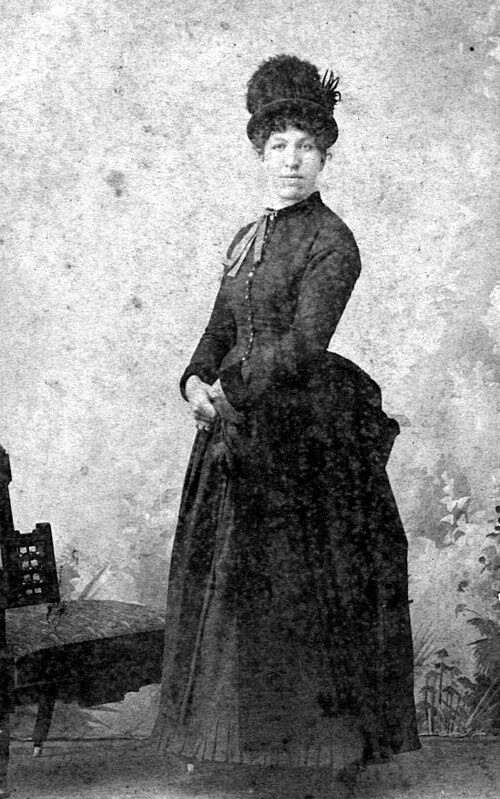
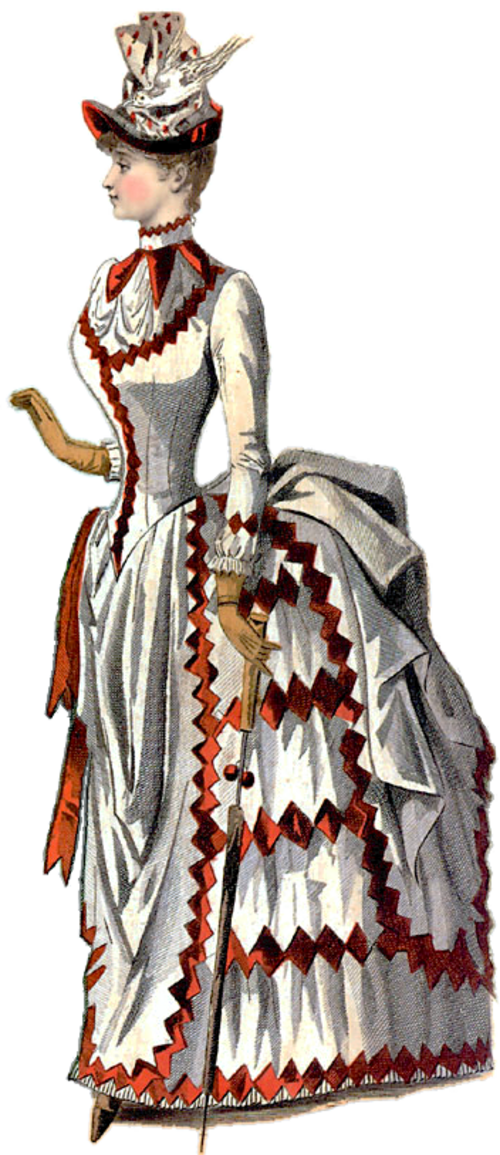
The bustle reappeared in late 1881,[13] and was exaggerated to become a major fashion feature in the mid and late 1880s, in 1885 reaching preposterous proportions to modern eyes, as used in the play Arms and the Man by George Bernard Shaw. The fashion for large bustles ended in 1889.[14]
The bustle then survived into the 1890s and early 20th century, as a skirt support was still needed and the curve the bustle provided on the back of the body emphasized the hips.[3] The bustle had completely disappeared by 1905, as the long corset of the early 20th century was now successful in shaping the body to protrude behind.[15] The bustle was also abandoned by some women for more practical dress to be able to use the newly invented bicycle.[15]
Bustles and bustle gowns are rarely worn in contemporary society. Notable exceptions survive in the realms of haute couture and bridal fashion, in addition to dedicated Neo-Victorian aesthetic circles including the steampunk, Gothic, and Lolita subcultures. Bustles are also employed as part of period costuming in film and theatre: an example would be the 1992 film Bram Stoker's Dracula, for which costume designer Eiko Ishioka won an Academy Award. The film features several extravagant bustle gowns created for female leads Winona Ryder and Sadie Frost.




 Media related to Bustle dresses at Wikimedia Commons