
Loading article…
In mathematics, a super vector space is a -graded vector space, that is, a vector space over a field with a given decomposition of subspaces of grade and grade . The study of super vector spaces and their generalizations is sometimes called super linear algebra. These objects find their principal application in theoretical physics where they are used to describe the various algebraic aspects of supersymmetry.
A super vector space is a -graded vector space with decomposition[1]
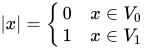
Vectors that are elements of either or are said to be homogeneous. The parity of a nonzero homogeneous element, denoted by , is or according to whether it is in or ,
Vectors of parity are called even and those of parity are called odd. In theoretical physics, the even elements are sometimes called Bose elements or bosonic, and the odd elements Fermi elements or fermionic. Definitions for super vector spaces are often given only in terms of homogeneous elements and then extended to nonhomogeneous elements by linearity.
If is finite-dimensional and the dimensions of and are and respectively, then is said to have dimension. The standard super coordinate space, denoted , is the ordinary coordinate space where the even subspace is spanned by the first coordinate basis vectors and the odd space is spanned by the last .
A homogeneous subspace of a super vector space is a linear subspace that is spanned by homogeneous elements. Homogeneous subspaces are super vector spaces in their own right (with the obvious grading).
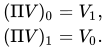
For any super vector space , one can define the parity reversed space to be the super vector space with the even and odd subspaces interchanged. That is,
A homomorphism, a morphism in the category of super vector spaces, from one super vector space to another is a grade-preserving linear transformation. A linear transformation between super vector spaces is grade preserving if
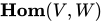
That is, it maps the even elements of to even elements of and odd elements of to odd elements of . An isomorphism of super vector spaces is a bijective homomorphism. The set of all homomorphisms is denoted .[2]
ある超ベクトル空間から別の超ベクトル空間への線形変換(必ずしも等級保存変換とは限らない)は、等級保存変換と等級反転変換の和として一意に表すことができる。つまり、変換はそのため
等級保存変換を偶数、等級反転変換を奇数と宣言すると、すべての線形変換の空間は次のようになる。に、と表記される内部と呼ばれ、スーパーベクトル空間の構造。特に、[ 3 ]
学年逆転の変革には準同型とみなすことができるパリティ反転空間へ、 となることによって
通常のベクトル空間における一般的な代数的構成法は、超ベクトル空間の設定においても対応するものが存在する。
デュアルスペース超ベクトル空間の偶関数を で消滅するものとすることで、 はスーパーベクトル空間とみなすことができるそして、奇妙な関数は、[ 4 ]同様に、次のように定義できる。線形マップの空間となるに(ベースフィールド)前のセクションで説明した段階付けを持つ、純粋に偶数スーパーベクトル空間として考えます。
超ベクトル空間の直和は、次数なしの場合と同様に、次数付けによって構成される。
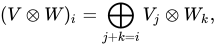
超ベクトル空間のテンソル積も構成できる。ここで、が作用する。基礎となる空間は、等級付けのないケースと同じで、等級付けは次のように与えられる。
インデックスは具体的には、
体上のベクトル空間を可換環上の加群に一般化できるのと同様に、体上の超ベクトル空間を超可換代数(または環)上の超加群に一般化することができる。
超ベクトル空間を扱う際の一般的な構成は、スカラーの体を超可換グラスマン代数に拡張することです。させて
によって生成されるグラスマン代数を表す。反交換奇数要素任意のスーパーベクトルスペースオーバーモジュールに埋め込むことができます(次数付き)テンソル積を考慮することによって
超ベクトル空間のカテゴリーは、は、対象がスーパーベクトル空間(固定体上)である圏である。)そしてその射は線形変換(つまり、次数を保存するもの)である。
超線形代数に対する圏論的アプローチは、まず通常の(次数なしの)代数的対象に関する定義と定理を圏論の言葉で定式化し、次にそれらを直接超ベクトル空間の圏に転送することである。これにより、超代数、リー超代数、超群などの「超対象」の扱いが、次数なしの対応するものと完全に類似したものとなる。
カテゴリーは、モノイド積として超テンソル積を持ち、純粋に偶数の超ベクトル空間であるモノイド圏である。単位オブジェクトとして。対合的組紐演算子
によって与えられた
均質な要素上で回転対称モノイド圏へ。この可換同型は、超線形代数に不可欠な「符号規則」を符号化している。これは、2つの奇数要素が交換されるたびにマイナス符号が付けられることを実質的に意味する。上記の演算子が適切な場所で使用されている限り、圏論的設定では符号について心配する必要はない。
は内部に Hom オブジェクトを持つ閉じたモノイド圏でもある。、すべての線形写像のスーパーベクトル空間によって与えられるに普通のセットは、その中の偶数部分空間である。
事実閉じているということは、ファンクターがファンクターの左随伴である自然な全単射が与えられた場合
上の超代数超ベクトル空間として記述できる乗算マップ付き
これは超ベクトル空間準同型です。これは[ 5 ]を要求することと同等です。





















![{\displaystyle R=\mathbb {K} [\theta _{1},\cdots ,\theta _{N}]}](https://wikimedia.org/api/rest_v1/media/math/render/svg/44512aeb6d5cd6ca376a1d33fbda4a4cc6551414)


![{\displaystyle \mathbb {K} [\theta _{1},\cdots ,\theta _{N}]\otimes V.}](https://wikimedia.org/api/rest_v1/media/math/render/svg/11569d86cef7cd8e7c1e572a384e5ea556690541)









