Loading article…
ソーダライト( / ˈ s oʊ . d ə ˌ l aɪ t / SOH -də-lyte ) は、式Naのテクトケイ酸塩鉱物です。8 (アル)6 Si6 O24 )Cl2ロイヤルブルーの装飾用宝石として広く使用されていますハウイン、ノゼアン、ラズライト、トゥグトゥパイトとともにソーダライトグループに属します。
カラル文化の人々は、コラオ高原(アンデス高原)からソーダライトを交易していた。 [ 6 ]ソーダライトは、1811年にグリーンランドのイリマウサック貫入岩体でヨーロッパ人によって初めて発見されたが、装飾石として広く重要になったのは、1891年にカナダのオンタリオ州で良質な鉱床が大量に発見されてからのことだった。
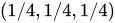
ソーダライトの構造は、1930年にライナス・ポーリングによって初めて研究されました。[ 7 ]これは空間群P43n (空間群218)の立方晶鉱物で、アルミノケイ酸塩ケージネットワークと、その骨格間にあるNa +陽イオンおよび塩化物陰イオンから構成されています。(代わりに少量の他の陽イオンおよび陰イオンが存在する場合もあります。)この骨格はゼオライトケージ構造を形成します。各単位格子には2つの空洞があり、それらはホウ酸塩ケージ(B)とほぼ同じ構造をしています。24 O48 ) 24−亜鉛ホウ酸塩Znに見られる4 O(BO2 )6、 [ 8 ]ベリロケイ酸塩ケージ(Be12 Si12 O48 ) 24−[ 7 ]アルミン酸塩ケージ( Al24 O48 ) 24−カリフォルニア州8 (アル)12 O24 )(WO4 )2、 [ 9 ]、類似鉱物のツグトゥパイト(Na4 AlBeSi4 O12Cl) (see Haüyne#Sodalite group). There is one cavity around each chloride ion. One chloride is located at the corners of the unit cell, and the other at the centre. Each cavity has chiral tetrahedral symmetry, and the cavities around these two chloride locations are mirror images one of the other (a glide plane or a four-fold improper rotation takes one into the other). There are four sodium ions around each chloride ion (at one distance, and four more at a greater distance), surrounded by twelve SiO4 tetrahedra and twelve AlO4 tetrahedra. The silicon and aluminum atoms are located at the corners of a truncated octahedron with the chloride and four sodium atoms inside.[8] (A similar structure called "carbon sodalite" may occur as a very high pressure form of carbon — see illustration in reference.[10]) Each oxygen atom links between an SiO4 tetrahedron and an AlO4 tetrahedron. All the oxygen atoms are equivalent, but one half are in environments that are enantiomorphic to the environments of the other half. The silicon atoms are at the location and symmetry-equivalent positions, and the aluminum ions at the location and symmetry-equivalent positions. The three silicon atoms and the three aluminum atoms listed above closest to a given corner of the unit cell form a six-membered ring of tetrahedra, and the four in any face of the unit cell form a four-membered ring of tetrahedra. The six-membered rings can serve as channels in which ions can diffuse through the crystal.[11]
The structure is a crumpled form of a structure in which the three-fold axes of each tetrahedron lie in planes parallel to the faces of the unit cell, thus putting half the oxygen atoms in the faces. As the temperature is raised the sodalite structure expands and uncrumples, becoming more like this structure. In this structure the two cavities are still chiral, because no indirect isometry centred on the cavity (i.e. a reflexion, inversion, or improper rotation) can superimpose the silicon atoms onto silicon atoms and the aluminum atoms onto aluminum atoms, while also superimposing the sodium atoms on other sodium atoms. A discontinuity of the thermal expansion coefficient occurs at a certain temperature when chloride is replaced by sulfate or iodide, and this is thought to happen when the framework becomes fully expanded or when the cation (sodium in natural sodalite) reaches the coordinates (その他)。[ 11 ]これにより対称性(単位格子の面の鏡面など)が加わり、空間群は Pm 3 n(空間群 223)となり、空洞はキラルではなくなり、パイリトヘドラル対称性を持つようになる。天然のソーダライトは主に塩化物アニオンをケージ内に保持しているが、硫酸塩、硫化物、水酸化物、三硫黄などの他のアニオンで置換することができ、ソーダライトグループの他の鉱物は端成分組成を表す。ナトリウムは他のアルカリグループ元素で、塩化物は他のハロゲン化物で置換することができる。これらの多くは合成されている。[ 11 ]
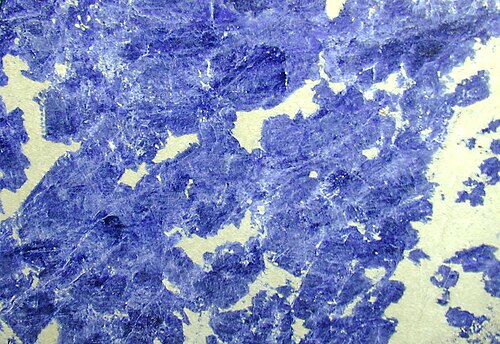
ソーダライトは、軽くて比較的硬いが脆い鉱物で、その名前はナトリウム含有量に由来する。鉱物学では長石類に分類される。青色でよく知られているが、灰色、黄色、緑色、ピンク色の場合もあり、白い筋や斑点が見られることも多い。より均一な青色のものは宝飾品に用いられ、カボションやビーズに加工される。少量のものは、様々な用途で表面材や象嵌材としてよく見られる。
ソーダライトはラズライトやラピスラズリと多少似ているものの、黄鉄鉱(ラピスラズリによく見られる内包物)をほとんど含まず、その青色はウルトラマリンというよりは伝統的なロイヤルブルーに近い。また、条痕が青色ではなく白色であることも、類似鉱物との大きな違いである。ソーダライトの6方向の劈開性は弱く、石を貫く初期の亀裂として観察できる。
ほとんどのソーダライトは紫外線の下でオレンジ色に蛍光し、ハックマナイトは光にさらされたり暗所に置かれたりすると色の濃淡が変化するテネブレッセンス、つまりフォトクロミズムの一種を示します。[ 13 ]

ハックマナイトは、テネブレッセンスを示すソーダライトの一種です。[ 14 ]モン・サン・イレール(ケベック州)またはイリマウサック(グリーンランド)産のハックマナイトは、採掘直後は一般的に淡い紫から濃い紫ですが、色はすぐに灰色または緑がかった白色に退色します。一方、アフガニスタンとミャンマー共和国産のハックマナイトは、最初はクリーム色ですが、日光の下で紫からピンクがかった赤色に変化します。しばらく暗い環境に置いておくと、紫色は再び退色します。テネブレッセンスは、長波紫外線、特に短波紫外線を使用することで促進されます。
ソーダライトは、1811年に西グリーンランドのナルサックにあるイリマウサック複合体の模式産地で初めて記載された。[ 2 ]
ソーダライトは通常塊状で産出し、ネフェリン閃長岩などの深成火成岩の脈充填物として見られる。これは、シリカ不飽和環境に典型的な他の鉱物、すなわちリューサイト、カンクリナイト、ナトロライトと共生している。その他の共生鉱物には、ネフェリン、チタンアンドラダイト、エジリン、マイクロクリン、サニディン、アルバイト、方解石、蛍石、アンケライト、重晶石などがある。[ 4 ]

微細な鉱物の重要な鉱床は、カナダのオンタリオ州バンクロフト(プリンセス・ソーダライト鉱山)とケベック州モン・サン・イレール、および米国のメイン州リッチフィールドとアーカンソー州マグネット・コーブのごく少数の場所に限られています。ブリティッシュコロンビア州ゴールデン近郊のアイスリバー複合鉱床にはソーダライトが含まれています。[ 15 ]小規模な鉱床は、南米(ブラジルとボリビア)、ポルトガル、ルーマニア、ビルマ、ロシアで発見されています。ハックマナイトは主にモン・サン・イレールとグリーンランドで発見されています。
自形結晶で透明な結晶は、ナミビア北部やイタリアのベスビオ山の溶岩中に見られる。
ソーダライト岩は、ソーダライトを豊富に含む噴出火成岩の一種である。 [ 16 ]その貫入岩の同等物はソーダライト岩である。[ 16 ]
ソーダライトのメソポーラスケージ構造は、多くの陰イオンの容器材料として有用である。ソーダライト構造材料に含まれることが知られている陰イオンには、硝酸塩[ 17 ] 、ヨウ化物[ 18 ] 、ヨウ素酸塩[ 19 ] 、過マンガン酸塩[ 20 ]、過塩素酸塩[ 21 ]、および過レニウム酸塩などがある。
 ウィキメディア・コモンズにあるソーダライト関連のメディア