Loading article…
In quantum mechanics, and especially quantum information theory, the purity of a normalized quantum state is a scalar defined as where is the density matrix of the state and is the trace operation. The purity defines a measure on quantum states, giving information on how much a state is mixed.
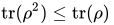
The purity of a normalized quantum state satisfies ,[1] where is the dimension of the Hilbert space upon which the state is defined. The upper bound is obtained by and (see trace).
If is a projection, which defines a pure state, then the upper bound is saturated: (see Projections). The lower bound is obtained by the completely mixed state, represented by the matrix .
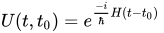
The purity of a quantum state is conserved under unitary transformations acting on the density matrix in the form , where U is a unitary matrix. Specifically, it is conserved under the time evolution operator, where H is the Hamiltonian operator.[1][2]
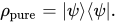
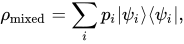
A pure quantum state can be represented as a single vector in the Hilbert space. In the density matrix formulation, a pure state is represented by the matrix However, a mixed state cannot be represented this way, and instead is represented by a convex combination of pure states while for normalization. The purity parameter is related to the coefficients: If only one coefficient is equal to 1, the state is pure. Indeed, the purity is 1/d when the state is completely mixed, i.e. where are d orthonormal vectors that constitute a basis of the Hilbert space.[3]
On the Bloch sphere, pure states are represented by a point on the surface of the sphere, whereas mixed states are represented by an interior point. Thus, the purity of a state can be visualized as the degree to which the point is close to the surface of the sphere.
For example, the completely mixed state of a single qubit is represented by the center of the sphere, by symmetry.
A graphical intuition of purity may be gained by looking at the relation between the density matrix and the Bloch sphere, where is the vector representing the quantum state (on or inside the sphere), and はパウリ行列のベクトルです。
パウリ行列はトレースがゼロなので、 tr( ρ ) = 1が依然として成り立つ。しかし、 したがって これは、球の表面上の状態のみが純粋であるという事実と一致します(つまり)
純度は線形エントロピーと自明な関係にある州によって
線形エントロピーは、フォン・ノイマンエントロピーSの低次近似であり、次のように定義される。
線形エントロピーは、純粋状態ρ 2 = ρの周りでln ρ = ln (1−(1− ρ ))を展開することによって得られます。つまり、非負行列1− ρに関して、対数の形式的 メルカトル級数で展開します。 そして、先頭項のみを残します。線形エントロピーとフォン・ノイマンエントロピーはどちらも状態の混合度を測定しますが、線形エントロピーは密度行列の対角化を必要としないため、計算が容易です。一部の著者[ 4 ]は、異なる正規化を用いて線形エントロピーを定義しています 。 これにより、数量がゼロから1の範囲に収まることが保証されます。
2量子ビットの純粋状態(シュミット分解を用いて)次のように書くことができる。、 どこは、それぞれ、その密度行列は量子もつれの度合いは、そのサブシステムの状態の純度と関係があり、、同様に(部分トレースを参照)。この初期状態が分離可能であれば(つまり、単一の)、 それから両方とも純粋です。そうでなければ、この状態はもつれていて、両方とも混合です。たとえば、これは最大エンタングル状態であり、両方とも完全に混ざり合っている。
2量子ビット(純粋状態または混合状態)の場合、シュミット数(シュミット係数の数)は最大で2です。これとペレス・ホロデツキ基準(2量子ビットの場合)を用いると、状態の部分転置が少なくとも1つの負の固有値を持つ場合、その状態はエンタングル状態となります。上記のシュミット係数を用いると、負の固有値は[ 5 ]ネガティブこの固有値の もエンタングルメントの尺度として使用されます。この固有値がより負の値であるほど(最大で )、状態はよりエンタングルメントされています。ベル状態の場合)。サブシステムの状態の場合(同様に)、それは次のように主張する。
そして純粋さは。
複合状態の絡み合いが強いほど(つまり負の値が強いほど)、部分系の状態の純度が低くなることがわかる。
局在化の文脈では、純度と密接に関連する量である、いわゆる逆参加率(IPR)が有用であることがわかります。これは、実空間、運動量空間、あるいは位相空間など、ある空間における密度の二乗の積分(有限システムサイズの場合は和)として定義されます。ここで、密度は実空間波動関数の二乗になります。運動量空間波動関数の二乗あるいは、それぞれフシミ分布のような位相空間密度である。[ 6 ]
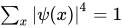
IPRの最小値は完全に非局在化した状態に対応し、規模のシステムの場合、IPR はIPRの値が1に近い場合は局在状態(類推では純粋状態)に対応し、これは完全に局在した状態にも見られる。、IPR は一次元では、IPRは局在長の逆数、すなわち状態が局在する領域の大きさに正比例します。凝縮系物理学の枠組みでは、局在状態と非局在(拡張)状態は、それぞれ絶縁体状態と金属状態に対応します。これは、格子上の電子が結晶内で移動できない状態(局在波動関数、IPRは1に近い)と移動できる状態(拡張状態、IPRは0に近い)を想像した場合です。
局在化の文脈では、波動関数自体を知る必要はなく、局在化特性を知るだけで十分な場合が多い。これが、IPRがこの文脈で役立つ理由である。IPRは基本的に量子システムに関する完全な情報(波動関数、例えば、次元ヒルベルト空間を保管する必要がある値、波動関数の成分)を圧縮し、状態の局在特性に関する情報のみを含む単一の数値にします。完全に局在した状態と完全に非局在化した状態のこの 2 つの例は、実空間波動関数とそれに対応する実空間 IPR についてのみ示されましたが、この考え方を運動量空間や位相空間に拡張することは明らかに可能です。この場合、IPR は考慮対象の空間における局在に関する情報を提供します。たとえば、平面波は実空間では強く非局在化していますが、そのフーリエ変換は強く局在化しているため、この場合、実空間 IPR はゼロに近く、運動量空間 IPR は 1 に近くなります。














![{\displaystyle \rho ^{2}={\tfrac {1}{2}}\left[{\tfrac {1}{2}}\left(1+|a|^{2}\right)I+\mathbf {a} \cdot {\boldsymbol {\sigma }}\right],}](https://wikimedia.org/api/rest_v1/media/math/render/svg/fe56490aeac690c246ebe29990ec77503e35c616)