
Loading article…
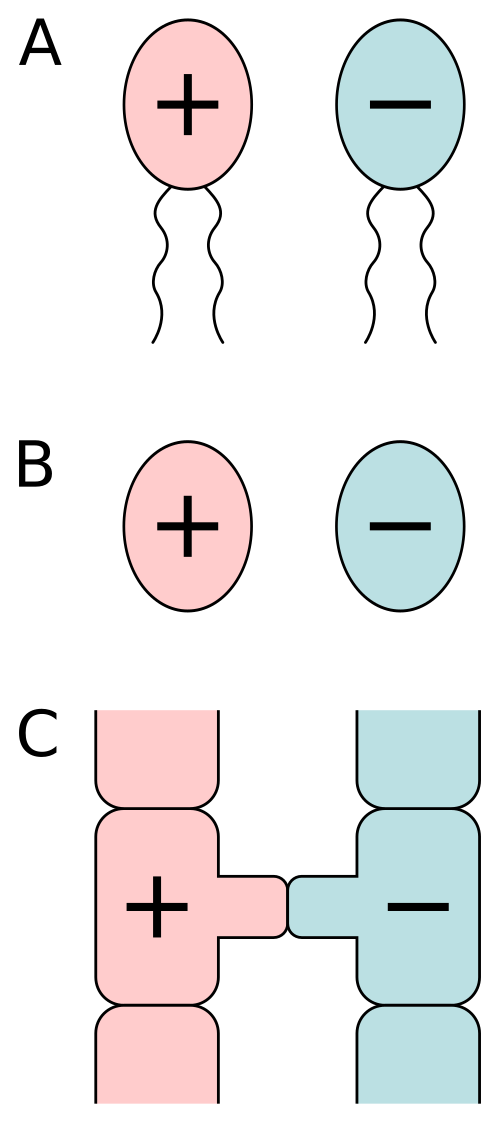
Isogamy is a form of sexual reproduction that involves gametes of the same morphology (indistinguishable in shape and size), and is found in most unicellular eukaryotes.[1] Because both gametes look alike, they generally cannot be classified as male or female.[2] Instead, organisms that reproduce through isogamy are said to have different mating types, most commonly noted as "+" and "−" strains.[3]
The etymology of isogamy derives from the Greek adjective isos (meaning equal) and the Greek verb gameo (meaning to have sex/to reproduce), eventually meaning "equal reproduction" which refers to a hypothetical initial model of equal contribution of resources by both gametes to a zygote in contrast to a later evolutional stage of anisogamy.[4] The term isogamy was first used in the year 1891.[5][6]
Isogamous species often have two mating types (heterothallism), but sometimes can occur between two haploid individuals that are mitotic descendents (homothallism).[1][Note 1] Some isogamous species have more than two mating types, but the number is usually lower than ten. In some extremely rare cases, such as in some basidiomycete species, a species can have thousands of mating types.[7]
Under the strict definition of isogamy, fertilization occurs when two gametes fuse to form a zygote.[8] Sexual reproduction between two cells that does not involve gametes (e.g. conjugation between two mycelia in basidiomycete fungi), is often called isogamy, although it is not technically isogametic reproduction in the strict sense.[1]
既知のすべての生命体における有性生殖の進化の最初の段階として、同型配偶子生殖は、すべての真核生物の共通祖先である単一の単細胞真核生物種で一度だけ進化したと考えられています。同型配偶子生殖は異型配偶子生殖の祖先状態であると一般的に受け入れられています。[ 1 ] [ 9 ]同型配偶子生殖は、植物と動物のいくつかの系統で独立して異型配偶子生殖(雄型と雌型の配偶子を持つ種)に進化し、その後卵配偶子生殖(雌の配偶子が雄よりもはるかに大きく、移動する能力がない種)に進化しました。このパターンは、有性生殖に必要な2つの配偶子が結合するメカニズムに対する物理的な制約によって引き起こされた可能性があります。[ 10 ]
同型配偶子接合は出現以来、単細胞真核生物種では標準的な形態であり続けており、多細胞生物種においても進化的に安定している可能性がある。[ 1 ]
ほとんどすべての単細胞真核生物は同型配偶子である。[ 11 ]多細胞生物では、同型配偶子は菌類と真核藻類に限られている。[ 12 ]緑藻類の多くの種は同型配偶子である。これは、Ulva、Hydrodictyon、Tetraspora、Zygnema、Spirogyra、Ulothrix、Chlamydomonas属で典型的である。[ 1 ] [ 13 ] Saccharomyces cerevisiaeやSchizosaccharomyces pombeなどの単細胞種を含む多くの菌類も同型配偶子である。[ 1 ] [ 14 ]
担子菌類などの一部の多細胞菌類では、 2つの菌糸体間で有性生殖が行われるが、配偶子の交換はない。[ 1 ]
同型配偶子を持つ後生動物、紅藻類、陸上植物の例は知られていない。[ 1 ]