Daylight saving time (DST) is the practice of advancing clocks during warmer months so that darkness falls later each day according to the clock.
Proponents of DST generally argue that it saves energy, promotes outdoor leisure activity in the evening (in summer), and therefore is good for physical and psychological health, reduces traffic accidents[1][2][3], reduces crime[4][5] or is good for business[6][7].
Opponents argue that DST disrupts human circadian rhythms (negatively impacting human health in the process),[8][9] that it increases fatal traffic collisions,[10] that the actual energy savings are inconclusive,[11] and that DST increases health risks such as heart attack.[11] Farmers have tended to oppose DST.[12][13]
Having a common agreement about the day's layout or schedule has so many advantages that a standard schedule over whole countries or large areas has generally been chosen over efforts in which some people get up earlier and others do not.[14] The advantages of coordination are so great that many people ignore whether DST is in effect by altering their work schedules to coordinate with television broadcasts or daylight.[15] DST is commonly not observed during most of winter, because the days are shorter then; workers may have no sunlit leisure time, and students may need to leave for school in the dark.[16]
Energy use
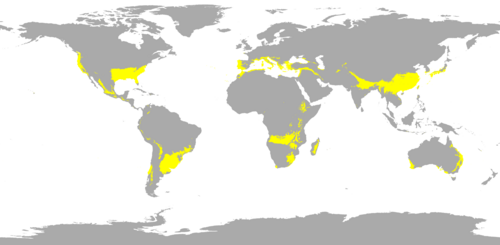
Subtropical climates are highlighted in yellow on this map. People living in these areas may consume more energy as a result of DST.
The government of Kazakhstan cited health complications due to clock shifts as a reason for abolishing DST in 2005.[80] In March 2011, Dmitri Medvedev, president of Russia, claimed that "stress of changing clocks" was the motivation for Russia to stay in DST all year long. Officials at the time talked about an annual increase in suicides.[81]
An unexpected adverse effect of daylight saving time may lie in the fact that an extra part of morning rush hour traffic occurs before dawn and traffic emissions then cause higher air pollution than during daylight hours.[82]
In 2025, a Stanford study compared the year-long circadian health impact of permanent Standard Time, permanent Daylight Saving Time, and biannually switching in the continental U.S. using models of the human circadian rhythm and health data from the CDC Places dataset. Researchers found that switching to permanent Standard Time was predicted to reduce cases of obesity by 2.6 million cases and stroke by 300,000 cases. Permanent Daylight Saving Time also reduced cases but to a lesser extent.[84] In interviews, the authors caution that this work is from a circadian health perspective and that other factors should be considered in policy decisions such as economic and safety impacts of time policy.
Complexity and disadvantages
DST's clock shifts have the obvious disadvantage of complexity. People must remember to change their clocks; this can be time-consuming, particularly for mechanical clocks that cannot be moved backward safely.[85] People who work across time zone boundaries need to keep track of multiple DST rules, as not all locations observe DST or observe it the same way. The length of the calendar day becomes variable; it is no longer always 24 hours. Disruption to meetings, travel, broadcasts, billing systems, and records management is common, and can be expensive.[86] During an autumn transition from 02:00 to 01:00, a clock reads times from 01:00:00 through 01:59:59 twice, possibly leading to confusion.[87]
1 2 Susan A. Ferguson; David F. Preusser; Adrian K. Lund; Paul L. Zador; Robert G. Ulmer (1995). "夏時間と自動車事故:歩行者と車両乗員の死亡者数の減少" (PDF) . American Journal of Public Health . 85 (1): 92– 95. doi : 10.2105/AJPH.85.1.92 . PMC 1615292 . PMID 7832269 .
1 2 Douglas Coate; Sara Markowitz (2003). 「米国における歩行者死亡事故および自動車乗員死亡事故に対する日照時間と夏時間の影響」。Accident Analysis & Prevention . 36 (3): 351– 357. doi : 10.1016/S0001-4575(03)00015-0 . PMID 15003579 .
1 2 Doleac, Jennifer L.; Sanders, Nicholas J. (2015 年 12 月 8 日). 「暗闇に紛れて: 周囲の光が犯罪活動に与える影響」 . Review of Economics and Statistics . 97 (5): 1093– 1103. doi : 10.1162/rest_a_00547 . S2CID 57566972 .
1 2 3 Grant, Laura (2017年11月1日) 「サマータイムは手間をかける価値があるのか?研究によるとノー」The Conversation。2018年3月12日取得。
1 2 Roenneberg, Till; Winnebeck, Eva C.; Klerman, Elizabeth B. (2019). "夏時間と人工時間帯 ― 生物学的時間と社会的時間の戦い" . Frontiers in Physiology . 10 944. doi : 10.3389/fphys.2019.00944 . PMC 6692659 . PMID 31447685 .
↑ Fritz, Josef (2020). "A Chronobiological Evaluation of the Acute Effects of Daylight Saving Time on Traffic Accident Risk" . Current Biology . 30 (4): 729–735.e2. Bibcode : 2020CBio...30E.729F . doi : 10.1016/j.cub.2019.12.045 . PMID 32008905. S2CID 210956409 .
↑ Dilip R. Ahuja; DP Sen Gupta; VK Agrawal (2007). 「インド標準時を30分進めることによるエネルギー節約」(PDF) . Current Science . 93 (3): 298– 302.
↑ Matthew J. Kotchen; Laura E. Grant (2008). 「夏時間はエネルギーを節約するのか?インディアナ州での自然実験からの証拠」(PDF) . NBERワーキングペーパー(14429).全米経済研究所。一般向け要約:ウォール・ストリート・ジャーナル、2008年2月27日。
↑ David B. Belzer、Stanton W. Hadley、Shih-Miao Chin (2008)。延長された夏時間による国家エネルギー消費への影響:議会への報告書、2005年エネルギー政策法第110条(PDF)(報告書)。米国エネルギー省。2013年5月18日のオリジナルからアーカイブ(PDF) 。
↑ Mark J. Kamstra; Lisa A. Kramer; Maurice D. Levi (2000). "Losing sleep at the market: the daylight saving anomaly" (PDF) . American Economic Review . 90 (4): 1005– 1011. CiteSeerX 10.1.1.714.2833 . doi : 10.1257/aer.90.4.1005 . hdl : 1807/99702 .
↑ Luisa Müller; Dirk Schiereck; Marc W. Simpson; Christian Voigt (2009). "夏時間効果". Journal of Multinational Financial Management . 19 (2): 127– 138. doi : 10.1016/j.mulfin.2008.09.001 .
↑ Mark J. Kamstra; Lisa A. Kramer; Maurice D. Levi (2002). "Losing sleep at the market: the daylight saving anomaly: Reply". American Economic Review . 92 (4): 1257– 1263. doi : 10.1257/00028280260344795 . JSTOR 3083314 .
↑ J. Broughton; M. Stone (1998). SDSTの導入が交通事故に及ぼす影響に関する新たな評価(報告書)。TRL368。運輸研究所。2016年8月21日のオリジナルからアーカイブ済み。 2020年11月9日取得。
↑ Alex Vincent; Stanley Coren (1998). "夏時間による衝突事故率への影響". New England Journal of Medicine (全文無料). 339 (16): 1167– 1168. doi : 10.1056/NEJM199810153391617 . PMID 9776656 .このやり取りにおけるコーレン側の主張を裏付けるデータは以下の通りである:スタンレー・コーレン(1998)。「睡眠不足、致命的な事故、そして春の夏時間への移行」。INABIS '98。
↑ Jason Varughese; Richard P. Allen (2001). 「夏時間変更後の死亡事故:アメリカの経験」Sleep Medicine . 2 (1): 31– 36. doi : 10.1016/S1389-9457(00)00032-0 . PMID 11152980 .
↑ J. Alsousoua; T. Jenks; O. Bouamra; F. Lecky; K. Willett (2009). "夏時間(DST)への移行:交通事故による重傷または死亡事故への影響" . Injury Extra . 40 (10): 211– 212. doi : 10.1016/j.injury.2009.06.241 .
↑ Christopher M. Barnes; David T. Wagner (2009). "サマータイムへの変更は睡眠時間を削り、職場での負傷を増加させる" (PDF) . Journal of Applied Psychology . 94 (5): 1305– 1317. doi : 10.1037/a0015320 . PMID 19702372 . S2CID 2538780 .
↑ Smith, Austin C. (2016). "Spring Forward at Your Own Risk: Daylight Saving Time and Fatal Vehicle Crashes". American Economic Journal: Applied Economics . 8 (2): 65–91 . CiteSeerX 10.1.1.676.1062 . doi : 10.1257/app.20140100 . ISSN 1945-7782 .
↑ Fritz, Josef (2020). "A Chronobiological Evaluation of the Acute Effects of Daylight Saving Time on Traffic Accident Risk" . Current Biology . 30 (4): 729–735.e2. Bibcode : 2020CBio...30E.729F . doi : 10.1016/j.cub.2019.12.045 . PMID 32008905. S2CID 210956409 .
↑ Barnes, Christopher M.; Drake, Christopher L. (2015年11月). "睡眠の健康を優先する" . Perspectives on Psychological Science . 10 (6): 733– 737. doi : 10.1177/1745691615598509 . PMID 26581727 .
↑ Michael Rosenberg; Lisa Wood (2010). 「行動変容に影響を与える政策の力:夏時間と身体活動への影響」。Australian and New Zealand Journal of Public Health . 34 (1): 83– 88. doi : 10.1111/j.1753-6405.2010.00479.x . PMID 20920111 . S2CID 9939560 .
↑ Parisi AV、Turner J、Turnbull DJ、Schouten P、Downs N (2008)。「夏時間による散乱性紅斑性太陽紫外線曝露への影響」( PDF )。Journal of Photochemistry and Photobiology B: Biology。91 ( 1 ) : 35–40。Bibcode : 2008JPPB... 91 ... 35P。CiteSeerX 10.1.1.575.2748。doi : 10.1016 / j.jphotobiol.2008.01.010。hdl : 10072 / 40485。PMID 18321724。
↑ Henry Olders (2003). 「平均日の出時刻はうつ病の有病率を予測する」。Journal of Psychosomatic Research . 55 (2): 99– 105. doi : 10.1016/S0022-3999(02)00479-8 . PMID 12932507 .
Pablo Valdez; Candelaria Ramírez; Aída García (2003). "睡眠覚醒サイクルのスケジュールの小さな(1~2時間)変化への調整". Biological Rhythm Research . 34 (2): 145– 155. Bibcode : 2003BioRR..34..145V . doi : 10.1076/brhm.34.2.145.14494 . S2CID 83648787 .
Thomas Kantermann; Myriam Juda; Martha Merrow; Till Roenneberg (2007). 「ヒトの概日時計の季節調整は夏時間によって阻害される」(PDF) . Current Biology . 17 (22): 1996–2000 . Bibcode : 2007CBio...17.1996K . doi : 10.1016/ j.cub.2007.10.025 . PMID 17964164. S2CID 3135927 .
↑ Michael Berk; Seetal Dodd; Karen Hallam; Lesley Berk; John Gleeson; Margaret Henry (2008). "日内リズムのわずかな変化は自殺の増加と関連している: サマータイムの影響". Sleep and Biological Rhythms . 6 (1): 22– 25. doi : 10.1111/j.1479-8425.2007.00331.x . S2CID 146306689 .
↑ Imre Janszky; Rickard Ljung (2008). "夏時間への移行と心筋梗塞の発生率" . New England Journal of Medicine . 359 (18): 1966–1968 . doi : 10.1056/NEJMc0807104 . PMID 18971502 . S2CID 205040478 .
↑ Int Panis, L.; Beckx, C. (2007). "夜間のトラックの走行と地域の大気汚染への影響" . European Transport Conference . doi : 10.6084/m9.figshare.7868777 .
↑ Cho, Kyoungmin; Barnes, Christopher M.; Guanara, Cristiano L. (2017年2月). "眠そうな罰者は厳しい罰者だ". Psychological Science . 28 (2): 242– 247. doi : 10.1177/0956797616678437 . PMID 28182529 . S2CID 11321574 .
↑ Weed, Lara; Zeitzer, Jamie M. (2025-09-23). "Circadian-informed modeling predicts regional variation in obesity and stroke outcomes under different permanent US time policies" . Proceedings of the National Academy of Sciences . 122 (38) e2508293122. Bibcode : 2025PNAS..12208293W . doi : 10.1073/pnas.2508293122 . PMC 12478180. PMID 40953265 .
↑ Stephen Tong; Joseph Williams (2007). 「2007年の夏時間への準備はできていますか?」. IT Professional . 9 (1): 36–41 . Bibcode : 2007ITPro...9a..36T . doi : 10.1109/MITP.2007.2 . S2CID 31325604 .
デイビッド・プレロー(2005)。『昼の光を掴め:サマータイムの奇妙で論争の的となった物語』サンダーズ・マウス・プレス。ISBN978-1-56025-655-7。英国版(英国に焦点を当てたもの)は『Saving the Daylight: Why We Put the Clocks Forward』 (Granta Books刊)である。ISBN978-1-86207-796-6。