Loading article…
The M65 atomic cannon, often called Atomic Annie,[6]:92 was an artillery piece built by the United States and capable of firing a nuclear weapon, developed in the early 1950s at the beginning of the Cold War. It was fielded between April 1955 and December 1962 in West Germany with the 7th US Army, in South Korea with the 8th US Army, and on Okinawa, Japan.[7]
In 1949, Picatinny Arsenal was tasked with creating a nuclear-capable artillery piece. Robert Schwartz, the engineer who created the preliminary designs, essentially scaled up the 240 mm howitzer shell (then the maximum in the arsenal) to 280 mm and used the similarly sized GermanK5 railroad gun as a point of departure for the carriage.[5] (The name Atomic Annie likely derives from the nickname Anzio Annie given to a pair of German K5 guns which were employed against the Allied landings in Italy.[1]) The design was approved by the Pentagon, largely through the intervention of Samuel Feltman,[5] chief of the ballistics section of the ordnance department's research and development division. A three-year developmental effort followed. The project proceeded quickly enough to produce a demonstration model to participate in Dwight D. Eisenhower's inaugural parade in January 1953. The gun was initially designated T131 and the carriage was T72.
大砲は、鉄道のシュナーベル車と同様の方法で、特別に設計された2台のトラクターによって輸送された。両方のトラクターは、一部の超大型消防車のように独立して操舵することができた。各トラクターは375馬力(280kW )の定格出力を持ち、やや扱いにくい組み合わせでも、時速35マイル(56km /h)の速度を達成し、幅28フィート(8.5m )の舗装路または固められた道路で直角に曲がることができた。 [ 1 ]砲は12分で展開でき、その後15分で移動構成に戻すことができた。[ 2 ]砲はトラクターから平らな地面に下ろすことで展開された。砲全体はボールジョイントでバランスが取られており、フットプレートを中心に旋回することができた。旋回範囲は、砲の後部の下に配置された湾曲したトラックによって制限された。
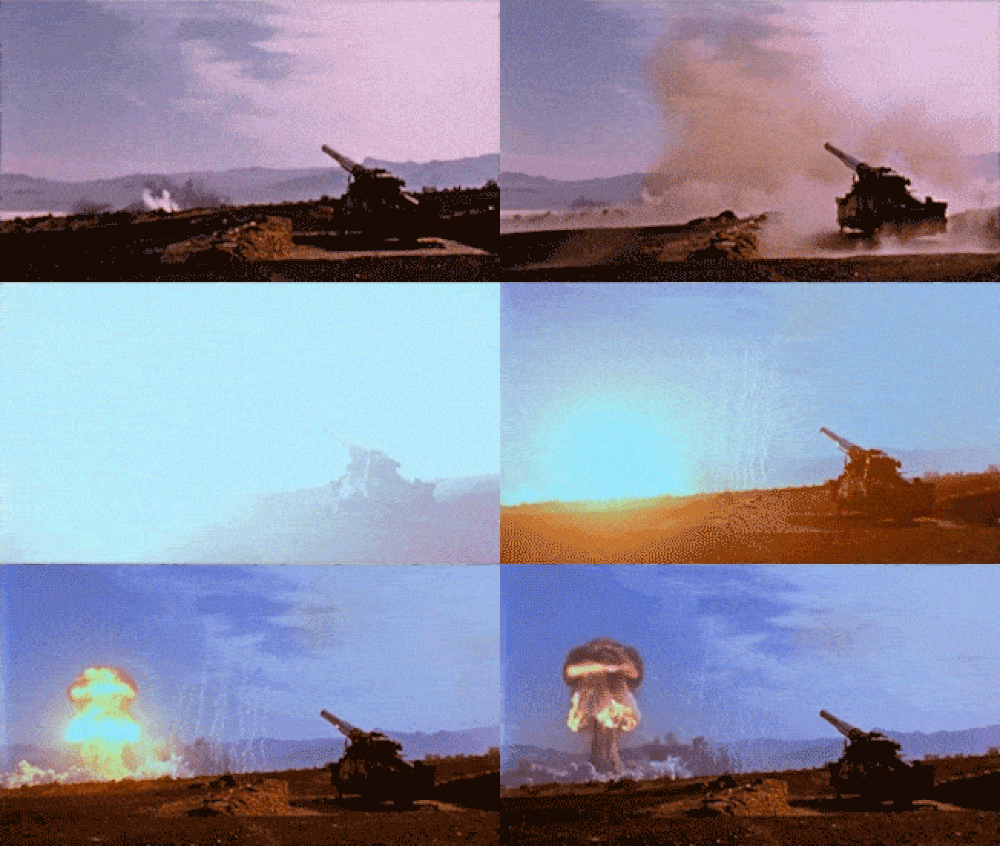
1953年5月25日午前8時30分、アップショット・ノットホール核実験シリーズの一環として、ネバダ核実験場(具体的にはフレンチマン・フラット )で原子砲の実験が行われた。この実験は「グレイブル」と名付けられ、統合参謀本部議長代理のアーサー・W・ラドフォード提督と米国国防長官のチャールズ・アーウィン・ウィルソンが出席した。実験の結果、15キロトン(63テラジュール)の砲弾(W9弾頭)が7マイル(11km )の距離で爆発した。これは砲から発射された最初で唯一の核砲弾であった。[ 1 ](リトル・フェラー1のW54の実験では、デイビー・クロケット兵器システムが使用された。これは、砲身に挿入されたスピゴットの先端に取り付けられた弾頭を発射する無反動滑腔砲であった。)

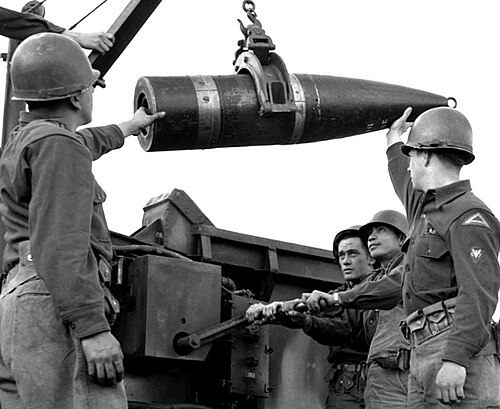
試験の成功後、ウォーターブリート兵器廠とウォータータウン兵器廠で少なくとも20門の大砲が製造され、1門あたり80万米ドルの費用がかかった。[ 1 ]大砲の重量は83.3トン、長さは84フィート、幅は16.1フィート、高さは12.2フィートだった。5~7人の砲兵によって操作され、重量600ポンド、射程7~20マイルの280mm口径の砲弾を発射した。砲弾の核出力は15~20キロトンだった。[ 8 ]これらの大砲はヨーロッパと朝鮮半島に海外配備され、敵軍に発見され標的にされることを避けるため頻繁に移動した。装置の大きさ、限られた射程のため、既存の大砲と互換性のある核砲弾(W48)の開発は155 mmとW33用203 mm の核砲弾や、ロケットやミサイルをベースとした核砲(リトル・ジョンやオネスト・ジョンといった戦術核ミサイルなど)の開発により、M65 は配備後まもなく事実上旧式化しました。しかし、威信兵器としての価値は残り、1963 年まで退役しませんでした。同年、W48 155 mm核砲弾がアメリカ陸軍で採用されました。
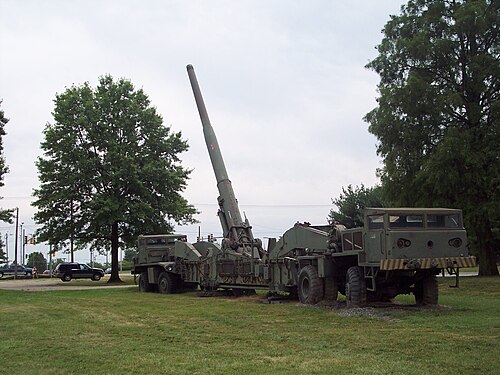
製造された20両のM65のうち、少なくとも7両が展示されている。そのほとんどはもはや原動機を備えていない。
The Virginia War Museum in Newport News, Virginia has been erroneously identified as possessing a 240 mm prototype of the M65. The weapon at the museum is actually a conventional 240 mm T1 Gun, one of two produced as part of a separate design program which was abandoned in favor of the T131 280 mm Atomic Cannon program. Both the T1 and T131/M65 share T72 carriages.[5][12]