
Loading article…
非慣性基準系(加速基準系とも呼ばれる[ 1 ])は、慣性系に対して加速する基準系である[ 2 ]。非慣性系で静止している加速度計は、一般にゼロでない加速度を検出する。運動法則はすべての慣性系で同じであるが、非慣性系では変化し、見かけの運動は加速度に依存する[ 3 ] [ 4 ] 。
古典力学では、ニュートンの第2法則に仮想力(慣性力、擬似力[ 5 ]、ダランベール力とも呼ばれる)を追加することで、非慣性座標系における物体の運動を説明できる場合が多い。その一般的な例としては、コリオリ力や遠心力などがある。一般に、任意の仮想力の式は、非慣性座標系の加速度から導出できる。[ 6 ]グッドマンとワーナーが述べているように、「いわゆる『逆有効力』または『慣性力』を含むように『力』という用語を再定義すれば、任意の座標系でF = m aが成り立つと言えるだろう。」 [ 7 ]
一般相対性理論では、時空の曲率によって、座標系は局所的には慣性を持つが、全体的には非慣性を持つ。曲がった時空の非ユークリッド幾何学のため、一般相対性理論には全体的な慣性座標系は存在しない。より具体的には、一般相対性理論に現れる仮想的な力は重力である。
平坦な時空では、必要に応じて非慣性系の使用を避けることができます。非慣性参照系に関する測定値は、慣性系から見た非慣性系の加速度を直接組み込むことで、常に慣性系に変換できます。[ 8 ]このアプローチは仮想力の使用を回避します(定義上、仮想力が存在しない慣性系に基づいています)が、直感的、観測的、さらには計算的な観点からは不便かもしれません。[ 9 ]気象学で使用される回転系の場合について、ライダーが指摘したように:[ 10 ]
この問題を解決する簡単な方法は、もちろん、すべての座標を慣性系に変換することです。しかし、これは時として不便です。例えば、地球の大気中の気圧勾配による気塊の動きを計算したいとします。結果は回転する地球を基準とする必要があるため、可能であればこの座標系内にとどまる方が良いでしょう。これは、慣性系と同様にニュートンの運動法則を適用できるようにする仮想的な(あるいは「存在しない」)力を導入することで実現できます。
—ピーター・ライダー著『古典力学』78-79ページ
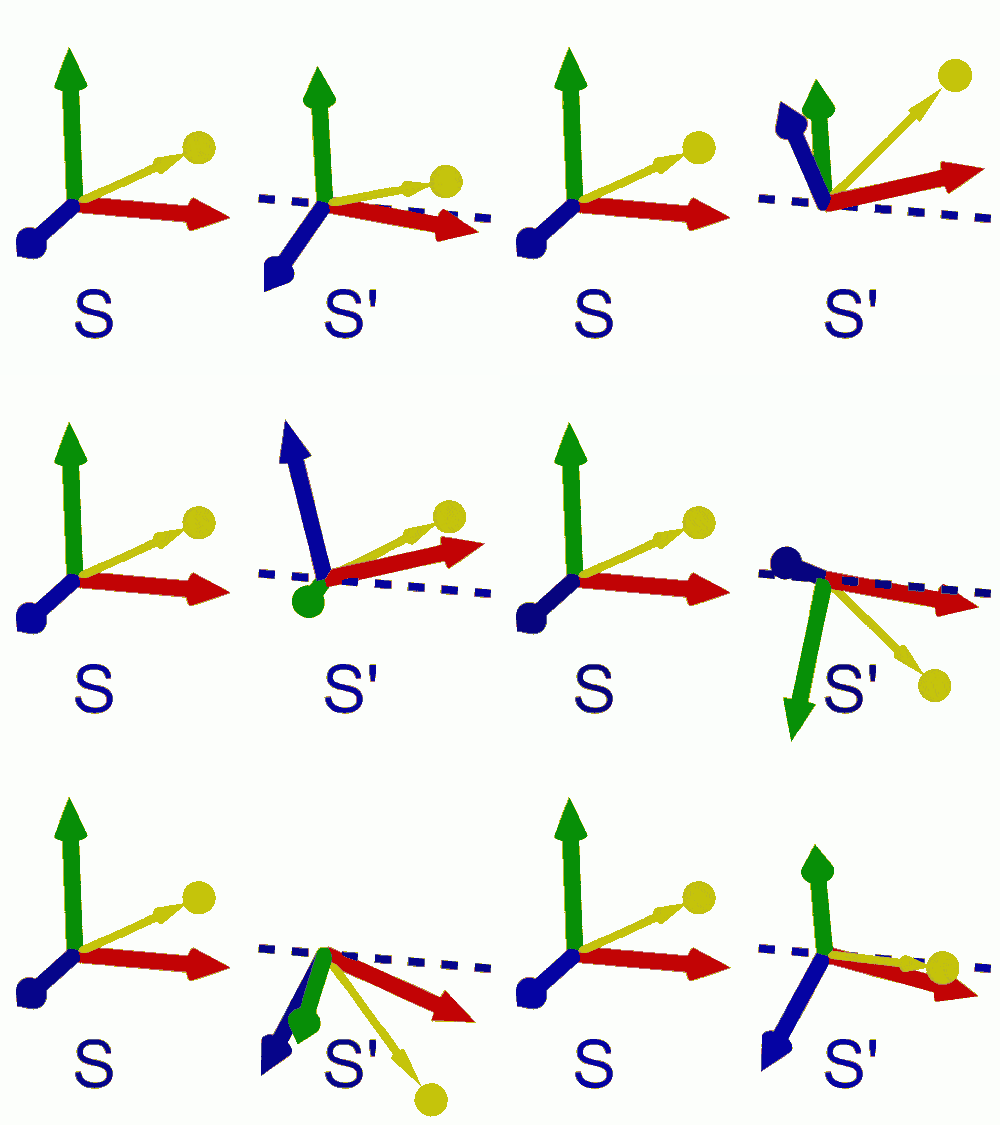
あるフレームが非慣性系であるという事実は、観測された運動を説明するために仮想的な力が必要であることから検出できます。[ 11 ] [ 12 ] [ 13 ] [ 14 ] [ 15 ]例えば、フーコー振り子を使用して地球の自転を観測できます。[ 16 ] 振り子の周囲が地球とともに動くため、地球の自転によって振り子の振動面が変化するように見えます。地球に縛られた(非慣性)参照系から見ると、この見かけ上の向きの変化を説明するには、仮想的なコリオリ力を導入する必要があります。
Another famous example is that of the tension in the string between two spheres rotating about each other.[17][18] In that case, the prediction of the measured tension in the string based on the motion of the spheres as observed from a rotating reference frame requires the rotating observers to introduce a fictitious centrifugal force.
In this connection, it may be noted that a change in coordinate system, for example, from Cartesian to polar, if implemented without any change in relative motion, does not cause the appearance of fictitious forces, although the form of the laws of motion varies from one type of curvilinear coordinate system to another.
If a region of spacetime is declared to be Euclidean, and effectively free from obvious gravitational fields, then if an accelerated coordinate system is overlaid onto the same region, it can be said that a uniform fictitious field exists in the accelerated frame (we reserve the word gravitational for the case in which a mass is involved). An object accelerated to be stationary in the accelerated frame will "feel" the presence of the field, and they will also be able to see environmental matter with inertial states of motion (stars, galaxies, etc.) to be apparently falling "downwards" in the field along curved trajectories as if the field is real.
In frame-based descriptions, this supposed field can be made to appear or disappear by switching between "accelerated" and "inertial" coordinate systems.
As the situation is modeled in finer detail, using the general principle of relativity, the concept of a frame-dependent gravitational field becomes less realistic. In these Machian models, the accelerated body can agree that the apparent gravitational field is associated with the motion of the background matter, but can also claim that the motion of the material as if there is a gravitational field, causes the gravitational field - the accelerating background matter "drags light". Similarly, a background observer can argue that the forced acceleration of the mass causes an apparent gravitational field in the region between it and the environmental material (the accelerated mass also "drags light"). This "mutual" effect, and the ability of an accelerated mass to warp lightbeam geometry and lightbeam-based coordinate systems, is referred to as frame-dragging.
フレームドラッギングは、重力の影響を示す加速座標系と、重力場の影響を受けないとされる慣性座標系との通常の区別をなくします。強制的に加速された物体が座標系を物理的に「引きずる」と、問題はすべての観測者にとって歪んだ時空を扱う演習となります。
物理法則を参照する。