
Loading article…
マルチボディシステムとは、相互に接続された剛体または柔軟な物体の動的挙動を研究するものであり、それぞれの物体は大きな並進変位および回転変位を起こす可能性がある。
相互接続された物体の動的挙動を体系的に扱うことで、力学の分野では数多くの重要な多体形式が生み出されてきた。多体システムの最も単純な物体または要素は、ニュートン(自由粒子)とオイラー(剛体)によって扱われた。オイラーは物体間の反作用力を導入した。その後、一連の形式が導き出されたが、最小座標に基づくラグランジュの形式と、拘束条件を導入する第2の定式化だけを挙げるとすれば、次のようになる。
基本的に、物体の運動は運動学的挙動によって記述されます。動的挙動は、加えられた力の平衡と運動量の変化率によって決まります。今日では、マルチボディシステムという用語は、特にロボット工学や車両力学など、多くの工学分野の研究に関連しています。重要な特徴として、マルチボディシステムの定式化は通常、相互接続された数千もの物体の任意の運動をモデル化、解析、シミュレーション、最適化するためのアルゴリズム的かつコンピュータ支援的な方法を提供します。
有限要素法では、機械システムの個々の物体や部品を詳細に解析するが、多体システム全体の挙動は、通常、以下の分野において多体システム解析法を用いて解析される。
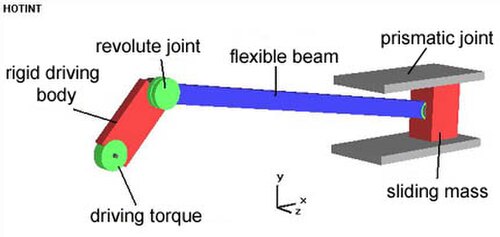
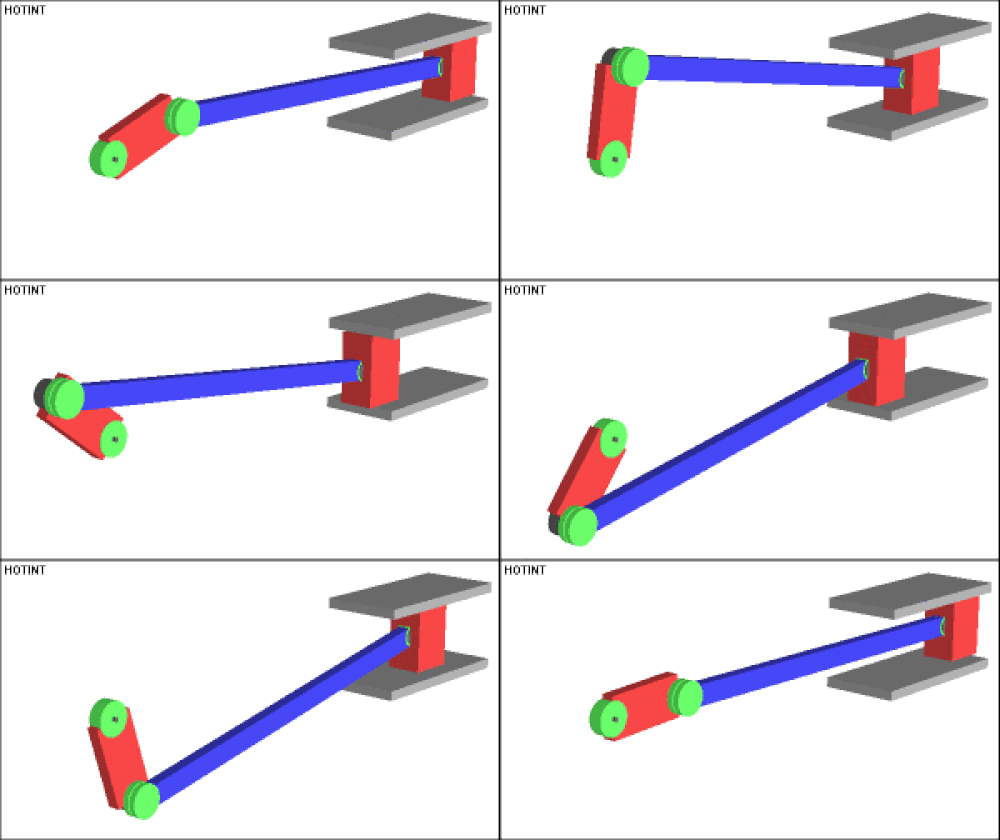
以下の例は、典型的な多体システムを示しています。これは通常、スライダークランク機構と呼ばれます。この機構は、回転する駆動ビーム、連結ロッド、および摺動体を用いて、回転運動を並進運動に変換するために使用されます。この例では、連結ロッドとして柔軟な物体が使用されています。摺動体は回転せず、3つの回転ジョイントを使用して各物体を接続しています。各物体は空間的に6自由度を持ちますが、運動学的条件により、システム全体としては1自由度となります。
機構の動作は、以下のGIFアニメーションでご覧いただけます。
物体とは、通常、機械システムの剛体または柔軟な部分を指します(人体とは混同しないでください)。物体の例としては、ロボットの腕、自動車の車輪や車軸、人間の前腕などがあります。リンクとは、2つ以上の物体、または物体と地面との接続です。リンクは、物体の相対運動を制限する特定の(運動学的)制約によって定義されます。典型的な制約は次のとおりです。
多体システムには、自由度と拘束条件という2つの重要な用語があります。
自由度とは、物体が独立して運動できる可能性の数を表す。言い換えれば、自由度とは、空間における物体の位置を完全に定義するために必要な最小限のパラメータ数である。
剛体は、一般的な空間運動の場合、6つの自由度を持ち、そのうち3つは並進自由度、3つは回転自由度です。平面運動の場合、剛体は3つの自由度しか持たず、回転自由度は1つ、並進自由度は2つです。
平面運動における自由度は、コンピューターのマウスを使って簡単に示すことができます。自由度は、左右方向、前後方向、そして垂直軸を中心とした回転です。
A constraint condition implies a restriction in the kinematical degrees of freedom of one or more bodies. The classical constraint is usually an algebraic equation that defines the relative translation or rotation between two bodies. There are furthermore possibilities to constrain the relative velocity between two bodies or a body and the ground. This is for example the case of a rolling disc, where the point of the disc that contacts the ground has always zero relative velocity with respect to the ground. In the case that the velocity constraint condition cannot be integrated in time in order to form a position constraint, it is called non-holonomic. This is the case for the general rolling constraint.
In addition to that there are non-classical constraints that might even introduce a new unknown coordinate, such as a sliding joint, where a point of a body is allowed to move along the surface of another body. In the case of contact, the constraint condition is based on inequalities and therefore such a constraint does not permanently restrict the degrees of freedom of bodies.
The equations of motion are used to describe the dynamic behavior of a multibody system. Each multibody system formulation may lead to a different mathematical appearance of the equations of motion while the physics behind is the same. The motion of the constrained bodies is described by means of equations that result basically from Newton’s second law. The equations are written for general motion of the single bodies with the addition of constraint conditions. Usually the equations of motions are derived from the Newton-Euler equations or Lagrange’s equations.
The motion of rigid bodies is described by means of
These types of equations of motion are based on so-called redundant coordinates, because the equations use more coordinates than degrees of freedom of the underlying system. The generalized coordinates are denoted by , the mass matrix is represented by which may depend on the generalized coordinates. represents the constraint conditions and the matrix (sometimes termed the Jacobian) is the derivative of the constraint conditions with respect to the coordinates. This matrix is used to apply constraint forces to the according equations of the bodies. The components of the vector are also denoted as Lagrange multipliers. In a rigid body, possible coordinates could be split into two parts,
where represents translations and describes the rotations.
In the case of rigid bodies, the so-called quadratic velocity vector is used to describe Coriolis and centrifugal terms in the equations of motion. The name is because 速度の二次項を含み、物体の運動エネルギーの偏微分によって生じる。
ラグランジュ乗数制約条件に関連しているそして通常は、拘束された自由度の「方向」に作用する力またはモーメントを表します。ラグランジュ乗数は、物体の位置エネルギーを変化させる外力とは異なり、「仕事」をしません。
運動方程式(1、2)は冗長座標によって表されます。つまり、座標は独立していません。これは、上に示したスライダークランク機構で例示できます。この機構では、各物体は6つの自由度を持ち、ほとんどの座標は他の物体の動きに依存しています。たとえば、剛体を含むスライダークランクの動きを記述するには、18個の座標と17個の拘束条件を使用できます。しかし、自由度は1つしかないため、運動方程式は、たとえば駆動リンクの角度を自由度として使用して、1つの方程式と1つの自由度によっても表すことができます。後者の定式化は、システムの運動を記述するために必要な座標の数が最小であるため、最小座標定式化と呼ばれます。冗長座標を最小座標に変換するのは、時に面倒で、ホロノミック拘束条件があり、運動学的ループがない場合にのみ可能です。最小座標運動方程式を導出するためのアルゴリズムがいくつか開発されており、いわゆる再帰的定式化もその一つです。結果として得られる方程式は、拘束条件がないため、標準的な時間積分法を用いて運動方程式を時間的に積分できるため、解きやすくなります。縮小されたシステムはより効率的に解けるかもしれませんが、座標変換には計算コストがかかる可能性があります。非常に一般的な多体システム定式化やソフトウェアシステムでは、システムの使いやすさと柔軟性を高めるために、冗長な座標が使用されます。
物体の柔軟性を考慮する必要があるケースはいくつかあります。例えば、柔軟性が運動学やコンプライアント機構において重要な役割を果たす場合などです。
柔軟性を考慮する方法はいくつかあります。主なアプローチは3つあります。



![\displaystyle \mathbf {q} =\left[\mathbf {u} \quad \mathbf {\Psi } \right]^{T}}](https://wikimedia.org/api/rest_v1/media/math/render/svg/c20d6dbee4375da4b6ffc3e0df78921b00d47139)


