Loading article…
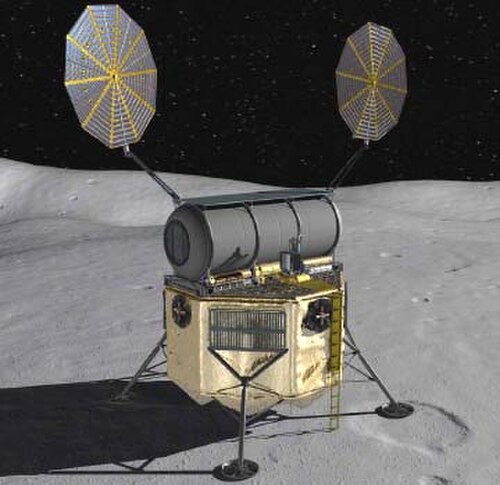
 Artist's impression of the crewed version of Altair on the surface of the Moon | |
| Names | Lunar Surface Access Module (LSAM) |
|---|---|
| Operator | NASA |
| Spacecraft properties | |
| Spacecraft type | Lander |
| Launch mass | 45,864 kg (101,113 lb) |
| Payload mass | 14,500 kg (32,000 lb) |
| Start of mission | |
| Rocket | Ares V |
| Launch site | KennedyLC-39A |
| Orbital parameters | |
| Reference system | Selenocentric |
 | |
The Altair spacecraft, previously known as the Lunar Surface Access Module or LSAM, was the planned lander spacecraft component of NASA's cancelled Constellation program. Astronauts would have used the spacecraft for landings on the Moon, which was intended to begin around 2019. The Altair spacecraft was planned to be used both for lunar sortie and lunar outpost missions.[1]
On February 1, 2010, U.S. President Barack Obama announced a proposal to cancel the Constellation program (except the Orion spacecraft), to be replaced with a re-scoped program, effective with the U.S. 2011 fiscal year budget.[2]
On December 13, 2007, NASA's Lunar Surface Access Module was retitled "Altair", after the 12th brightest star in the northern hemisphere's night sky, Altair in the constellation Aquila. In Latin, aquila means "eagle", providing a connection to the first crewed lunar landing, Apollo 11's Eagle; the name Altair itself is a latinization of the Arabicالطائرal-ṭā'ir, meaning "the eagle," "the bird," or "the flyer."[3]
Prior to the announcement of the "Altair" name, reports had suggested other names had been considered by NASA,[4][5] but Altair won in a vote by the design team over Pegasus.
NASA developed only conceptual designs for Altair. No Altair spacecraft were built—plans called for a first landing on the Moon in 2018.[6]
アポロ月着陸船(LM)と同様に、アルタイルも2段構成で構想されていた。降下モジュールは推進剤タンク、メインエンジン、着陸装置、支持構造からなり、上昇モジュールは与圧された乗員キャビン、生命維持システム、ドッキングシステム、アビオニクス、推進剤タンク、月面上昇用エンジンを備えている。[ 7 ]
アポロ月着陸船(LM)と同様に、アルタイルの乗員室も円筒形を基本としていた。当初はLMと同様に水平円筒形(外観は「箱型」に見えるが)であったが、当時の設計図やコンピュータシミュレーションでは垂直円筒形が採用されていた。2人乗りのアポロ宇宙船とは異なり、アルタイルは4人全員を月面に運ぶように設計されており、一時的に無人となるオリオン宇宙船は月周回軌道上に留まることになっていた。
アルタイルは、地球から離れた場所(宇宙空間および月面)で最大210地球日間運用できることが意図されていました。[ 8 ]アルタイルは、アポロ応用計画中にLMトラックのコンセプトで提案されたように、無人ミッションを飛行することも可能でした。 [ 8 ]ミッション計画担当者は、アルタイルの3つの異なるミッションモードから選択することができました。[ 8 ]

アルタイルは月着陸船(LM)と同様に、2つのハッチを備える計画だった。1つは上部にあり、アルタイルとオリオン間のドッキングと内部移動用、もう1つは月面へのアクセス用のメインハッチである。アポロ月着陸船とは異なり、アルタイルにはスペースシャトルや国際宇宙ステーションにあるようなエアロックがキャビンとメインハッチの間に設けられる予定だった。このエアロックにより、宇宙飛行士は宇宙服の着脱時に、潜在的に危険な月の塵をメインキャビンに持ち込むことなく行うことができ、また、機内の気圧を維持することができた。船外活動中にキャビン全体が減圧されるアポロ月着陸船とは異なり、このエアロックにより、宇宙服に不具合が生じた乗組員は船外活動を中断することなくアルタイル宇宙船に迅速に戻ることができ、着陸チームは7日間の月面滞在中にほとんどの任務を完了することができた。また、エアロックはアルタイルの降下段の一部として残されるため、NASAはエアロックを月面基地の構成要素として利用することができる。
アレスVのペイロードシュラウドは直径33フィート(10メートル)、高さ49フィート(15メートル) (着陸装置を含む)となるように計画されていたため、着陸機はアレスVのペイロードシュラウド内に収まるように格納されるように設計された。
この宇宙船には、現在ISSやロシアのソユーズ宇宙船で使用されているものと同様の、改良された小型キャンプ用トイレ、アポロ計画で使われていた「冷たいスープ」メニューをなくすための食品保温装置、先進的な無人月周回宇宙船が取得したデータを利用したレーザー誘導距離測定システム(レーダーによるバックアップ付き)、そしてオリオン宇宙船と同じボーイング787ベースの新しい「グラスコックピット」とコンピューターシステムも搭載される予定だった。
アルタイルは、降下段には最新の極低温技術を、上昇段には自己着火性燃料技術を利用することを意図していた。当時としてはコンピュータ技術と工学技術の両面で最先端だったアポロ月着陸船は、両段に自己着火性燃料を使用していた。これは互いに接触すると燃焼する化学物質であり、点火機構を必要とせず、無期限の保存が可能だった。アポロ月着陸船と同様に、極低温システムと自己着火性燃料システムは高圧ヘリウムを用いて強制的に供給されるため、ほとんどのロケットエンジンで使用されているターボポンプは不要となる。
Mission requirements obliged the vehicle to be able to descend from an equatorial or high-inclination lunar orbit to a polar landing site, along with bringing it and the Orion spacecraft into lunar orbit, as the Orion spacecraft's onboard AerojetAJ-10 rocket engine and the amount of fuel it carried would have been insufficient to brake the Orion/Altair stack into lunar orbit (also necessary if flown without Orion for cargo-only missions). The new lander would have been powered by a modified RL-10 engine (currently in use on the upper stage of the Delta IV rocket and Centaur upper stage of the Atlas V rocket), burning liquid hydrogen (LH2) and liquid oxygen (LOX) for the descent phase. A single AJ-10 rocket engine, like that on the Orion, was intended to power the ascent stage.
Originally, NASA wanted to power the ascent stage using LOX and liquid methane (LCH4) engines, RS-18, as future missions to Mars would require the astronauts to live on the planet. The Sabatier Reactor could be used to convert the carbon dioxide (CO2) found on Mars into methane, using either found or transported hydrogen, a catalyst, and a source of heat. Cost overruns and immature LOX/LCH4 rocket technology forced NASA to stick with cryogenic and hypergolic systems, although later variants of Altair were meant to serve as testbeds for methane rockets and Sabatier reactors after a permanent lunar base was established.
Because of the spacecraft's size and weight, Altair, and its associated Earth Departure Stage, would have been launched into a low-Earth orbit (LEO) using the super heavy-lift Ares V launch vehicle, followed by a separate launch of an Orion spacecraft lifted by an Ares I. After rendezvous and docking with Altair in LEO, the crew would have then configured the Orion/Altair for the journey to the Moon.
アルタイルの開発は、ジョンソン宇宙センター(JSC)のコンステレーション月着陸船プロジェクトオフィスによって管理されました。JSCは、アポロ宇宙飛行士、さまざまな業界サプライヤー、大学と直接協力して、アルタイルのアーキテクチャを開発しました。初期開発と並行して、特殊なサブシステムやその他の設計上の考慮事項を研究/開発するために、JSCでモックアップまたはテストベッドが開発される予定でした。アポロ月着陸船を製造したノースロップ・グラマンは、プロジェクトオフィスがシステムコンセプトを開発するのを支援するために契約されました。[ 9 ]
 この記事には、米国航空宇宙局のウェブサイトや文書からのパブリックドメインの資料が含まれています。