
Loading article…

A chiton (/ˈkaɪtɒn,-tən/; Ancient Greek: χιτών, romanized: khitṓn[kʰitɔ̌ːn]) is a form of tunic that fastens at the shoulder, worn by men and women of ancient Greece and Rome.[1][2] There are two forms of chiton: the Doric and the later Ionic. According to Herodotus, popular legend was that Athenian women began to wear the chiton as opposed to the peplos after several women stabbed a messenger to death with the bronze pins characteristic of the peplos.[3]
The word chiton is derived from Ancient Greek χιτών (khitṓn, “tunic”), from a Central Semitic language *kittān (as in Maltese) from the Akkadian𒌆𒃰 (kitû, literally “flax, linen”), from Sumerian 𒄑𒃰 (kitû [GIŠ.GADA]).[4][5]
A shorter version of the chiton was called the chitoniskos.
The Doric chiton is a single rectangle of woolen or linen fabric. It can be worn plain or with an overfold called an apoptygma (ἀπόπτυγμα), which is more common to women. It can be draped and fastened at the shoulder by pins (Greek: peronai;[6] Latin: fibulae) or sewing, or by buttons.[7]
The Ionic chiton could also be made from linen or wool and was draped without the fold and held in place from neck to wrist by several small pins or buttons.
Herodotus states the dress of the women in Athens was changed from the Doric peplos to the Ionic chiton after the widows of the men killed on military expedition to Aegina stabbed and killed the sole survivor with their peplos pins, each demanding where their husband was. This lynching 'seemed a thing more terrible than the disaster'. Thereafter their chitons were held with buttons, often styled with the face of the Gorgon.
キトンの上には、ゾスターと呼ばれる大きなベルトを着用することがあり、通常は胸の下(「ハイ・ガードル」)または腰の周り(「ロー・ガードル」)に着用した。あるいは、より細い「ゾーン」または帯を使用することもあった。キトンの長さは着用者の身長よりも長かったため、余った生地はブラウスのようにベルトの上に引き上げられた。二重に帯を締めるスタイルも存在した。キトンは、その上に重厚なヒマティオンを重ね着することも多く、ヒマティオンはマントの役割を果たした。

単独で使用される場合(ヒマティオンなしの場合)、キトンはモノキトンと呼ばれた。かかとまで届く長いキトンはキトン・ポデレスと呼ばれ、地面を引きずるほど長いものはキトン・シルトスまたはヘルケキトン(ἑλκεχίτων)(文字通り「地面を引きずるキトン」)と呼ばれた。[ 8 ] [ 9 ]女性のキトンは常に足首の長さで着用された。男性はアルカイック時代には長いキトンを着用したが、後には司祭や戦車御者などの特定の職業や高齢者を除いて膝丈で着用するようになった。
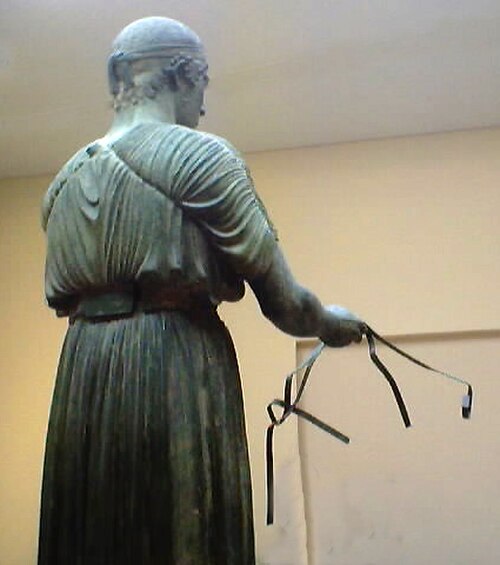
袖付きのものは、神官や俳優が着用した。色や模様はしばしば身分を示すものであったが、時代によって変化した。キトンは非常に女性的であると考えられていたため、アフロディーテの衣装であったが、男性も着用した。ディオニュソスはしばしばキトンを着用している姿で描かれる。キトンは紀元前3世紀以降、ローマ人にも着用された。ただし、彼らはそれをチュニカと呼んだ。キトンの例は、アテネのエレクテイオンの柱廊にあるカリアティードが着用しているのを見ることができる。記事の冒頭の画像にあるデルフィの御者(紀元前474年)には、御者のキトンが見られる。 [ 10 ]

スパルタでは、ラコニア人の女性の衣服はシンプルで丈が短かった。彼女たちは太ももを露出させるスリットの入ったスカートのドリア式ペプロスを着用していた。 [ 11 ]ドリア式ペプロスはイオニアで一般的なものよりも厚手のウール素材で作られており、肩の部分はピンで留められていた。[ 12 ]競走の際には、スパルタの少女たちは特徴的な片方の肩が開いた膝丈のキトンを着用していた。[ 13 ]