クンマー理論につながる体の巡回拡大に関するクンマーの結果
抽象代数学
において 、 ヒルベルトの定理90 (または サッツ90 )は、 体 の 巡回拡大 (またはその一般化の1つ) に関する重要な結果であり、 クンマー理論 につながります。最も基本的な形式では、 L / Kが巡回 ガロア群 G = Gal( L / K )を持つ体の拡大で、 元によって生成され、が 相対ノルム 1の L の元である 場合 、つまり
σ 、
{\displaystyle \sigma ,}
1つの
{\displaystyle a}
いいえ ( 1つの ) := 1つの σ ( 1つの )
σ
2
( 1つの ) ⋯
σ
ん − 1
( 1つの ) = 1 、
{\displaystyle N(a):=a\,\sigma (a)\,\sigma ^{2}(a)\cdots \sigma ^{n-1}(a)=1,}
すると、 L に は
b
{\displaystyle b}
1つの = b
/
σ ( b ) 。
{\displaystyle a=b/\sigma (b).}
この定理は、もともとはクンマー (1855、p.213、1861)
によるものですが、 デイヴィッド・ヒルベルト の 論文 (Hilbert 1897、1998)の 90 番目の定理であることからその名前が付けられました。
エミー・ネーター (1933)によるより一般的な定理には 、この名前が付けられることが多い。これは、 L / Kが任意のガロア群 G = Gal( L / K )を持つ体の 有限 ガロア拡大である場合、 L の乗法群に係数を持つ G の 最初の コホモロジー 群は自明である、というものである。
H
1
( グ 、
ら
×
) = { 1 } 。
{\displaystyle H^{1}(G,L^{\times })=\{1\}.}
例 を二次拡大 と する 。ガロア群は位数2の巡回群であり、その生成子は 共役を介して作用する。
ら
/
け
{\displaystyle L/K}
質問
( 私 )
/
質問
{\displaystyle \mathbb {Q} (i)/\mathbb {Q} }
σ
{\displaystyle \sigma }
σ
:
c
+
d
i
↦
c
−
d
i
.
{\displaystyle \sigma :c+di\mapsto c-di.}
の元 は ノルム を持つ 。したがって、ノルム 1 の元は方程式の有理解 、つまり 単位円 上の有理座標の点に対応する。ヒルベルトの定理 90 によれば、ノルム 1 の元 a は すべて次のように書ける。
a
=
x
+
y
i
{\displaystyle a=x+yi}
Q
(
i
)
{\displaystyle \mathbb {Q} (i)}
a
σ
(
a
)
=
x
2
+
y
2
{\displaystyle a\sigma (a)=x^{2}+y^{2}}
x
2
+
y
2
=
1
{\displaystyle x^{2}+y^{2}=1}
a
=
c
−
d
i
c
+
d
i
=
c
2
−
d
2
c
2
+
d
2
−
2
c
d
c
2
+
d
2
i
,
{\displaystyle a={\frac {c-di}{c+di}}={\frac {c^{2}-d^{2}}{c^{2}+d^{2}}}-{\frac {2cd}{c^{2}+d^{2}}}i,}
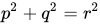
ここで、 は定理の結論と同じであり、 c と d は 両方とも整数です。 これは、単位円上の有理点の有理パラメータ化と見ることができます。 単位円上の有理点は、 ピタゴラスの三つ組 、つまり を 満たす整数の三つ組 に対応します 。
b
=
c
+
d
i
{\displaystyle b=c+di}
(
x
,
y
)
=
(
p
/
r
,
q
/
r
)
{\displaystyle (x,y)=(p/r,q/r)}
x
2
+
y
2
=
1
{\displaystyle x^{2}+y^{2}=1}
(
p
,
q
,
r
)
{\displaystyle (p,q,r)}
p
2
+
q
2
=
r
2
{\displaystyle p^{2}+q^{2}=r^{2}}
コホモロジー この定理は群コホモロジー の観点から述べることができる 。L × が 体 K の任意の(必ずしも有限ではない)ガロア拡大 L の 乗法群 であり、 対応するガロア群 G を持つ場合、
H
1
(
G
,
L
×
)
=
{
1
}
.
{\displaystyle H^{1}(G,L^{\times })=\{1\}.}
具体的には、群コホモロジーとは、 i 次 コチェーン が群元の i 組から乗法係数群への任意の関数である 複体 のコホモロジーであり、その微分は次のように 次元で定義されます 。
C
i
(
G
,
L
×
)
=
{
ϕ
:
G
i
→
L
×
}
{\displaystyle C^{i}(G,L^{\times })=\{\phi :G^{i}\to L^{\times }\}}
d
i
:
C
i
→
C
i
+
1
{\displaystyle d^{i}:C^{i}\to C^{i+1}}
i
=
0
,
1
{\displaystyle i=0,1}
(
d
0
(
b
)
)
(
σ
)
=
b
/
b
σ
,
and
(
d
1
(
ϕ
)
)
(
σ
,
τ
)
=
ϕ
(
σ
)
ϕ
(
τ
)
σ
/
ϕ
(
σ
τ
)
,
{\displaystyle (d^{0}(b))(\sigma )=b/b^{\sigma },\quad {\text{ and }}\quad (d^{1}(\phi ))(\sigma ,\tau )\,=\,\phi (\sigma )\phi (\tau )^{\sigma }/\phi (\sigma \tau ),}
ここで、 は、 群要素 の作用下にある - 加群要素 の像を表します。これらの最初のものでは、 一意の像値 を持つ 0- コチェーン を特定したことに注意してください。最初のコホモロジー群の自明性は、1-コサイクルが 1-コ境界 に等しいことと同等です 。
x
g
{\displaystyle x^{g}}
G
{\displaystyle G}
x
{\displaystyle x}
g
∈
G
{\displaystyle g\in G}
γ
=
γ
b
:
G
0
=
i
d
G
→
L
×
{\displaystyle \gamma =\gamma _{b}:G^{0}=id_{G}\to L^{\times }}
b
∈
L
×
{\displaystyle b\in L^{\times }}
Z
1
{\displaystyle Z^{1}}
B
1
{\displaystyle B^{1}}
Z
1
=
ker
d
1
=
{
ϕ
∈
C
1
satisfying
∀
σ
,
τ
∈
G
:
ϕ
(
σ
τ
)
=
ϕ
(
σ
)
ϕ
(
τ
)
σ
}
is equal to
B
1
=
im
d
0
=
{
ϕ
∈
C
1
:
∃
b
∈
L
×
such that
ϕ
(
σ
)
=
b
/
b
σ
∀
σ
∈
G
}
.
{\displaystyle {\begin{array}{rcl}Z^{1}&=&\ker d^{1}&=&\{\phi \in C^{1}{\text{ satisfying }}\,\,\forall \sigma ,\tau \in G\,\colon \,\,\phi (\sigma \tau )=\phi (\sigma )\,\phi (\tau )^{\sigma }\}\\{\text{ is equal to }}\\B^{1}&=&{\text{im }}d^{0}&=&\{\phi \in C^{1}\ \,\colon \,\,\exists \,b\in L^{\times }{\text{ such that }}\phi (\sigma )=b/b^{\sigma }\ \ \forall \sigma \in G\}.\end{array}}}
巡回 の場合 、1-コサイクルは によって決定され 、 次のようになります。
G
=
{
1
,
σ
,
…
,
σ
n
−
1
}
{\displaystyle G=\{1,\sigma ,\ldots ,\sigma ^{n-1}\}}
ϕ
(
σ
)
=
a
∈
L
×
{\displaystyle \phi (\sigma )=a\in L^{\times }}
ϕ
(
σ
i
)
=
a
σ
(
a
)
⋯
σ
i
−
1
(
a
)
{\displaystyle \phi (\sigma ^{i})=a\,\sigma (a)\cdots \sigma ^{i-1}(a)}
1
=
ϕ
(
1
)
=
ϕ
(
σ
n
)
=
a
σ
(
a
)
⋯
σ
n
−
1
(
a
)
=
N
(
a
)
.
{\displaystyle 1=\phi (1)=\phi (\sigma ^{n})=a\,\sigma (a)\cdots \sigma ^{n-1}(a)=N(a).}
一方、1-共境界は によって決定されます 。これらを等しくすると、定理の元のバージョンが得られます。
ϕ
(
σ
)
=
b
/
b
σ
{\displaystyle \phi (\sigma )=b/b^{\sigma }}
さらに一般化して、非アーベル係数
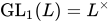
を持つコホモロジーに一般化できる 。つまり、 Hが L 上の 一般 線型 群か 特殊線型群 (を含む)であれば 、
GL
1
(
L
)
=
L
×
{\displaystyle \operatorname {GL} _{1}(L)=L^{\times }}
H
1
(
G
,
H
)
=
{
1
}
.
{\displaystyle H^{1}(G,H)=\{1\}.}
もう1つの一般化はスキーム X です。
H
et
1
(
X
,
G
m
)
=
H
1
(
X
,
O
X
×
)
=
Pic
(
X
)
,
{\displaystyle H_{\text{et}}^{1}(X,\mathbb {G} _{m})=H^{1}(X,{\mathcal {O}}_{X}^{\times })=\operatorname {Pic} (X),}
ここで、はザリスキ位相のランク1の-加 群の局所自由層の同型類の群であり 、は 乗法の下で群として考えられた原点のないアフィン直線によって定義される層である。 [1]
Pic
(
X
)
{\displaystyle \operatorname {Pic} (X)}
O
X
×
{\displaystyle {\mathcal {O}}_{X}^{\times }}
G
m
{\displaystyle \mathbb {G} _{m}}
ミルノアの K 理論 にはさらに別の一般化があり、これは ヴォエヴォツキーによる ミルノア予想 の証明 において役割を果たしています 。
証拠 を次数の巡回とし 、 を 生成する 。 ノルムの
いずれかを選択する。
L
/
K
{\displaystyle L/K}
n
,
{\displaystyle n,}
σ
{\displaystyle \sigma }
Gal
(
L
/
K
)
{\displaystyle \operatorname {Gal} (L/K)}
a
∈
L
{\displaystyle a\in L}
N
(
a
)
:=
a
σ
(
a
)
σ
2
(
a
)
⋯
σ
n
−
1
(
a
)
=
1.
{\displaystyle N(a):=a\sigma (a)\sigma ^{2}(a)\cdots \sigma ^{n-1}(a)=1.}
分母を消去することで、解くことはが固有値で ある ことを示すことと同じになります。これを -ベクトル空間
の写像に拡張すると、
a
=
x
/
σ
−
1
(
x
)
∈
L
{\displaystyle a=x/\sigma ^{-1}(x)\in L}
a
σ
−
1
(
⋅
)
:
L
→
L
{\displaystyle a\sigma ^{-1}(\cdot ):L\to L}
1
{\displaystyle 1}
L
{\displaystyle L}
{
1
L
⊗
a
σ
−
1
(
⋅
)
:
L
⊗
K
L
→
L
⊗
K
L
ℓ
⊗
ℓ
′
↦
ℓ
⊗
a
σ
−
1
(
ℓ
′
)
.
{\displaystyle {\begin{cases}1_{L}\otimes a\sigma ^{-1}(\cdot ):L\otimes _{K}L\to L\otimes _{K}L\\\ell \otimes \ell '\mapsto \ell \otimes a\sigma ^{-1}(\ell ').\end{cases}}}
原始 元定理は、 ある に対して 成立する 。 は最小多項式を持つ
ので、
L
=
K
(
α
)
{\displaystyle L=K(\alpha )}
α
{\displaystyle \alpha }
α
{\displaystyle \alpha }
f
(
t
)
=
(
t
−
α
)
(
t
−
σ
(
α
)
)
⋯
(
t
−
σ
n
−
1
(
α
)
)
∈
K
[
t
]
,
{\displaystyle f(t)=(t-\alpha )(t-\sigma (\alpha ))\cdots \left(t-\sigma ^{n-1}(\alpha )\right)\in K[t],}
私たちは識別できる
L
⊗
K
L
→
∼
L
⊗
K
K
[
t
]
/
f
(
t
)
→
∼
L
[
t
]
/
f
(
t
)
→
∼
L
n
{\displaystyle L\otimes _{K}L{\stackrel {\sim }{\to }}L\otimes _{K}K[t]/f(t){\stackrel {\sim }{\to }}L[t]/f(t){\stackrel {\sim }{\to }}L^{n}}
経由
ℓ
⊗
p
(
α
)
↦
ℓ
(
p
(
α
)
,
p
(
σ
α
)
,
…
,
p
(
σ
n
−
1
α
)
)
.
{\displaystyle \ell \otimes p(\alpha )\mapsto \ell \left(p(\alpha ),p(\sigma \alpha ),\ldots ,p(\sigma ^{n-1}\alpha )\right).}
ここで、2 番目の因数を の -多項式として書きました 。
K
{\displaystyle K}
α
{\displaystyle \alpha }
この識別の下では、私たちの地図は
{
a
σ
−
1
(
⋅
)
:
L
n
→
L
n
ℓ
(
p
(
α
)
,
…
,
p
(
σ
n
−
1
α
)
)
↦
ℓ
(
a
p
(
σ
n
−
1
α
)
,
σ
a
p
(
α
)
,
…
,
σ
n
−
1
a
p
(
σ
n
−
2
α
)
)
.
{\displaystyle {\begin{cases}a\sigma ^{-1}(\cdot ):L^{n}\to L^{n}\\\ell \left(p(\alpha ),\ldots ,p(\sigma ^{n-1}\alpha ))\mapsto \ell (ap(\sigma ^{n-1}\alpha ),\sigma ap(\alpha ),\ldots ,\sigma ^{n-1}ap(\sigma ^{n-2}\alpha )\right).\end{cases}}}
つまりこの地図の下では
(
ℓ
1
,
…
,
ℓ
n
)
↦
(
a
ℓ
n
,
σ
a
ℓ
1
,
…
,
σ
n
−
1
a
ℓ
n
−
1
)
.
{\displaystyle (\ell _{1},\ldots ,\ell _{n})\mapsto (a\ell _{n},\sigma a\ell _{1},\ldots ,\sigma ^{n-1}a\ell _{n-1}).}
(
1
,
σ
a
,
σ
a
σ
2
a
,
…
,
σ
a
⋯
σ
n
−
1
a
)
{\displaystyle (1,\sigma a,\sigma a\sigma ^{2}a,\ldots ,\sigma a\cdots \sigma ^{n-1}a)}
は、ノルム を持つ 場合に限り、 固有値 を持つ固有ベクトルです 。
1
{\displaystyle 1}
a
{\displaystyle a}
1
{\displaystyle 1}
参考文献
^ Milne, James S. (2013). 「エタールコホモロジーに関する講義 (v2.21)」 (PDF) . p. 80.
David Hilbert (1897)、「Die Theorie der algebraischen Zahlkörper」、 Jahresbericht der Deutschen Mathematiker-Vereinigung (ドイツ語)、 4 : 175–546、 ISSN 0012-0456 ヒルベルト、デイヴィッド (1998)、代数的数体の理論、ベルリン、ニューヨーク: シュプリンガー・フェアラーク 、 ISBN 978-3-540-62779-1 、 MR 1646901 Kummer、Ernst Eduard (1855)、「Über eine besondere Art, aus complexen Einheiten gebildeter Ausdrücke.」、 Journal für die reine und angewandte Mathematik (ドイツ語)、 50 : 212–232、 doi :10.1515/crll.1855.50.212、 ISSN 0075-4102 Kummer、Ernst Eduard (1861)、「Zwei neue Beweise der allgemeinen Reciprocitätsgesetze unter den Resten und Nichtresten der Potenzen, deren Grad eine Primzahl ist」、 Abdruck aus den Abhandlungen der Kgl。 Akademie der Wissenschaften zu Berlin (ドイツ語)、著作集の第 1 巻に再録、699 ~ 839 ページ JSミルンの 「類体理論」 第2章は彼のウェブサイト[1]で閲覧可能。 Neukirch, ユルゲン ;シュミット、アレクサンダー。 Wingberg, Kay (2000)、 数体のコホモロジー 、 Grundlehren der Mathematischen Wissenschaften 、vol. 323、ベルリン: Springer-Verlag、 ISBN 978-3-540-66671-4 、 MR 1737196、 Zbl 0948.11001 ネーター、エミー (1933)、「Der Hauptgeschlechtssatz für relativ-galoissche Zahlkörper.」、 Mathematische Annalen (ドイツ語)、 108 (1): 411–419、 doi :10.1007/BF01452845、 ISSN 0025-5831、 Zbl 0007.29501 スネイス、ビクター P. (1994)、 「ガロア加群構造 」、フィールズ研究所モノグラフ、プロビデンス、ロードアイランド州: アメリカ数学会 、 ISBN 0-8218-0264-X 、 ZBL 0830.11042
外部リンク
Wikisource には この記事に関連する原文があります:
ヒルベルトの定理 90: David Hilbert、Gesammelte Abhandlungen、Erster Band













































![{\displaystyle f(t)=(t-\alpha )(t-\sigma (\alpha ))\cdots \left(t-\sigma ^{n-1}(\alpha )\right)\in K[t],}](https://wikimedia.org/api/rest_v1/media/math/render/svg/61dabd6047ef8858bbda6ab041907feb8cc2fd06)
![{\displaystyle L\otimes _{K}L{\stackrel {\sim }{\to }}L\otimes _{K}K[t]/f(t){\stackrel {\sim }{\to }}L[t]/f(t){\stackrel {\sim }{\to }}L^{n}}](https://wikimedia.org/api/rest_v1/media/math/render/svg/ff3f6b1f96db3cbdd661f71692e389b1e79dec72)