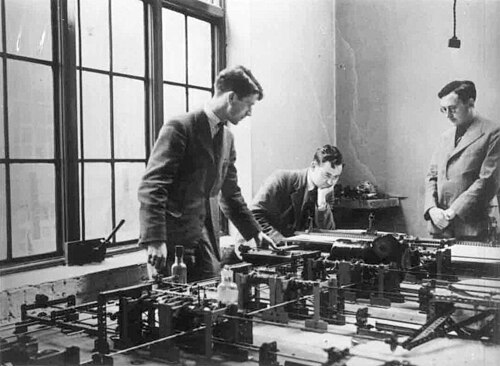
Douglas Hartree of Manchester University brought Bush's design to England, where he constructed his first "proof of concept" model with his student, Arthur Porter, during 1934. As a result of this, the university acquired a full-scale machine incorporating four mechanical integrators in March 1935, which was built by Metropolitan-Vickers, and was, according to Hartree, "[the] first machine of its kind in operation outside the United States".[15] During the next five years three more were added, at Cambridge University, Queen's University Belfast, and the Royal Aircraft Establishment in Farnborough.[16] One of the integrators from this proof of concept is on display in the History of Computing section of the Science Museum in London, alongside a complete Manchester machine.
In Norway, the locally built Oslo Analyser was finished during 1938, based on the same principles as the MIT machine. This machine had 12 integrators, and was the largest analyser built for a period of four years.[17]
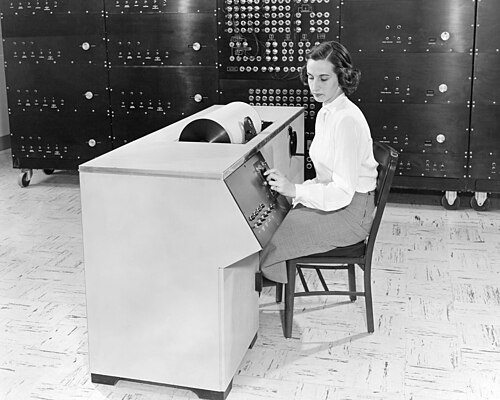
In the United States, further differential analysers were built at the Ballistic Research Laboratory in Maryland and in the basement of the Moore School of Electrical Engineering at the University of Pennsylvania during the early 1940s.[18] The latter was used extensively in the computation of artillery firing tables prior to the invention of the ENIAC, which, in many ways, was modelled on the differential analyser.[19] Also in the early 1940s, with Samuel H. Caldwell, one of the initial contributors during the early 1930s, Bush attempted an electrical, rather than mechanical, variation, but the digital computer built elsewhere had much greater promise and the project ceased.[20] In 1947, UCLA installed a differential analyser built for them by General Electric at a cost of $125,000.[21] By 1950, this machine had been joined by three more.[22] The UCLA differential analyser appeared in 1950's Destination Moon, and the same footage in 1951's When Worlds Collide, where it was called "DA". A different shot appears in 1956's Earth vs. the Flying Saucers.
↑ Hartree, DR (1940 年 9 月) 「ブッシュ微分解析器とその意義」Nature . 146 (3697): 319. Bibcode : 1940Natur.146..319H . doi : 10.1038/146319a0 . S2CID 40727987 .ケルビン卿の説明: Thomson, William (1876). "Mechanical Integration of Linear Differential Equations of the Second Order with Variable Coefficients" . Proceedings of the Royal Society . 24 ( 164– 170): 269– 71. doi : 10.1098/rspl.1875.0035 . S2CID 62694536 .Thomson, William (1876). 「変数係数を持つ任意の次数の一般線形微分方程式の機械的積分」 . Proceedings of the Royal Society . 24 ( 164– 170): 271– 5. doi : 10.1098/rspl.1875.0036 .
↑グレイック、ジェームズ (2011). 『情報:歴史、理論、洪水』(電子書籍) . パテオン. p. 342/1102. ISBN978-0-00-742311-8。
↑ Robinson, Tim (2005 年 6 月),前掲書、Hartree, DR (1940 年 9 月),前掲書。Hartreeと Porter は、論文「モデル微分解析器の構成と動作」の中でこのモデルについて記述している。Memoirs and Proceedings of the Manchester Literary & Philosophical Society . 79 : 51– 74. 1935 年。。
↑ Holst, PA (1996 年10月~12 月)「Svein Rosseland と Oslo アナライザ」IEEE Annals of the History of Computing 18 (4): 16–26 . Bibcode : 1996IAHC...18d..16H . doi : 10.1109/85.539912 .
Thomson, William (1876). 「可変係数を持つ2階線形微分方程式の機械的積分」 . Proceedings of the Royal Society . 24 ( 164–170 ): 269–71 . doi : 10.1098/rspl.1875.0035 . S2CID 62694536 .
Thomson, William (1876). 「変数係数を持つ任意の次数の一般線形微分方程式の機械的積分」 . Proceedings of the Royal Society . 24 ( 164– 170): 271– 5. doi : 10.1098/rspl.1875.0036 .
Crank, J. (1947).微分解析装置、ロンドン:Longmans, Green(これは機械式微分解析装置のセットアップと操作方法を説明した唯一の本です)。
MacNee, AB (1948).電子微分解析器(RLE、技術報告書 90、MIT。この論文は機械式微分解析器ではなく、非常に初期の電子アナログコンピュータについて記述していることに注意してください。著者は、このような革新を紹介する唯一の方法は「電子微分解析器」と表現することだと明らかに感じていたため、この論文は含まれています。