
Loading article…


A wireless microphone, or cordless microphone, is a microphone without a physical cable connecting it directly to the sound recording or amplifying equipment with which it is associated. Also known as a radio microphone, it has a small, battery-powered radio transmitter in the microphone body, which transmits the audio signal from the microphone by radio waves to a nearby receiver unit, which recovers the audio. The other audio equipment is connected to the receiver unit by cable. In one type, the transmitter is contained within the handheld microphone body. In another type, the transmitter is contained within a separate unit called a "bodypack", usually clipped to the user's belt or concealed under their clothes. The bodypack is connected by wire to a "lavalier microphone" or "lav" (a small microphone clipped to the user's lapel), a headset or earset microphone, or another wired microphone. Most bodypack designs also support a wired instrument connection (e.g., to a guitar). Wireless microphones are widely used in the entertainment industry, television broadcasting, and public speaking to allow public speakers, interviewers, performers, and entertainers to move about freely while using a microphone without requiring a cable attached to the microphone.
Wireless microphones usually use the VHF or UHF radio frequency bands since they allow the transmitter to use a small, unobtrusive antenna. Cheap units use a fixed frequency, but most units allow a choice of several frequency channels, in case of interference on a channel or to allow the use of multiple microphones at the same time. Frequency modulation is usually used, although some models use digital modulation to prevent unauthorized reception by scanner radio receivers; these operate in the 900 MHz, 2.4 GHz or 6 GHz ISM bands. Some models use antenna diversity (two antennas) to prevent nulls from interrupting transmission as the performer moves around. A few low-cost (or specialist) models use infrared light, although these require a direct line of sight between microphone and receiver.
Various individuals and organizations claim to be the inventors of the wireless microphone.
From about 1945 there were schematics and hobbyist kits offered in Popular Science and Popular Mechanics for making a wireless microphone that would transmit the voice to a nearby radio.[1][2]
Figure skater and Royal Air Force flight engineer Reg Moores developed a radio microphone in 1947 that he first used in the Tom Arnold production "Aladdin on Ice" at Brighton's sports stadium from September 1949 through the Christmas season. Moores affixed the wireless transmitter to the costume of the character Abanazar, and it worked perfectly. Moores did not patent his idea, as he was illegally using the radio frequency 76 MHz. The producers of the ice show decided that they would not continue using the device; they would rather hire actors and singers to perform into hidden microphones to "dub" the voices of the other ice skaters, who would thus be free to concentrate on their skating. In 1972 Moores donated his 1947 prototype to the Science Museum in London.[3][4][5]
Herbert "Mac" McClelland, founder of McClelland Sound in Wichita, Kansas, fabricated a wireless microphone to be worn by baseball umpires at major league games broadcast by NBC from Lawrence–Dumont Stadium in 1951.[6] The transmitter was strapped to the umpire's back. Mac's brother was Harold M. McClelland, the chief communications architect of the U.S. Air Force.
Shure Brothers claims that its Vagabond 88 system from 1953 was "the first handheld wireless microphone system for performers."[7] Its transmitter used five subminiature vacuum tubes and could cover an area from 500 to 5,000 square feet (46 to 465 m2) (a line-of-sight distance of 15 to 40 feet (4.6 to 12.2 m) from the receiver, depending on local electromagnetic interference), using FM at a carrier frequency of 2.1 MHz.[8] At about the same time, Donald[9] E. Thomas at Bell Labs described an experimental transmitter that used a single point-contact transistor as both oscillator and modulator and whose signal could be picked up by any commercial FM receiver.[10]
In 1957, the German audio equipment manufacturer Sennheiser, at that time called Lab W, working with the German broadcaster Norddeutscher Rundfunk (NDR), exhibited a wireless microphone system. From 1958 the system was marketed through Telefunken under the name of Mikroport. The pocket-sized Mikroport incorporated a dynamic moving-coil cartridge microphone with a cardioid pickup pattern. It transmitted at 37 MHz with a specified range of 300 feet (90 m).[11]
The first recorded patent for a wireless microphone was filed by Raymond A. Litke, an American electrical engineer with Educational Media Resources and San Jose State College, who invented a wireless microphone in 1957 to meet the multimedia needs for television, radio, and classroom instruction. The main transmitter module was a cigar-sized device that weighed 7 ounces (200 g), contained the microphone and circuitry including four junction transistors (a two-transistor audio amplifier, a one-transistor oscillator/modulator similar to the one described by Thomas, and a final RF amplifier), and was suspended around the user's neck in lavalier fashion by a cord that also carried the antenna wire.[12] Vega Electronics Corporation manufactured the design in 1959, producing it as a product called the Vega-Mike. The device was used by the broadcast media at the 1960 Democratic and Republican National Conventions. It allowed television reporters to roam the floor of the convention to interview participants, including presidential candidates John F. Kennedy and Richard Nixon.[13] Litke's patent was granted in May 1964, assigned to Vega Electronics.[12]
Introduced in 1958, the Sony CR-4 wireless microphone was being recommended as early as 1960 for theater performances and nightclub acts. Animal trainers at Marineland of the Pacific in California were wearing the $250 device for performances in 1961. The 27.12 MHz solid-state FM transmitter was capable of fitting into a shirt pocket. Said to be effective out to 100 feet (30 m), it mounted a flexible dangling antenna and a detachable dynamic microphone. The tube-based receiver incorporated a carrying drawer for the transmitter and a small monitor loudspeaker with volume control.[14][15]
Another German equipment manufacturer, Beyerdynamic, claims that its Transistophone, which went into production in 1962, was the first wireless microphone.[16][17]
The first time that a wireless microphone was used to record sound during filming of a motion picture was allegedly on Rex Harrison in the 1964 film My Fair Lady, through the efforts of Academy Award-winning Hollywood sound engineer George Groves.[18]
By 1971, wireless microphone products for amateurs and hobbyists were available. Radio Shack offered a microphone/transmitter module that proved to be vulnerable to capacitive detuning as a user moved around and mingled with crowds. One solution was to build on a final RF amplifier stage, which the module lacked,[19] though Litke had already anticipated the problem and included one in his patent.[12]
Wider dynamic range came with the introduction of the first compander wireless microphone, offered by Nady Systems in 1976. Todd Rundgren and the Rolling Stones were the first popular musicians to use these systems live in concert. Kate Bush is regarded as the first artist to have had a headset with a wireless microphone built for use in music. For her Tour of Life in 1979 she had a compact microphone combined with a self-made construction of wire clothes hangers, to free her hands for expressionist dance performances. Her idea was adopted for live performance by other artists such as Madonna and Peter Gabriel.[20]
Nady joined CBS, Sennheiser and Vega in 1996 to receive a joint Emmy Award for "pioneering [the] development of the broadcast wireless microphone".[21]
The professional models transmit in VHF or UHF radio frequency and have 'true' diversity reception (two separate receiver modules, each with its own antenna), which eliminates dead spots (caused by phase cancellation) and the effects caused by the reflection of the radio waves on walls and surfaces in general. (See antenna diversity).
Another technique used to improve the sound quality (actually, to improve the dynamic range), is companding. Nady Systems, Inc. was the first to offer this technology in wireless microphones in 1976, which was based on the patent obtained by company founder John Nady.
Some models have adjustable gain on the microphone itself to be able to accommodate different level sources, such as loud instruments or quiet voices. Adjustable gain helps to avoid clipping and maximize signal to noise ratio.
Some models have adjustable squelch, which silences the output when the receiver does not get a strong or quality signal from the microphone, instead of reproducing noise. When squelch is adjusted, the threshold of the signal quality or level is adjusted.
AKG Acoustics, Audio Ltd, Audio-Technica, Electro-Voice, Lectrosonics, MIPRO, Nady Systems, Inc, Samson Technologies, Sennheiser, Shure, Sony, Wisycom and Zaxcom are all major manufacturers of wireless microphone systems. They have made significant advances in dealing with many of the disadvantages listed above. For example, while there is a limited band in which the microphones may operate, several high-end systems can consist of over 100 different microphones operating simultaneously. However, the ability to have more microphones operating at the same time increases the cost due to component specifications, design and construction. That is one reason for such large price differences between different series of wireless systems.
Generally there are three wireless microphone types: handheld, plug-in and bodypack:
ゼンハイザー、AKG、Nady Systems、Lectrosonics、Zaxcomなど、複数のメーカーが既存の有線マイク用のプラグイントランスミッターを提供しています。これはマイクのXLR出力に接続し、メーカー標準のレシーバーに信号を送信します。これにより、統合システムの多くの利点が得られるだけでなく、ワイヤレスでは同等のマイクが存在しないタイプのマイクもケーブルなしで使用できるようになります。例えば、テレビや映画の音響エンジニアは、プラグイントランスミッターを使用して指向性の高いライフルマイク(または「ショットガンマイク」)の音声をワイヤレスで送信することで、ケーブル接続による安全上のリスクを排除し、より自由に動き回ることができます。プラグイントランスミッターは、ビンテージマイクをワイヤレスで使用できるようにする機能も備えています。ビンテージマイクが視覚的またはその他の芸術的な理由で必要な場合に便利で、ケーブルがないことでシーンの切り替えが迅速に行え、つまずきの危険性も軽減されます。場合によっては、これらのプラグイントランスミッターは48ボルトのファンタム電源を供給できるため、コンデンサーマイクも使用できます。送信機内部のDC-DCコンバータ回路は、3ボルト以下の場合もあるバッテリー電源を、必要な48ボルトまで増幅するために使用される。
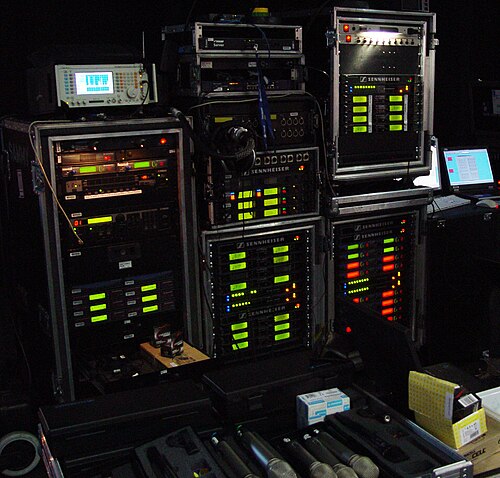

受信機には多くの種類があります。トゥルーダイバーシティ受信機は、2つの無線モジュールと2つのアンテナを備えています。ダイバーシティ受信機は、1つの無線モジュールと2つのアンテナを備えていますが、2つ目のアンテナが目立たない場合もあります。非ダイバーシティ受信機は、アンテナが1つしかありません。
受信機は一般的にハーフラック構成で筐体に収められており、ラックシステムに2台を一緒に設置できます(つまり、受信機は高さ1U、幅半分の筐体に収められているため、1Uに2台の受信機を設置できます)。テレビ放送スタジオやミュージカル制作で使用されるような大規模で複雑なマルチチャンネル無線マイクシステム向けには、ラックマウント型のメインフレーム筐体に複数の(一般的には6台または8台の)トゥルーダイバーシティ受信機を差し込むモジュール式受信機システムが利用可能です。必要な数の受信機を供給するために、ラックに複数のメインフレームを一緒に使用できます。ミュージカル制作によっては、40台以上の無線マイクを使用するシステムも珍しくありません。
Receivers specifically for use with video cameras are often mounted in a bodypack configuration, typically with a hotshoe mount to be fitted onto the hotshoe of the camcorder. Small true diversity receivers which slot into a special housing on many professional broadcast standard video cameras are produced by manufacturers including Sennheiser, Lectrosonics and Sony. For less demanding or more budget conscious video applications small non-diversity receivers are common. When used at relatively short operating distances from the transmitter this arrangement gives adequate and reliable performance.
Almost all wireless microphone systems use wide band frequency modulation, requiring approximately 200 kHz of bandwidth. Because of the relatively large bandwidth requirements, wireless microphone use is effectively restricted to VHF and above.
Many older wireless microphone systems operate in the VHF part of the electromagnetic spectrum. Systems operating in this range are often crystal-controlled, and therefore operate on a single frequency. However, if this frequency is chosen properly, the system will be able to operate for years without any problems.
Most modern wireless microphone products operate in the UHF television band, however. In the United States, this band extends from 470 to 614 MHz. In 2010 the Federal Communications Commission issued new regulations on the operations of TV-band devices. Other countries have similar band limits; for example, as of January 2014, Great Britain's UHF TV band extends from 470 to 790 MHz. Typically, wireless microphones operate on unused TV channels ("white spaces"), with room for one to two microphones per megahertz of spectrum available.
Intermodulation (IM) is a major problem when operating multiple systems in one location. IM occurs when two or more RF signals mix in a non-linear circuit, such as an oscillator or mixer. When this occurs, predictable combinations of these frequencies can occur. For example, the combinations 2A-B, 2B-A, and A+B-C might occur, where A, B, and C are the frequencies in operation. If one of these combinations is close to the operating frequency of another system (or one of the original frequencies A, B, or C), then interference will result on that channel. The solution to this problem is to manually calculate all of the possible products, or use a computer program that does this calculation automatically.
デジタルハイブリッドシステムは、アナログFM伝送方式とデジタル信号処理(DSP)を組み合わせることで、システムのオーディオ性能を向上させます。DSPを用いることで、アナログ領域では不可能な予測アルゴリズムなどのデジタル技術を利用できるようになり、純粋なアナログシステムと比較して、オーディオスペクトルにおける周波数特性をよりフラットにするとともに、ノイズやその他の不要なアーティファクトをさらに低減できます。
別の方法として、DSPを用いてアナログ圧縮方式をエミュレートすることで、旧式のアナログシステムと新しいシステムとの互換性を維持する方法があります。受信機のみにDSPを使用することで、バッテリー駆動の送信機にDSPを組み込む際に発生する消費電力の増加やそれに伴うバッテリー寿命の短縮といったデメリットなしに、オーディオ性能全体を向上させることができます。
純粋なデジタル方式のワイヤレスマイクシステムは数多く存在し、様々なデジタル変調方式が可能である。
ゼンハイザー、ソニー、シュア、ザックスコム、AKG、MIPROのデジタルシステムは、固定ビットレートでデジタル信号を送信するためにアナログFMシステムで使用されていたのと同じUHF周波数を使用します。これらのシステムは、RFキャリアを1チャンネル、場合によっては2チャンネルのデジタルオーディオでエンコードします。2013年に発表されたゼンハイザーのDigital 9000システムだけが、 アナログFMシステムで使用されていたのと同じ200kHz帯域幅のUHFチャンネルで、フル帯域幅の非圧縮デジタルオーディオを送信できます。[ 22 ] 純粋なデジタルシステムが提供する利点には、低ノイズ、低歪み、暗号化の可能性、および強化された送信信頼性が含まれます。
純粋なデジタルシステムにはさまざまな形態があります。一部のシステムは、コードレス電話や無線操縦モデルで使用されているものと同様の周波数ホッピングスペクトラム拡散 技術を使用しています。これは広帯域FM信号よりも広い帯域幅を必要とする可能性があるため、これらのマイクは通常、免許不要の900MHz 、2.4GHz 、または6GHz 帯域で動作します。これらの周波数帯域では免許が不要であることは、使用されている技術に関係なく、多くのユーザーにとって大きな魅力となっています。900MHz 帯域は、世界のほとんどの地域でGSM携帯電話ネットワークで使用されているため、米国とカナダ以外では選択肢になりません。2.4GHz帯域は、 Wi-Fi、Bluetooth、電子レンジからの漏洩 など、さまざまなシステムで混雑が進んでいます。6GHz帯域は、伝送キャリアの波長が非常に短いため、範囲の問題(見通しが必要)があります。Alteros GTXシリーズは、パフォーマンスエリアの周囲に最大64個のトランシーバーを使用することで見通しの問題を克服するローカルエリアワイヤレスマイクネットワークです。また、このシステムは超広帯域パルスRF技術を採用している唯一のシステムであり、他のほとんどのシステムで使用されているFM、QAM、GFSK変調キャリアに共通する相互変調積を生成しません。
デジタル無線マイクは、一般的な「スキャン受信機」がFMやAMといった従来のアナログ変調方式しか復調できないため、一般の「スキャナー」リスナーによる傍受が本質的に困難です。しかし、一部のデジタル無線マイクシステムは、企業ユーザーやセキュリティ上重要な状況で無線マイクを使用するユーザーにとって懸念となる可能性のある、より深刻な「盗聴」を防ぐために、暗号化技術も提供しています。
現在、デジタルワイヤレスマイクシステムを提供しているメーカーには、AKG-Acoustics、Alteros、Audio-Technica、Lectrosonics、Line 6、MIPRO、Shure、Sony、Sennheiser、Zaxcomなどがある。これらのメーカーはそれぞれ異なるデジタル変調方式を採用している。
英国では、無線マイクシステムの使用には無線電信法に基づく免許が必要ですが、173.8~175.0 MHz および 863~865 MHz の免許不要帯域は例外です。2013 年に、英国の通信規制機関であるOfcom は 、790 MHz から 862 MHz までの UHF 帯域をモバイル ブロードバンド サービスに使用するためにオークションで販売しまし た。[ 23 ] [ 24 ] [ 25 ]
米国では、放送補助サービス(BAS)の一環として、空きテレビチャンネルでワイヤレスマイクを使用するにはライセンスが必要です。ライセンスは、放送事業者、ケーブルネットワーク、テレビおよび映画制作者のみに発行されます。
現在、米国でスタジオと送信機間の 通信用に確保されている944~952MHz帯で動作するワイヤレスマイクを販売しているメーカーがいくつかあります。2017年4月13日に完了したインセンティブオークションの結果、2017年からワイヤレスマイクに使用できるテレビ放送帯域のスペクトル量は減少しています。
オーストラリアでは、 520~694MHzの周波数帯で最大100mW EIRPの無線マイクを運用する場合 、未使用のテレビチャンネルを使用し、包括免許によってカバーされているため、どのユーザーも個別の免許を取得することなく機器を運用できる。
欧州諸国におけるライセンスは、デンマークに本部を置く欧州郵便電気通信行政会議(CEPT)の一部である電子通信委員会(ECC)によって規制されている。[ 26 ]
米国では、UHFテレビ周波数帯を使用した個人用無免許広帯域デジタル機器の運用を許可する動きがある。これらの「ホワイトスペース」機器(WSD)は、他の周波数帯利用者との干渉を避けるため、 GPS機能と位置情報データベースへのアクセスが義務付けられる。FCCが実施した初期テストでは、これらの機器の試作品が使用中の周波数を正しく識別できない場合があり、そのため誤って他の利用者の周波数帯に干渉してしまう可能性があることが示された。放送局、劇場、ワイヤレスマイクメーカーは、表向きはこの理由から、これらの機器に強く反対していた。
FCCによるその後のテストでは、これらのデバイスは安全に使用できることが示されました。[ 27 ]しかし、ホワイトスペースで提供される高速モバイルインターネットアクセスによるエンターテイメント配信の競争の可能性を懸念していた放送事業者の反対は軽減されませんでした。
2010年9月23日、FCCは、免許不要の無線機器のホワイトスペースの使用に関する最終規則を定めた覚書意見および命令を発表しました。[ 28 ]最終規則は、ホワイトスペース連合の提案を採用しています。[ 29 ]
A similar class of device to those known in the US as White Space Devices (WSD) is being researched in the UK and probably many other countries. While the WSD situation in the US is being closely watched by interested parties in the UK and elsewhere, early in 2009 Ofcom launched research and a public consultation on Cognitive Access to the UHF interleaved spectrum.[30] The outcome of this consultation and the related WSD activities in the US could have far reaching implications for users of UHF radio microphones in the UK and around the world.
{{cite journal}}:欠落または空欄|title=(ヘルプ)