Loading article…
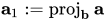
ベクトルaの非ゼロベクトルbへのベクトル射影(ベクトル成分またはベクトル分解とも呼ばれる)は、 aをbに平行な直線に直交射影したものです。a のbへの射影は、しばしば次のように表されます。またはa ∥ b。
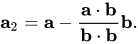
aのbに垂直なベクトル成分またはベクトル分解は、bからのaのベクトル除去とも呼ばれることがあります(表記は です)。またはa ⊥ b )、[ 1 ]は、 bに直交する平面(または一般に超平面)へのaの直交射影です。そしてこれらはベクトルであり、それらの合計はaに等しい。bからaを棄却する確率は次のように与えられる。
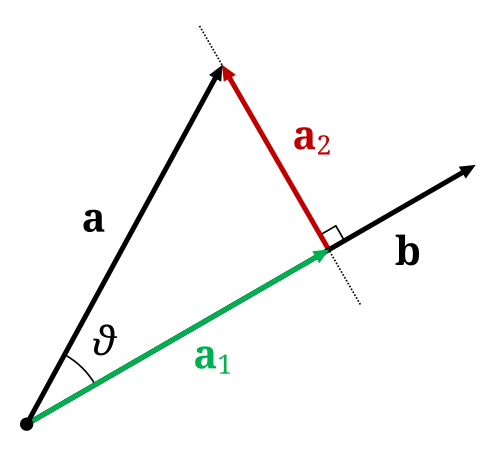
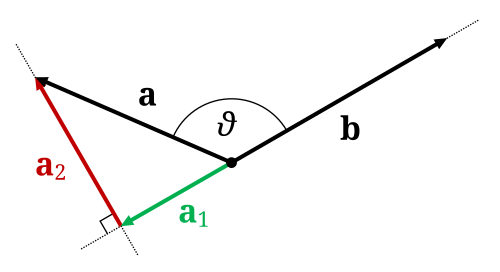
表記を簡略化するために、この記事では以下のように定義します。そして したがって、ベクトルと並行していますベクトルは直交するそして
aからbへの射影は、次のように表すことで方向とスカラー量に分解できます。 どこはスカラーであり、aからbへのスカラー射影と呼ばれ、b̂はbの方向の単位ベクトルです。スカラー射影は次のように定義されます[ 2 ] where the operator ⋅ denotes a dot product, ‖a‖ is the length of a, and θ is the angle between a and b. The scalar projection is equal in absolute value to the length of the vector projection, with a minus sign if the direction of the projection is opposite to the direction of b, that is, if the angle between the vectors is more than 90 degrees.
The vector projection can be calculated using the dot product of and as:
This article uses the convention that vectors are denoted in a bold font (e.g. a1), and scalars are written in normal font (e.g. a1).
The dot product of vectors a and b is written as , the norm of a is written ‖a‖, and the angle between a and b is denoted by θ.
The scalar projection of a on b is a scalar equal to where θ is the angle between a and b.
A scalar projection can be used as a scale factor to compute the corresponding vector projection.
The vector projection of a on b is a vector whose magnitude is the scalar projection of a on b with the same direction as b. Namely, it is defined as where is the corresponding scalar projection, as defined above, and is the unit vector with the same direction as b:
By definition, the vector rejection of a on b is:
Hence,
When θ is not known, the cosine of θ can be computed in terms of a and b, by the following property of the dot producta⋅b
By the above-mentioned property of the dot product, the definition of the scalar projection becomes:[2]
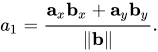
In two dimensions, this becomes
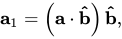
Similarly, the definition of the vector projection of a onto b becomes:[2] which is equivalent to either or[3]
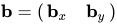
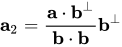
2次元では、スカラー除去は、aをに投影することに相当する。それは左に90°回転した。したがって、
このような内積は「垂直内積」と呼ばれます。
定義により、
したがって、
垂直内積を用いたスカラー除去法を用いると、
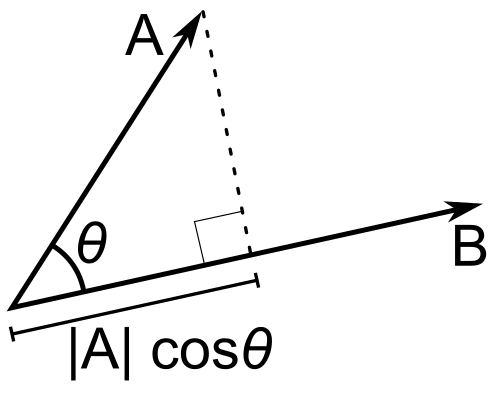
スカラーaからbへの射影は、 90 度< θ ≤ 180 度の場合に負の符号を持つスカラーです。角度が90°より小さい場合、ベクトル射影の長さ‖c‖と一致します。より正確には、次のようになります。
ベクトルaからbへの射影は、零ベクトルまたはbに平行なベクトルa1である。より正確には:
bに対するaのベクトル棄却は、零ベクトルまたはbに直交するベクトルa2である。より正確には:
直交射影は射影行列で表すことができます。ベクトルを単位ベクトルa = ( a x , a y , a z )に射影するには、この射影行列を乗算する必要があります。
ベクトル射影は、ベクトル空間基底のグラム・シュミット直交化において重要な演算である。また、2つの凸形状が交差するかどうかを判定する分離軸定理においても用いられる。
ベクトルの長さやベクトル間の角度といった概念は、任意のn次元内積空間に一般化できるため、ベクトルの直交射影、あるベクトルから別のベクトルへの射影、そしてあるベクトルから別のベクトルへの棄却といった概念についても同様です。
場合によっては、内積はドット積と一致します。一致しない場合は、射影と棄却の正式な定義でドット積の代わりに内積が使用されます。 3 次元内積空間の場合、ベクトルの別のベクトルへの射影と、別のベクトルからの別のベクトルの棄却の概念は、ベクトルの平面への射影と、平面からのベクトルの棄却の概念に一般化できます。[ 4 ]ベクトルの平面への射影は、その平面への直交射影です。ベクトルの平面からの棄却は、その平面に直交する直線への直交射影です。どちらもベクトルです。前者は平面に平行で、後者は直交しています。
与えられたベクトルと平面に対して、射影と棄却の和は元のベクトルに等しくなります。同様に、3 次元を超える内積空間では、ベクトルへの射影とベクトルからの棄却の概念は、超平面への射影と超平面からの棄却の概念に一般化できます。幾何代数では、これらはさらに、任意の可逆なkブレードへの、またはそこからの一般的な多重ベクトルの射影と棄却の概念に一般化できます。