
Loading article…
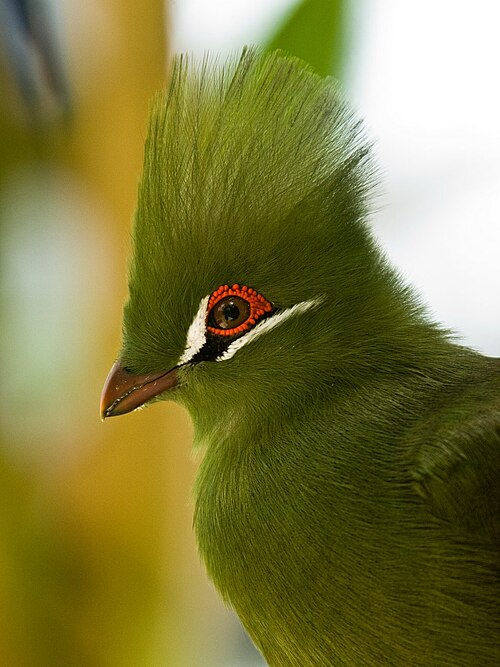
トゥラコベルジンは、ツラコ科の鳥類、特にツラコの鮮やかな緑色の原因となる独特の銅ウロポルフィリン色素です。化学的には、ツラコにほぼ限定的に見られる赤色色素であるツラシンと関連があります。 [ 1 ]ツラコベルジンは、鳥類に見られる唯一の真の緑色色素の1つです。ほとんどの緑色の羽毛に見られる色は、青色の構造発色と黄色のカロテノイドの組み合わせによる独特の性質によるものです。[ 2 ]ツラコベルジンとツラシンは、化学的に特徴づけられた最初の羽毛色素であり、ツラコベルジンは1882年にCFWクルーケンベルク博士によって初めて単離され、記載されました。[ 3 ]
これまで、ツラコベルジンの化学的性質に関する研究はほとんど行われていない。1950年代のRE Moreauによる研究では、ツラコベルジンは化学的に類似したツラシンよりも塩基性溶液への溶解度が低いことが示された。発見者は当初、銅をほとんど含まないと考え、鉄をベースとしていると信じていたが、後の分光分析により、ナイズナツラコとシャローツラコの緑色の羽毛の色素には高濃度の銅(および低濃度の鉄)が含まれていることが示された。Moreauはまた、ツラコの緑色は、極性がわずかに異なる2種類のツラコベルジン色素の複合効果によるものである可能性も示した。[ 4 ]
When extracted and exposed to light, oxygen, or strong bases, turacin has been shown to take on a green hue. This has caused several researchers to suggest that turacoverdin may be an oxidizedmetabolite of turacin.[4][5] This has been supported by data comparing the absorption bands of the "altered turacin" with those of turacoverdin, which are shown to be very similar to one another.[6] Several researchers have noted the chemical similarities between turacin and turacoverdin. This relationship has been supported by spectral properties, the fact that both pigments contain copper, their similar microscopic arrangement in feather cells, and the co-occurrence of the pigments: turacin and turacoverdin are always found together in the same species, and in many cases are also found in the same plumage locations. The green appearance of turacoverdin can be derived from its absorbance curve, which peaks at blue wavelengths and in the long-wave range above yellow. Turacoverdin shows little UV reflectance.[4]
Turacin and turacoverdin are both found in four of the six genera of turacos. The subfamily Criniferinae is typically regarded as being devoid of the brighter pigments, although the genus Corythaeola does have a small stripe of turacoverdin on its breast. The remaining turaco genera are placed in the subfamily Musophaginae and are referred to as the turacin-bearing turacos. More than half of turaco species belong to the genus Tauraco, and are all notable for being mostly a vivid green.[7]
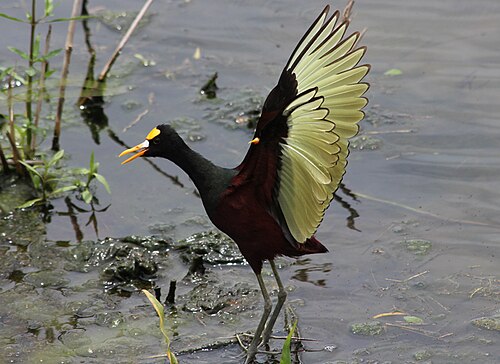
Recent spectrophotometric evidence suggests that turacoverdin may be closely related or identical to green pigments in the feathers of the northern jacana (Jacana spinosa), the blood pheasant (Ithaginis cruentus), and the crested wood-partridge (Rollulus rouloul).[4] As Ithaginis and Rollulus are members of the order Galliformes, this has led some researchers to assume support for a turacoverdin-bearing common ancestor of Musophagidae and Galliformes, making the presence of the pigment a symplesiomorphy for these groups. The pigment data specifically suggests that turacos evolved from a group of galliform species, which is represented by the extant genera Ithaginis and Rollolus. Based on the appearance of its green feathers, researcher Jan Dyck speculates that Rollolus is closer to a possible ancestor than Ithaginis.[6]
The northern jacana, on the other hand, is a member of the order Charadriiformes, a group clearly not closely related to either Musophagidae or Galliformes. This makes it highly unlikely that turacoverdin in Jacana reflects common ancestry with either turacos or galliforms. If the green pigment in Jacana is truly turacoverdin, then the pigment must have evolved independently in this order. This is further supported by the fact that the pigment in Jacana is located only in the remiges, while in all musophagid and galliform species, the pigment is found mainly in body feathers.[6]
銅をベースとした色素であるツラシンとツラコベルジンは、製造に大量の銅を必要とします。ツラコは主に樹上性の種であるため、果物、花、芽、その他の植物を豊富に含む食事を通して銅を蓄積することができます。チャーチとモローは、3か月分の果物摂取が、ツラコの一種であるT. corythaix(ナイズナツラコ)の新たに生えた羽毛に含まれる色素の生成に貢献すると推定しました。 [ 4 ]また、若いツラコが鮮やかな成鳥の羽毛を獲得するのに約1年かかることが観察されており、一部の著者は、必要な銅を獲得するのにそのくらいの期間が必要だろうと推測しています。また、ツラコはすべて中央アフリカ全域に生息しており、地理的には世界で最も豊かな銅鉱帯の1つと一致していることも指摘されています。[ 8 ]ツメバゲリの食餌が他の鳥類の食餌と比べて特に銅が豊富なのか、あるいはツメバゲリが食物から銅を抽出するのに特に効果的なのかは不明である。また、ツラシンとツラコベルジンによる色素沈着を欠くツメバゲリの種が、比較的銅が不足した食餌を摂取しているのか、食物から銅を吸収する量が少ないのか、あるいは色素を合成するために必要な酵素を欠いているのかも不明である。 [ 4 ]

ツラコベルジン色素による体色の機能的意義を調査する正式な試験は行われていないが、憶測は数多く存在する。1958年にモローは、森林に生息するツラコ類は他の環境に生息する種よりも緑色である可能性が高く、これは捕食者からの隠蔽に役立つ可能性があると観察した。[ 9 ]実際、ツラコ類の森林生息地が緑豊かで密集しているほど羽毛の緑色が濃くなり、森林に生息しないツラコ類は緑色の色素を欠いている傾向があることが観察されている。[ 10 ]しかし、この主張は生化学的または系統発生学的観点から厳密に研究されておらず、さらなる研究を待っている。ツラコ類は、その独特な緑色を性的または社会的広告に利用している可能性があるが、ここでも体色の性差をテストするための分光光度法または生化学的研究は行われておらず、限られた人間の知覚では性差はないように見える。[ 4 ]
他の研究者たちは、ツラコ類やツラコベルジンを使用する他の鳥類は、この色素を合成することで生理学的および生化学的な利益を得ているのではないかと推測している。銅はポルフィリンと同様に、高濃度で蓄積すると鳥類に有害となる可能性がある。[ 11 ]ツラコ類は、ポルフィリンを豊富に含む食事で摂取した高濃度の銅を解毒し、羽毛に銅を豊富に含む色素を沈着させることで自らに与えた保護をアピールしているのかもしれない。[ 12 ]また、ツラコ類はすべて翼の羽毛の全く同じ領域にツラシンとツラコベルジンで着色されているように見えることも、生物学的に重要な意味を持つ可能性がある。[ 4 ]