
Loading article…
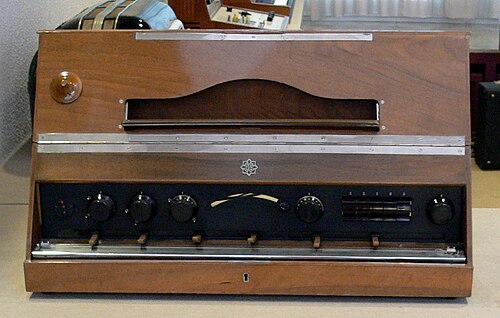
トラウトニウムは、 1930年にベルリンの音楽大学の音楽・ラジオ研究所である放送実験室(現在のベルリン芸術大学)でフリードリヒ・トラウトワインによって発明された電子シンセサイザーである[ 1 ] [ 2 ] [ 3 ]。その後すぐにオスカー・サラが加わり、2002年にサラが亡くなるまで開発を支援し続けた。
鍵盤の代わりに、金属板の上に抵抗線が張られた手鍵盤が用いられており、これを押すことで音が出る仕組みになっていた。この抵抗線を指で滑らせることで、繊細な動きでビブラートをかけ、表現豊かな演奏が可能だった。音量は、抵抗線と手鍵盤を指で押す圧力によって調整された。最初のトラウトニウムは、テレフンケン社によって1933年から1935年まで販売された(200台製造)。
音は当初、ネオン管の弛緩発振器[ 5 ](後にサイラトロン、そしてトランジスタ)によって生成され、のこぎり波のような波形を生成した[ 6 ]。音高は、演奏者が抵抗線を下のプレートに接触させる位置によって決まり、これにより抵抗線の長さが実質的に変化し、適切なテクニックによってビブラート、四分音、ポルタメントが可能になった。発振器の出力は、2つの並列共振フィルタ回路に入力された。フットペダルは、2つのフィルタの出力の音量比を制御し、それがアンプに送られた[ 7 ] 。
1930年6月20日、オスカー・サラとパウル・ヒンデミットは、ベルリン音楽大学のホールで「ノイエ・ムジーク・ベルリン1930」と題した公開演奏会を行い、トラウトニウムを紹介した。その後、オスカー・サラはトラウトニウムを携えてドイツ各地を巡業し、1931年にはヒンデミットのトラウトニウム協奏曲(弦楽四重奏付き)の演奏会でソリストを務めた。また、ヒンデミットの弟子であるハラルド・ゲンツマーのトラウトニウム協奏曲(管弦楽付き)の初演でもソリストを務めた。
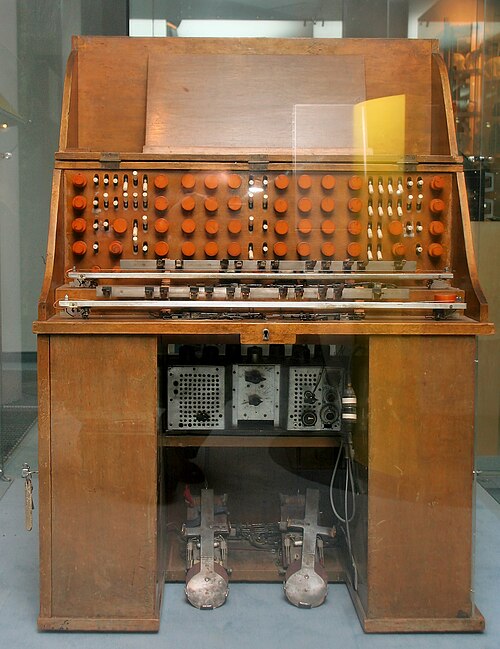
Paul Hindemith wrote several short trios for three Trautoniums with three different tunings: bass, middle, and high voice. His student Harald Genzmer wrote two concertos with orchestra, one for the monophonic Trautonium and, later, one for Oskar Sala's Mixtur-Trautonium. One of the first additions of Sala was to add a switch for changing the static tuning. Later he added a noise generator and an envelope generator (so called 'Schlagwerk'), formant filter (several bandpass filters) and the subharmonicoscillators. These oscillators generate a main pitch and several subharmonics, which are not multiples of the fundamental tone, but fractions of it. For either of the (now two) manuals, four of these waves can be mixed and the player can switch through these predefined settings. Thus, it was called the Mixtur-Trautonium. Oskar Sala composed music for industrial films, but the most famous was the bird noises for Alfred Hitchcock's The Birds. The Trautonium was also used in the Dresden première of Richard Strauss's Japanese Festival Music in 1942 for emulating the gongs- and bells-parts and in the 1950s in Bayreuth for the Monsalvat bells in Wagner's Parsifal.
Sala and Remi Gassmann utilized the Trautonium for George Balanchine's science fiction ballet Electronics, performed by New York City Ballet in 1961.[8][9]
The German manufacturer Doepfer sells some devices for the commercial market to allow for Trautonium-like synthesizer control.[10]
The German manufacturer Trautoniks sells custom made Trautoniums.[11]
Oskar Sala developed the Trautonium further and worked with at least one pupil, music therapy pioneer Maria Schüppel.[12] However, Peter Pichler, a Munich musician and artist, had heard the sound of the Trautonium when he was a young man and was fascinated by its emotional impact and dynamic range. Pichler found he could not forget the unique sound; he searched obsessively for anyone who could help him understand the instrument, and he finally tracked down Sala. In 1996, the two met in Sala's studio in Berlin, and the result was the preservation of much of Sala's knowledge.
ピヒラーはこの経験によって大きく変わったが、トラウトニクス社に自分のミクストゥルトラウトニウムを注文できるまでには15年待たなければならなかった。[ 13 ] 彼はトラウトニウムの創始者たちについての音楽劇「トラウトニウムで再会」を作曲し、2010年にオスカー・サラの100歳の誕生日を記念してミュンヘンのドイツ博物館で上演された。この音楽劇のために、ピヒラーは3台の「フォルクストラウトニウム」(楽器の小型版)を依頼し、そのうちの1台は後にドイツ博物館が永久コレクションとして購入した。ピヒラーは現在もサラの遺産を管理しているミュンヘンのドイツ博物館と緊密に協力している。[ 14 ]
それ以来、ピヒラーはミクストゥルトラウトニウムで様々な音楽ジャンルに定期的に出演している。例えば、パウル・ヒンデミット、ハラルド・ゲンツマー、オスカー・サラがこの楽器のために作曲したクラシック音楽は、経験豊富な音楽家にとっても演奏するのが非常に難しい。[ 15 ]
ピヒラーは、この楽器をマスターし、作曲も手がける世界でも数少ない音楽家の一人である。[ 16 ] 2025年10月、ペーター・ピヒラーが演奏するミクストゥール・トラウトニウムは、映画『小さな演奏家のバラード』 (エドワード・ベルガー監督、フォルカー・ベルテルマン作曲)のサウンドトラックに使用された。[ 17 ]
ダニエル・マッツは、アグネス・オベルのアルバム『Citizen of Glass』と『Late Night Tales』でトラウトニウムを演奏している。[ 18 ]
オランダの演奏家ルドウィック[タイス・ロデウィック] [ 19 ]もトラウトニウムを演奏し、ミクストゥル・トラウトニウムを所有し演奏する数少ない人物の一人です。


フリードリヒ・トラウトヴァイン博士の創作物「トラウトニウム」