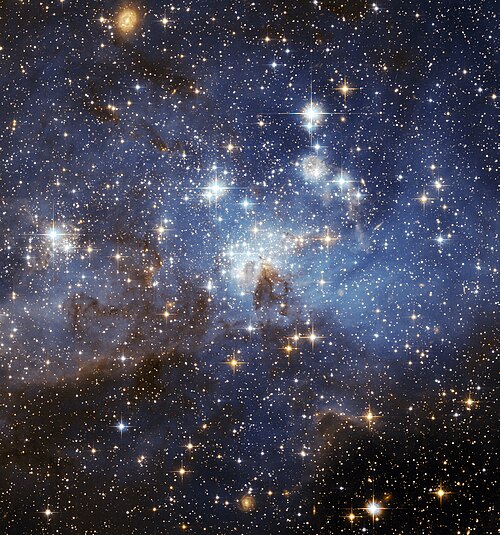
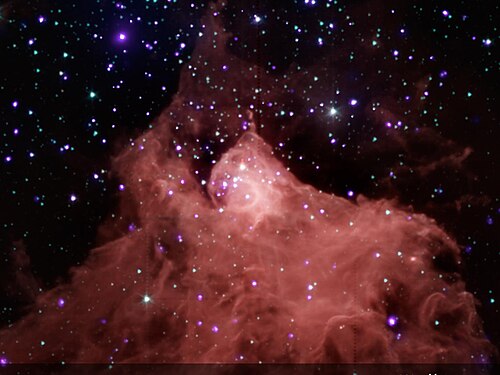
崩壊中、雲の密度は中心に向かって増加するため、まず中央領域が光学的に不透明になります。これは密度が約10 −13 g / cm 3のときに起こります。崩壊が実質的に停止する最初の静水圧核と呼ばれるコア領域が形成されます。この領域はビリアル定理によって決定されるように温度が上昇し続けます。この不透明な領域に向かって落下するガスは、この領域と衝突して衝撃波を発生させ、コアをさらに加熱します。[ 30 ]
X-ray observations have proven useful for studying young stars, since X-ray emission from these objects is about 100–100,000 times stronger than X-ray emission from main-sequence stars.[41] The earliest detections of X-rays from T Tauri stars were made by the Einstein X-ray Observatory.[42][43] For low-mass stars X-rays are generated by the heating of the stellar corona through magnetic reconnection, while for high-mass O and early B-type stars X-rays are generated through supersonic shocks in the stellar winds. Photons in the soft X-ray energy range covered by the Chandra X-ray Observatory and XMM-Newton may penetrate the interstellar medium with only moderate absorption due to gas, making the X-ray a useful wavelength for seeing the stellar populations within molecular clouds. X-ray emission as evidence of stellar youth makes this band particularly useful for performing censuses of stars in star-forming regions, given that not all young stars have infrared excesses.[44] X-ray observations have provided near-complete censuses of all stellar-mass objects in the Orion Nebula Cluster and Taurus Molecular Cloud.[45][46]
The formation of individual stars can only be directly observed in the Milky Way Galaxy, but in distant galaxies star formation has been detected through its unique spectral signature.
Initial research indicates star-forming clumps start as giant, dense areas in turbulent gas-rich matter in young galaxies, live about 500 million years, and may migrate to the center of a galaxy, creating the central bulge of a galaxy.[47]
On February 21, 2014, NASA announced a greatly upgraded database for tracking polycyclic aromatic hydrocarbons (PAHs) in the universe. According to scientists, more than 20% of the carbon in the universe may be associated with PAHs, possible starting materials for the formation of life. PAHs seem to have been formed shortly after the Big Bang, are widespread throughout the universe, and are associated with new stars and exoplanets.[48]
↑ Sandstrom, Karin M.; Peek, JEG; Bower, Geoffrey C.; Bolatto, Alberto D.; Plambeck, Richard L. (2007). "A Parallactic Distance of「超長基線アレイ観測によるオリオン星雲クラスターまでのパーセク」。天体物理学ジャーナル。667 ( 2 ):1161。arXiv :0706.2361。Bibcode:2007ApJ...667.1161S。doi :10.1086 /520922。S2CID 18192326。
↑ Wilking, BA; Gagné, M.; Allen, LE (2008). "ρ Ophiuchi 分子雲における星形成". Bo Reipurth (編). Handbook of Star Forming Regions, Volume II: The Southern Sky ASP Monograph Publications . arXiv : 0811.0005 . Bibcode : 2008hsf2.book..351W .
↑ Jog, CJ (1997年8月26日~30日)「相互作用銀河における雲の圧縮によって引き起こされるスターバースト」Barnes, JE、Sanders, DB (編) 『IAUシンポジウム第186回、低赤方偏移および高赤方偏移における銀河の相互作用』京都、日本。Bibcode : 1999IAUS..186..235J。
↑ Gralla, Meg; et al. (2014年9月29日). 「低周波電波源に関連するミリ波放射とスニャエフ・ゼルドビッチ効果の測定」 . Monthly Notices of the Royal Astronomical Society . 445 (1). Oxford University Press: 460–478 . arXiv : 1310.8281 . Bibcode : 2014MNRAS.445..460G . doi : 10.1093/mnras/stu1592 . S2CID 8171745 .
↑ van Breugel, Wil; et al. (2004 年 11 月). T. Storchi-Bergmann; LC Ho; Henrique R. Schmitt (編). The Interplay among Black Holes, Stars and ISM in Galactic Nuclei . Cambridge University Press. pp. 485– 488. arXiv : astro-ph/0406668 . Bibcode : 2004IAUS..222..485V . doi : 10.1017/S1743921304002996 .
↑Hartmann, Lee (2000). Accretion Processes in Star Formation. Cambridge University Press. p.22. ISBN0-521-78520-0.
↑Li, Hua-bai; Dowell, C. Darren; Goodman, Alyssa; Hildebrand, Roger; Novak, Giles (2009-08-11). "Anchoring Magnetic Field in Turbulent Molecular Clouds". The Astrophysical Journal. 704 (2): 891. arXiv:0908.1549. Bibcode:2009ApJ...704..891L. doi:10.1088/0004-637X/704/2/891. S2CID118341372.
↑Ballesteros-Paredes, J.; Klessen, R. S.; Mac Low, M.-M.; Vazquez-Semadeni, E. (2007). "Molecular Cloud Turbulence and Star Formation". In Reipurth, B.; Jewitt, D.; Keil, K. (eds.). Protostars and Planets V. University of Arizona Press. pp.63–80. ISBN978-0-8165-2654-3.
↑Longair, M. S. (2008). Galaxy Formation (2nded.). Springer. p.478. ISBN978-3-540-73477-2.
↑Salaris, Maurizio (2005). Cassisi, Santi (ed.). Evolution of stars and stellar populations. John Wiley and Sons. pp.108–109. ISBN0-470-09220-3.
↑"Glory From Gloom". www.eso.org. Retrieved 2 February 2018.
↑C. Hayashi (1961). "Stellar evolution in early phases of gravitational contraction". Publications of the Astronomical Society of Japan. 13 (4): 450–452. Bibcode:1961PASJ...13..450H. doi:10.1093/pasj/13.4.450.
↑L. G. Henyey; R. Lelevier; R. D. Levée (1955). "The Early Phases of Stellar Evolution". Publications of the Astronomical Society of the Pacific. 67 (396): 154. Bibcode:1955PASP...67..154H. doi:10.1086/126791.
↑B. J. Bok & E. F. Reilly (1947). "Small Dark Nebulae". Astrophysical Journal. 105: 255. Bibcode:1947ApJ...105..255B. doi:10.1086/144901.Yun, Joao Lin; Clemens, Dan P. (1990). "Star formation in small globules – Bart BOK was correct". The Astrophysical Journal. 365: L73. Bibcode:1990ApJ...365L..73Y. doi:10.1086/185891.
↑Benjamin, Robert A.; Churchwell, E.; Babler, Brian L.; Bania, T. M.; Clemens, Dan P.; Cohen, Martin; Dickey, John M.; Indebetouw, Rémy; etal. (2003). "GLIMPSE. I. An SIRTF Legacy Project to Map the Inner Galaxy". Publications of the Astronomical Society of the Pacific. 115 (810): 953–964. arXiv:astro-ph/0306274. Bibcode:2003PASP..115..953B. doi:10.1086/376696. S2CID119510724.
↑"Wide-field Infrared Survey Explorer Mission". NASA.
↑Majaess, D. (2013). Discovering protostars and their host clusters via WISE, ApSS, 344, 1 (VizieR catalog)
↑Camargo et al. (2015). New Galactic embedded clusters and candidates from a WISE Survey, New Astronomy, 34
↑Getman, K.; etal. (2014). "Core-Halo Age Gradients and Star Formation in the Orion Nebula and NGC 2024 Young Stellar Clusters". Astrophysical Journal Supplement. 787 (2): 109. arXiv:1403.2742. Bibcode:2014ApJ...787..109G. doi:10.1088/0004-637X/787/2/109. S2CID118503957.
↑Preibisch, T.; etal. (2005). "The Origin of T Tauri X-Ray Emission: New Insights from the Chandra Orion Ultradeep Project". Astrophysical Journal Supplement. 160 (2): 401–422. arXiv:astro-ph/0506526. Bibcode:2005ApJS..160..401P. doi:10.1086/432891. S2CID18155082.
↑ Hunter, TR; Brogan, CL; MacLeod, G.; Cyganowski, CJ; Chandler, CJ; Chibueze, JO; Friesen, R.; Indebetouw, R.; Thesner, C.; Young, KH (2017-03-15). "An Extraordinary Outburst in the Massive Protostellar System NGC 6334I-MM1: Quadrupling of the Millimeter Continuum" . The Astrophysical Journal . 837 (2): L29. arXiv : 1701.08637 . Bibcode : 2017ApJ...837L..29H . doi : 10.3847/2041-8213/aa5d0e . ISSN 2041-8213 .
↑ Beuther, H.; Kuiper, R.; Tafalla, M. (2025-08-18). "低質量から高質量までの星形成:比較の視点" . Annual Review of Astronomy and Astrophysics . 63 : 1– 44. doi : 10.1146/annurev-astro-013125-122023 . ISSN 0066-4146 .
↑ IA Bonnell; MR Bate; CJ Clarke; JE Pringle (1997). "小さな星団における降着と恒星質量スペクトル" . Monthly Notices of the Royal Astronomical Society . 285 (1): 201– 208. Bibcode : 1997MNRAS.285..201B . doi : 10.1093/mnras/285.1.201 .
↑ IA Bonnell; MR Bate (2006). "重力崩壊と競合的降着による星形成" . Monthly Notices of the Royal Astronomical Society . 370 (1): 488– 494. arXiv : astro-ph/0604615 . Bibcode : 2006MNRAS.370..488B . doi : 10.1111/j.1365-2966.2006.10495.x . S2CID 15652967 .
↑ Hennebelle, Patrick; Lebreuilly, Ugo; Colman, Tine; Elia, Davide; Fuller, Gary; Leurini, Silvia; Nony, Thomas; Schisano, Eugenio; Soler, Juan D.; Traficante, Alessio; Klessen, Ralf S.; Molinari, Sergio; Testi, Leonardo (2022-12-01). "Influence of magnetic field and stellar radiative feedback on the collapse and the stellar mass spectrum of a massive star-forming clump" . Astronomy & Astrophysics . 668 : A147. doi : 10.1051/0004-6361/202243803 . ISSN 0004-6361 .
↑ IA Bonnell; MR Bate; H. Zinnecker (1998). "On the formation of massive stars" . Monthly Notices of the Royal Astronomical Society . 298 (1): 93– 102. arXiv : astro-ph/9802332 . Bibcode : 1998MNRAS.298...93B . doi : 10.1046/j.1365-8711.1998.01590.x . S2CID 119346630 .
↑ Marchant, Pablo; Bodensteiner, Julia (2024-09-13). "The Evolution of Massive Binary Stars" . Annual Review of Astronomy and Astrophysics . 62 : 21– 61. doi : 10.1146/annurev-astro-052722-105936 . hdl : 1854/LU-01K47SAXD9F4P67QY7S4HXVCC2 . ISSN 0066-4146 .